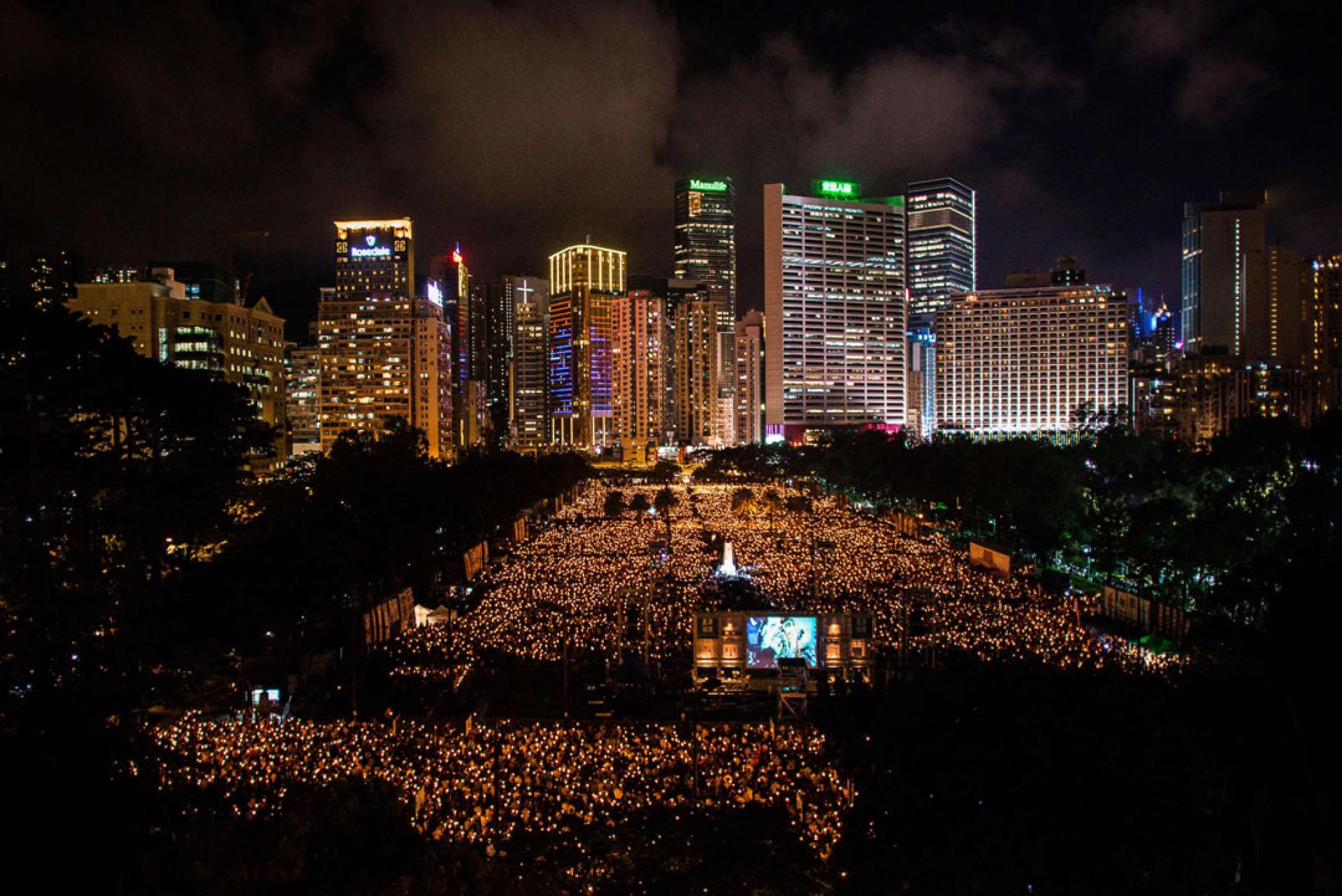
The disbanded Hong Kong Alliance in Support of Patriotic Democratic Movements of China (HK Alliance), its former chairman Lee Cheuk-yan, former vice-chairman Albert Ho, and Chow Hang-tung, have been charged with 'inciting others to subvert state power.' The Alliance, Lee, and Chow pleaded not guilty and stood trial, with the case decided on the 21st at West Kowloon Magistrates' Courts (temporarily acting as the High Court).
The court pointed out that the defendants incited others to overthrow the fundamental system established by the Constitution and believed that if the audience acted upon their incitement, they would use illegal means to subvert state power. Albert Ho and Chow Hang-tung were regarded as the guiding will of the Alliance, and they were ultimately found guilty.
The judgment stated that, at the time of the offense, the defendants understood that the HK Alliance’s platform of 'ending one-party dictatorship' would be in conflict with the Constitution, yet they insisted on maintaining this stance of resistance; moreover, they deliberately compared the June Fourth Incident with the then anti-extradition bill protests, aiming to stir up hostility among the public towards the Communist Party of China.
Chow, Ho, Lee, and the Alliance were all charged with one count of 'inciting others to subvert state power,' with the charge spanning from July 1, 2020, to September 8, 2021. Albert Ho had previously admitted the charge, while the remaining defendants denied the charge. The case was heard by judges Li Yunteng, Chan Chung-hang, and Lai Yuen-kei, designated under the Hong Kong National Security Law.
According to the National Security Law, the sentencing for this charge is divided into two levels: those with lesser circumstances may be sentenced to imprisonment for five years or less, while those with serious circumstances may face imprisonment for five to ten years.
The judgment noted that the core issue in this case was the Alliance’s platform of 'ending one-party dictatorship.' The Constitution of the People's Republic of China, as amended in 2018, states that 'the socialist system is the fundamental system of the People’s Republic of China. The leadership of the Communist Party of China is the most essential feature of socialism with Chinese characteristics.' Chow Hang-tung had argued that the Constitution regulates public authority and is not directed at ordinary citizens, but the court held that this does not mean citizens have no responsibility to abide by the Constitution; the leadership position of the Communist Party as the ruling party is established by the current Constitution, and there is no possibility of Western-style party alternation. Under the current Constitution, overthrowing or undermining the leadership of the Communist Party is equivalent to what is referred to in Article 22 of the National Security Law as 'overthrowing or undermining the fundamental system established by the Constitution.'
The court ruled that during the charged period, the HK Alliance’s platform of 'ending one-party dictatorship' specifically targeted the Communist Party of China, with the aim of ending its leadership status under the Constitution. Albert Ho, Lee Cheuk-yan, and Chow Hang-tung harbored hostility towards the Communist Party of China, actively advocated and executed activities related to the aforementioned platform, insisted on an uncompromising stance against the central government, and, even after the National Security Law came into effect, knowingly persisted in a position that would conflict with the Constitution.
The court pointed out that Lee Cheuk-yan and Chow Hang-tung attempted to incite hostility and division, causing others to lose trust in the Communist Party of China, thereby achieving the purpose of undermining the 'fundamental system,' and believed that if the audience acted upon their incitement, illegal means would be used to subvert state power.