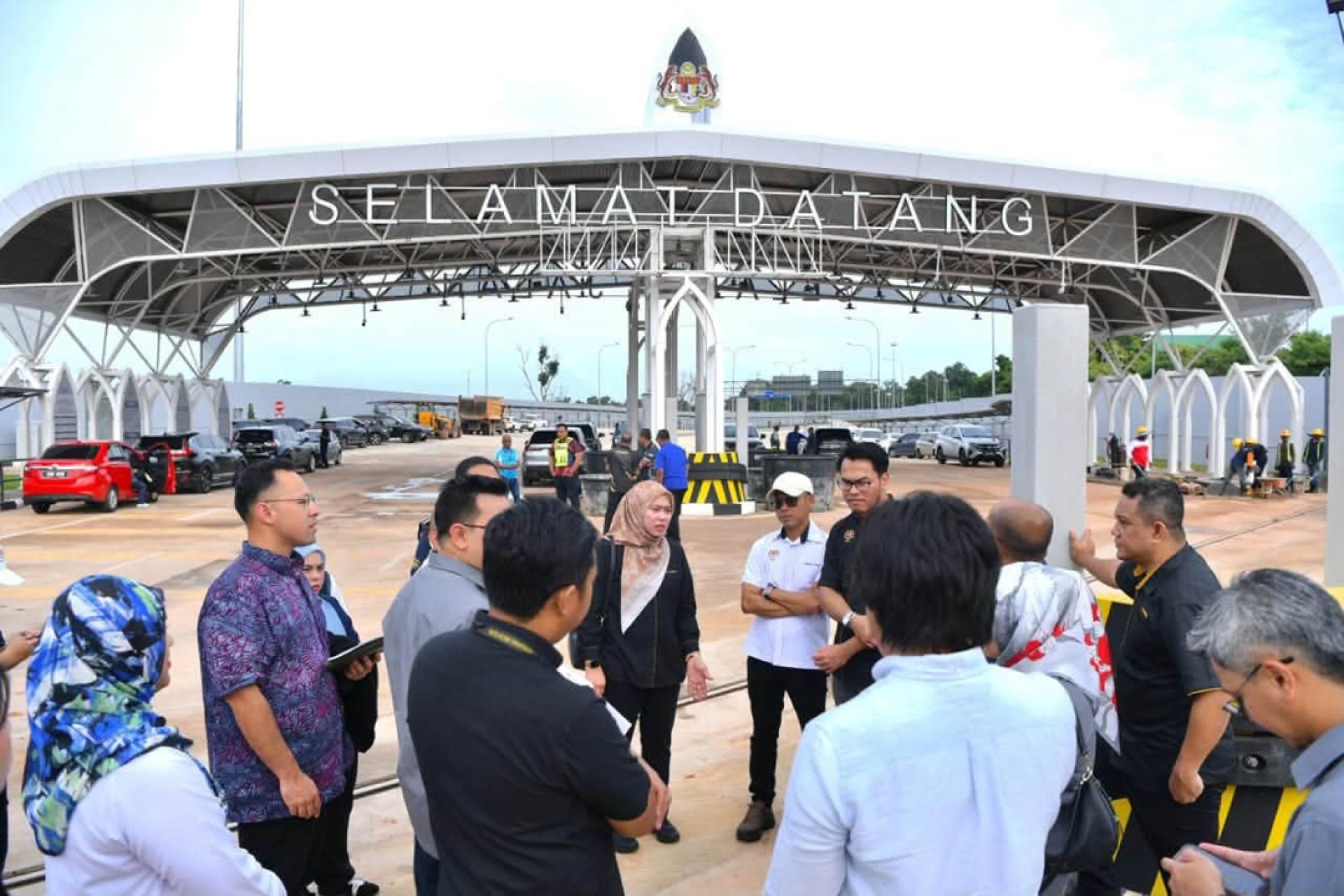
The new border crossing project connecting Bukit Kayu Hitam in Malaysia to Sadao in Southern Thailand has been fully completed, and will be officially inaugurated on July 10 by Prime Minister Dato’ Seri Anwar and Thai Prime Minister Anutin, with operations formally commencing on July 11.
After the new checkpoint is opened, the old checkpoint will not be closed. Instead, both the new and old checkpoints will operate concurrently, with a brand new vehicle diversion system implemented.
According to Thai media reports, the Sadao New Border Checkpoint, connecting Thailand and Malaysia’s Bukit Kayu Hitam border, will officially start operation on July 11 to further enhance border crossing efficiency and alleviate long-standing traffic congestion.
This new passageway connects the Malaysian Bukit Kayu Hitam integrated Immigration, Customs, and Security Quarantine Complex to the Thai Sadao checkpoint building, with the passage spanning about 1 kilometer.
According to the latest arrangements, starting from July 11, all heavy-duty trucks and long-distance buses must use the new checkpoint for immigration procedures; as for private cars, vans, motorcycles, and pedestrians, they can freely choose to use either the new or old checkpoint to cross the border.

President of Songkhla Hotel Association, Wongsitipa, after recently conducting an on-site inspection at the new checkpoint and recording a video, stated that the road route on the Malaysian side has not changed. Travelers complete Malaysian exit procedures, then continue straight for about 1 kilometer to a fork where they can choose to go to the new or old checkpoint.
He said that vehicles choosing to cross via the new checkpoint may follow the newly built road for about 1 kilometer straight to the new checkpoint building to complete immigration procedures; for those choosing the old checkpoint, there is a connecting road returning to the old checkpoint area for border clearance.
He said that as for those coming from the Thailand side heading toward Malaysia, users of the new checkpoint can directly use the new road for exit procedures; those choosing the old checkpoint must pass through local community roads to the old border checkpoint for departure clearance.
Wongsitipa also reminded that vehicles wishing to exit via the old Thai checkpoint, after completing passport stamping, must U-turn as directed on site, drive to the new checkpoint area, and then proceed to Malaysia; pedestrians can use the dedicated pedestrian pathways at both the new and old checkpoints to cross the border.
He said that the simultaneous operation of both checkpoints mainly aims to fully divert heavy trucks and long-distance buses to the new checkpoint to ease long-term congestion at the old checkpoint, while maintaining flexible route choices for small vehicles and travelers, thus further improving border crossing efficiency between Thailand and Malaysia and promoting tourism between the two countries.

On the other hand, Malaysia’s Ministry of Home Affairs posted on Facebook, stating that in conjunction with the impending launch ceremony of the new Malaysia-Thailand border passage, the Ministry carried out on-site inspections and coordination work at the Bukit Kayu Hitam integrated Immigration, Customs, and Security Quarantine Complex on Thursday (July 2) to ensure all preparations are smoothly completed.
Datuk Ahmad Fu Abandi, Secretary of the Development Division of the Home Ministry, led the Malaysian delegation for a site visit and facility inspection, and coordinated with the relevant government departments and agencies regarding various arrangements for the opening ceremony.
Later, the Malaysian and Thai delegations also held a bilateral meeting to coordinate procedures and final preparations to ensure the event goes smoothly.
The Ministry of Home Affairs stated that after the new passageway opens, it is expected to further enhance the efficiency of immigration procedures at the Malaysia-Thailand border, improve the circulation of people and goods between the two countries, further deepen bilateral cooperation, and spur cross-border trade, investment, and border economic development.
Background:
The new passageway project connecting Malaysia’s Bukit Kayu Hitam Customs, Immigration, Quarantine, and Security Integrated Complex and Thailand’s Sadao Customs, Immigration, and Quarantine Integrated Complex was announced by Prime Minister Dato’ Seri Anwar during a meeting with the then-Prime Minister of Thailand in November 2023.
This project also coincides with the Thai government’s construction of an entirely new Sadao Customs, Immigration, and Quarantine Integrated Complex to replace the old facilities, which can no longer cope with the increasing number of vehicles and visitors.
The project cost a total of RM141.6 million, with the main component being the construction of a 900-meter-long, dual-carriageway road with 6 lanes at the Malaysia-Thailand border.
In addition, the project includes building a 300-meter-long road leading to the Bukit Kayu Hitam General Operations Force outpost camp, rebuilding 10 buildings of the 5th Battalion of the Bukit Kayu Hitam border camp, and constructing an entirely new terminal checkpoint and border gate.