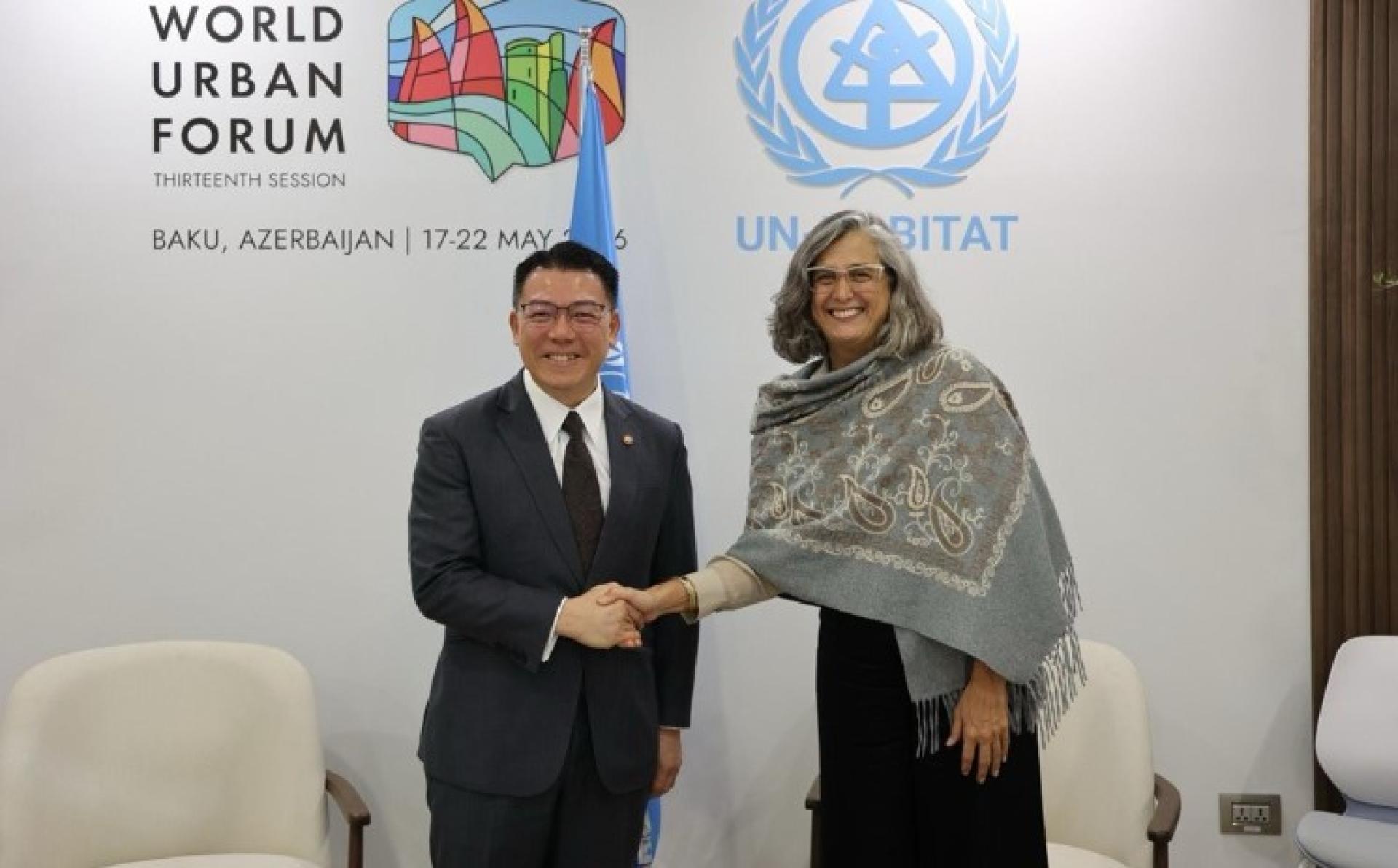
(Baku, 16th) Minister of Housing and Local Government Nga Kor Ming today led the Malaysian delegation in a visit to Baku, Azerbaijan's capital, to strengthen Malaysia’s strategic cooperation with UN-Habitat in three key fields: urban livability, digital urbanization, and Voluntary Local Reviews (VLRs), aiming to create globally sustainable urban development.
He said that despite the gloomy global geopolitical situation, Malaysia continues to advance sustainable development and the process of building climate-resilient cities.
This also marks the highest-level global urban diplomacy undertaken by Nga Kor Ming as Malaysia’s representative and as President of the UN-Habitat Assembly.
Upon arrival, he immediately held a bilateral meeting with UN-Habitat Executive Director Maimunah Mohd Sharif, where both parties had an in-depth discussion on the implementation progress of the “2026–2029 UN-Habitat Strategic Plan.”
Malaysia put forward three proposals during the meeting, including establishing a “Global Urban Livability Centre of Excellence” in Malaysia to set a regional benchmark for urban planning; launching a “Digital Urbanization Lab” focusing on the practical application of artificial intelligence and big data in local governance; and suggesting the establishment of a “Global Voluntary Local Review Fund” to provide peer guidance and financial support to developing countries implementing VLRs.
During the meeting, Nga Kor Ming emphasized that to address today’s complex challenges, we must return to “people-oriented” solutions.
He reiterated that Malaysia is building cities that are resilient to extreme weather by integrating affordable housing, smart city strategies, and community well-being.
“Malaysia has always been committed to collaborating with international partners to ensure that our cities are more inclusive in the future. We want to empower communities so that even when facing global uncertainties, they can continue to enjoy a high quality of life.”
The 13th World Urban Forum (WUF13) will officially open from May 17 to 22. This world’s largest urban event is expected to attract 30,000 representatives from 180 countries.
The Malaysian delegation will use this platform to further promote the “New Urban Agenda” (NUA), and share Malaysia’s successful experiences in low-carbon cities and the digital transformation of urban services.
He said that despite the gloomy global geopolitical situation, Malaysia continues to advance sustainable development and the process of building climate-resilient cities.
This also marks the highest-level global urban diplomacy undertaken by Nga Kor Ming as Malaysia’s representative and as President of the UN-Habitat Assembly.
Upon arrival, he immediately held a bilateral meeting with UN-Habitat Executive Director Maimunah Mohd Sharif, where both parties had an in-depth discussion on the implementation progress of the “2026–2029 UN-Habitat Strategic Plan.”
During the meeting, Nga Kor Ming emphasized that to address today’s complex challenges, we must return to “people-oriented” solutions.
He reiterated that Malaysia is building cities that are resilient to extreme weather by integrating affordable housing, smart city strategies, and community well-being.
“Malaysia has always been committed to collaborating with international partners to ensure that our cities are more inclusive in the future. We want to empower communities so that even when facing global uncertainties, they can continue to enjoy a high quality of life.”
The 13th World Urban Forum (WUF13) will officially open from May 17 to 22. This world’s largest urban event is expected to attract 30,000 representatives from 180 countries.
The Malaysian delegation will use this platform to further promote the “New Urban Agenda” (NUA), and share Malaysia’s successful experiences in low-carbon cities and the digital transformation of urban services.