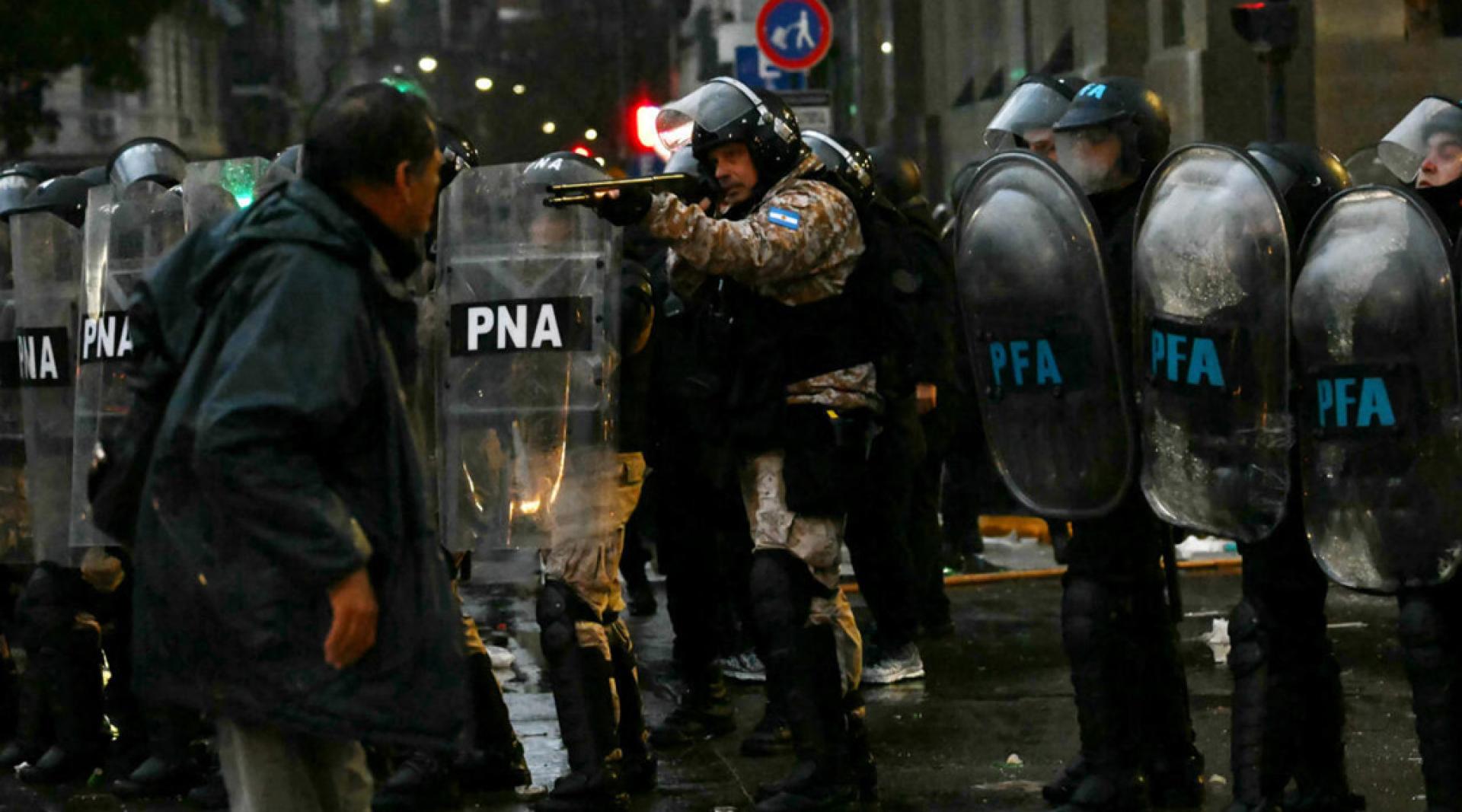
Thousands of Argentinians held a demonstration outside the Senate on the 6th, clashing with police.
Some protesters threw stones and other objects at the police, who responded with rubber bullets, tear gas, and water cannons. After two hours of intermittent standoffs and clashes, police cleared the Congress Square, but some people remained at the scene.
Local media reported that at least two police officers and one protester were injured, and ten people were arrested.
The protest was initiated by leftist groups and labor unions, opposing the government’s private property bill. Although the government had already made concessions by removing a provision from the bill that would have loosened restrictions on foreign individuals and institutions purchasing Argentine land, opposition remained strong. The original clause proposed raising the cap on land that foreign capital could own from 15% to 25%.
Protesters waved the Argentine flag and held banners reading "The motherland is not for sale."
The "Inviolability of Private Property Bill" currently under review in Congress aims to amend Argentina's property regime, including simplifying eviction procedures, adjusting rural land use regulations, and making it more difficult for the state to acquire private land ownership.
President Milei's government stated that the bill aims to establish a legal framework to attract investment. However, opposition parties and environmental groups strongly oppose it, criticizing that it brings risks of "national colonization, division, fragmentation, and balkanization."
According to a 2025 report by the University of Buenos Aires and other researchers, about 5% of Argentina’s territory is currently owned by foreigners or foreign institutions, an area roughly equivalent to England.
The report notes that in certain administrative areas, the proportion of land held by foreign capital has already exceeded the 15% legal cap, especially in regions with water resources, mineral resources, or ports with logistical advantages.