(Bandar Seri Begawan, 27th) Multiple Bruneian representatives were invited to attend the “Southeast Asia Forum,” including the Deputy Vice-Chancellor of Universiti Brunei Darussalam (UBD), the Director of UBD’s Asian Studies Institute, the Dean of the Faculty of Arts and Social Sciences, a lecturer at the UBD Language Centre, Ko Wen Wei, Liao Tianshun, Ko Liuting, Wu Junlin, Shen Renxiang, and others.
“Southeast Asia Forum 2025” is the ninth consecutive forum organized by the Southeast Asia Research Center of South China Normal University, serving as an important platform for China–Southeast Asia academic exchange and practical dialogue, playing an increasingly vital role in regional exchanges, dialogues, and connectivity.
According to a report contributed by the Southeast Asia Research Center of South China Normal University (Yang Tiyong, Wu Jingling, Liu Xinyue, etc.) and photographs provided by the event organizers, in late November, the Southeast Asia Research Center of South China Normal University (as a research base under the Ministry of Education for country and region studies), the Guangdong International Cultural Exchange Center, and the Cross-Strait, Hong Kong and Macau Collaborative Innovation Alliance co-hosted the “Southeast Asia Forum 2025” international conference. Focusing on the theme of “Inclusive Cooperation and Resilient Development of the Guangdong-Hong Kong-Macao Greater Bay Area–Hainan Free Trade Port–Southeast Asia under Great Changes,” the conference attracted around 300 representatives from China and ASEAN countries—universities and research institutes, think tanks, enterprises, social organizations, media, and other sectors.
In addition to the main venue, this conference featured six sub-forums, further enriching the conference structure and enhancing the effectiveness of the overall layout of Southeast Asia exchange and cooperation.
Sub-forum One invited researchers from Brunei–China Friendship Association, Yunnan Academy of Social Sciences, Guangxi University for Nationalities, Hainan Normal University, Sun Yat-sen University, and Jinan University, to discuss “Challenges and Responses Facing China–Southeast Asia Economic and Trade Cooperation”; Sub-forum Two focused on “Improving the Quality of China–Southeast Asia Science and Technology and Education Cooperation under the Background of Artificial Intelligence,” attracting representatives from Vietnam, Malaysia, Brunei, the Philippines, and related schools and enterprises from China;
Sub-forum Three emphasized “Southeast Asian History and Culture: Exchange and Symbiosis,” where researchers from China and Southeast Asia deeply explored new findings in the domains of chamber of commerce interaction, overseas Chinese affairs governance, and the Southeast Asian regional order;
Sub-forum Four focused on “Security and Development of China and Southeast Asia under Changes in Geopolitics,” covering topics such as minilateralism, construction of legal resilience, defense and security, and green development cooperation;
Sub-forum Five, “International Hakka Folk Song Exchange and Performance,” infused a multicultural element into the conference, attracting dozens of Hakka organizations from the United States, Singapore, Malaysia, and China to gather together.
The Postgraduate Forum, themed “Super-knowledge Integration Across Disciplines: Country and Regional Studies of Southeast Asia,” provided an interdisciplinary communication and dialogue platform for postgraduate students from Renmin University of China, Yunnan University, Macau University of Science and Technology, South China Normal University, and Trinity College Dublin, Ireland, among others.
This conference also featured a special tour of education technology enterprises, showcasing the latest achievements in AI education research and development from the Guangdong-Hong Kong-Macao Greater Bay Area to guests from Laos, Cambodia, Myanmar, Malaysia, Singapore, Indonesia, Brunei, the Philippines, and other Southeast Asian nations, disseminating a vivid and dynamic image of modern China.
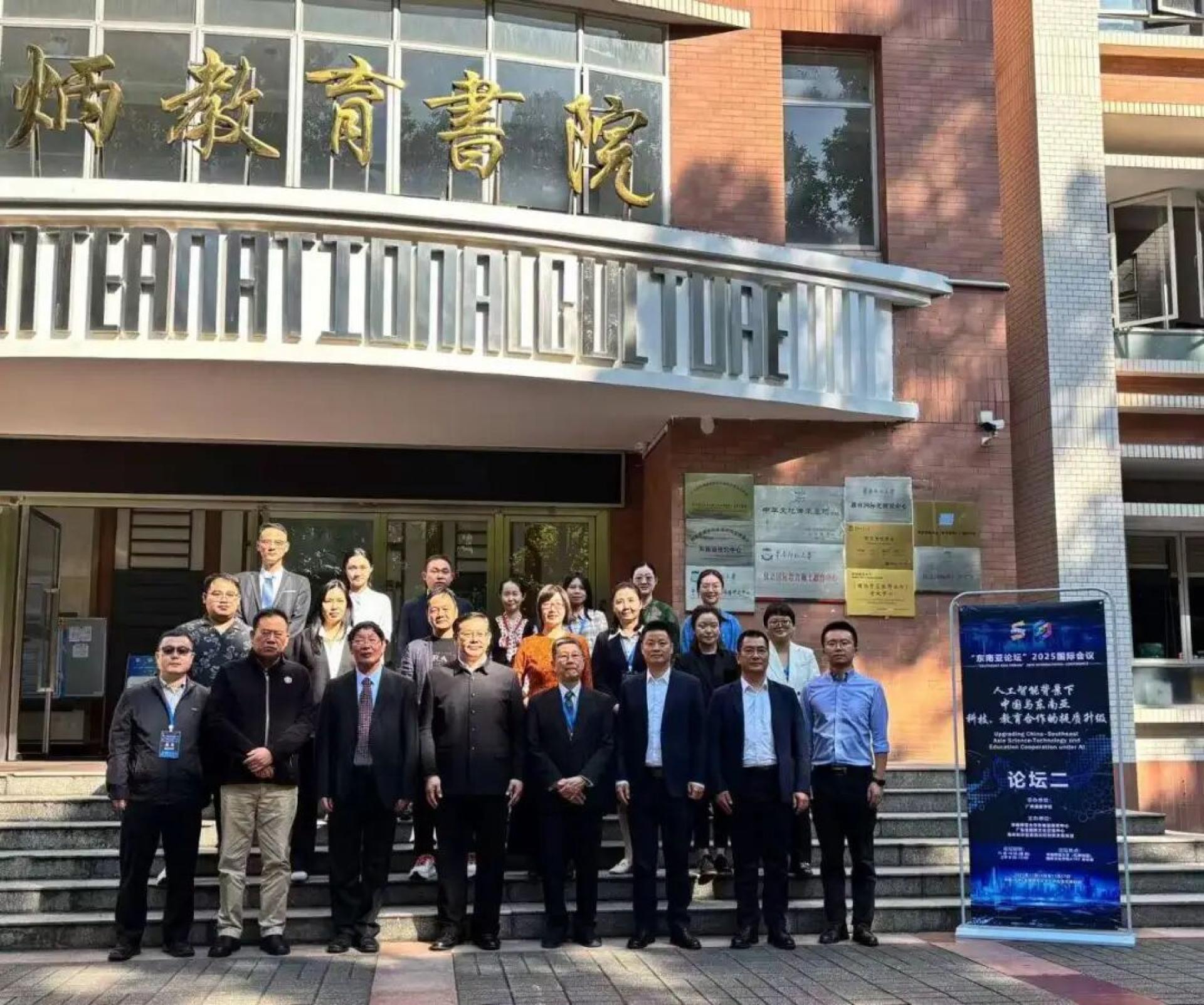
The second sub-forum of the “Southeast Asia Forum 2025” international conference was held in the International Culture College of South China Normal University, where experts and scholars from China, the Philippines, Brunei, Vietnam, Malaysia, and other countries and regions gave keynote speeches and in-depth discussions around “Improving the Quality of China–Southeast Asia Science and Technology and Education Cooperation under the Background of Artificial Intelligence.” The meeting was chaired by Yang Tiyong, a distinguished research fellow at the Southeast Asia Research Center and the International Cultural College of South China Normal University.
In the first half, several guests made keynote speeches on the synergistic development of educational technology and AI empowerment pathways. Professor Zhou Mansheng, former deputy director of the National Center for Education Development Research, in his report “China and ASEAN Working Together to Promote the Application of AI in Basic Education Teaching,” thoroughly analyzed the challenges of applying AI in K-12 education, emphasized the key role of regional cooperation, proposed building a fair and inclusive regional intelligent education ecosystem, and advocated “four-chain integration” to upgrade cooperation. Zhang Qixiang, Principal of Guangzhou Yinghao School, pointed out in his speech “AI Empowering China–Southeast Asia EdTech Community” that AI is the core driving force for jointly constructing the ‘Digital Silk Road,’ calling for the reshaping of the form of education, the building of collaborative systems and innovation alliances, and realizing mutual benefit of inclusive education. Wang Yuhang, Vice Principal of Philippine Chongda School, in his report “Improving the Quality of China–Southeast Asia Science and Technology and Education Cooperation under the Background of Artificial Intelligence,” focused on China-Philippines AI education cooperation, proposed upgrade paths, and advocated joint construction of an ‘Intelligent Education Community.’ Dr. Peng Zhihong, Chairman of YuanZhong Digital Technology (Wuhan) Co., Ltd., stressed that AI services can significantly lower language communication barriers and provides efficient cross-language support for companies going overseas. Senior Bruneian Principal Shen Renxiang delivered his report “Brunei Jade, Future Core: Customized Empowerment and Elite Cultivation Programme, Jointly Building a New China–Brunei Digital Education Ecosystem,” discussing the construction of a digital education ecosystem between the two countries, proposing targeted empowerment measures, and supporting Brunei’s economic transformation. Dr. Vo Minh Hai, a lecturer at Vietnam National University, Hanoi, delivered his online report “Educational Cooperation as a Bridge for People-to-People Exchanges: Repositioning Vietnam–China Relations,” systematically reviewing the course of China-Vietnam education cooperation, highlighting the central role of education in people-to-people exchanges, and suggesting the establishment of cooperation funds to deepen bilateral relations.
The second half of the meeting focused on topics such as AI empowerment, cross-border collaboration, and sustainable development. Wu Weicheng, Principal of Malaysia Chung Ling Independent High School, in his speech “The Status Quo and Future of Malaysian Chinese Education: Challenges and Opportunities in the AI Era,” analyzed the current situation of Chinese-medium schools in Malaysia and the advantages of trilingual education, exploring paths for AI-driven transformation of Chinese education. Associate Professor Liang Jie of Guizhou Minzu University, in “Southeast Asian Chinese Social Networks and Cross-border Education Cooperation: Theoretical and Practical Perspectives from Area Studies,” theoretically analyzed the mechanisms of Chinese network influence, assessed the opportunities and challenges of cross-border education cooperation, and proposed paths for resource integration and policy coordination optimization. Dr. Min Shen, a lecturer at Universiti Brunei Darussalam, in “Toward Intelligent and Intercultural Language Education in the Age of Artificial Intelligence,” pointed out the limitations of current language education, emphasized the integration of AI literacy and intercultural competence, and laid the groundwork for regional cooperation in language learning. Fang Xing, General Manager of Guangdong Shengchuang Digital Intelligent Electronic Manufacturing Co., Ltd., in “The Path of Chinese EdTech Companies Going Overseas to Southeast Asia—A Case Study,” reviewed the company’s development, analyzed the layout of overseas strategies, showcased core achievements, and explained the vision of ‘innovative cooperation, win-win future.’ Liu Qiuhua, Chinese Director of Philippine Guangqi School, in “Education as a Bridge, Culture Facilitates Understanding—A Case Study of the Philippine Guangqi School Study Tour,” introduced the school’s China study tour programme, explaining its significance in fostering China-Philippines cultural connections and cross-cultural understanding. Jiang Xiaofei, a lecturer at Guangzhou Southern College, in “China–Brunei Chinese Education Cooperation: Progress, Challenges, and Responses,” reviewed bilateral cooperation achievements in Chinese language education, analyzed the effectiveness of the ‘vocational+Chinese’ talent development model, identified existing challenges, proposed diversified development pathways, and called for multi-party collaboration to promote sustainable development of Chinese language education between the two countries. Zhang Liang, Party Secretary of Hainan Wanning Middle School, Huang Zijie, Deputy Director of the Development Strategy Department of the Secretariat of the China–ASEAN Education Cooperation Week Organizing Committee, and other domestic and international guests attended the forum.
2025 is the first year of China’s release and implementation of the “Action Plan for Building a Strong Nation Through Education (2024–2035),” and also a critical year for ASEAN’s publication of its long-term Vision 2045 plan. Against this background, discussions on China–Southeast Asia cooperation in education, science, and technology talent possess significant theoretical and practical importance. In the future, South China Normal University’s Southeast Asia Research Center will further increase its investment in advancing high-quality China–Southeast Asia educational exchange and cooperation, engage in in-depth dialogue with partners inside and outside the field, and produce more high-level achievements.
This report is primarily contributed by the Southeast Asia Research Center of South China Normal University (Yang Tiyong, Wu Jingling, Liu Xinyue, etc.), with images provided by the conference organizers.
“Southeast Asia Forum 2025” is the ninth consecutive forum organized by the Southeast Asia Research Center of South China Normal University, serving as an important platform for China–Southeast Asia academic exchange and practical dialogue, playing an increasingly vital role in regional exchanges, dialogues, and connectivity.
According to a report contributed by the Southeast Asia Research Center of South China Normal University (Yang Tiyong, Wu Jingling, Liu Xinyue, etc.) and photographs provided by the event organizers, in late November, the Southeast Asia Research Center of South China Normal University (as a research base under the Ministry of Education for country and region studies), the Guangdong International Cultural Exchange Center, and the Cross-Strait, Hong Kong and Macau Collaborative Innovation Alliance co-hosted the “Southeast Asia Forum 2025” international conference. Focusing on the theme of “Inclusive Cooperation and Resilient Development of the Guangdong-Hong Kong-Macao Greater Bay Area–Hainan Free Trade Port–Southeast Asia under Great Changes,” the conference attracted around 300 representatives from China and ASEAN countries—universities and research institutes, think tanks, enterprises, social organizations, media, and other sectors.
In addition to the main venue, this conference featured six sub-forums, further enriching the conference structure and enhancing the effectiveness of the overall layout of Southeast Asia exchange and cooperation.
Sub-forum One invited researchers from Brunei–China Friendship Association, Yunnan Academy of Social Sciences, Guangxi University for Nationalities, Hainan Normal University, Sun Yat-sen University, and Jinan University, to discuss “Challenges and Responses Facing China–Southeast Asia Economic and Trade Cooperation”; Sub-forum Two focused on “Improving the Quality of China–Southeast Asia Science and Technology and Education Cooperation under the Background of Artificial Intelligence,” attracting representatives from Vietnam, Malaysia, Brunei, the Philippines, and related schools and enterprises from China;
Sub-forum Three emphasized “Southeast Asian History and Culture: Exchange and Symbiosis,” where researchers from China and Southeast Asia deeply explored new findings in the domains of chamber of commerce interaction, overseas Chinese affairs governance, and the Southeast Asian regional order;
Sub-forum Four focused on “Security and Development of China and Southeast Asia under Changes in Geopolitics,” covering topics such as minilateralism, construction of legal resilience, defense and security, and green development cooperation;
Sub-forum Five, “International Hakka Folk Song Exchange and Performance,” infused a multicultural element into the conference, attracting dozens of Hakka organizations from the United States, Singapore, Malaysia, and China to gather together.
The Postgraduate Forum, themed “Super-knowledge Integration Across Disciplines: Country and Regional Studies of Southeast Asia,” provided an interdisciplinary communication and dialogue platform for postgraduate students from Renmin University of China, Yunnan University, Macau University of Science and Technology, South China Normal University, and Trinity College Dublin, Ireland, among others.
This conference also featured a special tour of education technology enterprises, showcasing the latest achievements in AI education research and development from the Guangdong-Hong Kong-Macao Greater Bay Area to guests from Laos, Cambodia, Myanmar, Malaysia, Singapore, Indonesia, Brunei, the Philippines, and other Southeast Asian nations, disseminating a vivid and dynamic image of modern China.
The second sub-forum of the “Southeast Asia Forum 2025” international conference was held in the International Culture College of South China Normal University, where experts and scholars from China, the Philippines, Brunei, Vietnam, Malaysia, and other countries and regions gave keynote speeches and in-depth discussions around “Improving the Quality of China–Southeast Asia Science and Technology and Education Cooperation under the Background of Artificial Intelligence.” The meeting was chaired by Yang Tiyong, a distinguished research fellow at the Southeast Asia Research Center and the International Cultural College of South China Normal University.
In the first half, several guests made keynote speeches on the synergistic development of educational technology and AI empowerment pathways. Professor Zhou Mansheng, former deputy director of the National Center for Education Development Research, in his report “China and ASEAN Working Together to Promote the Application of AI in Basic Education Teaching,” thoroughly analyzed the challenges of applying AI in K-12 education, emphasized the key role of regional cooperation, proposed building a fair and inclusive regional intelligent education ecosystem, and advocated “four-chain integration” to upgrade cooperation. Zhang Qixiang, Principal of Guangzhou Yinghao School, pointed out in his speech “AI Empowering China–Southeast Asia EdTech Community” that AI is the core driving force for jointly constructing the ‘Digital Silk Road,’ calling for the reshaping of the form of education, the building of collaborative systems and innovation alliances, and realizing mutual benefit of inclusive education. Wang Yuhang, Vice Principal of Philippine Chongda School, in his report “Improving the Quality of China–Southeast Asia Science and Technology and Education Cooperation under the Background of Artificial Intelligence,” focused on China-Philippines AI education cooperation, proposed upgrade paths, and advocated joint construction of an ‘Intelligent Education Community.’ Dr. Peng Zhihong, Chairman of YuanZhong Digital Technology (Wuhan) Co., Ltd., stressed that AI services can significantly lower language communication barriers and provides efficient cross-language support for companies going overseas. Senior Bruneian Principal Shen Renxiang delivered his report “Brunei Jade, Future Core: Customized Empowerment and Elite Cultivation Programme, Jointly Building a New China–Brunei Digital Education Ecosystem,” discussing the construction of a digital education ecosystem between the two countries, proposing targeted empowerment measures, and supporting Brunei’s economic transformation. Dr. Vo Minh Hai, a lecturer at Vietnam National University, Hanoi, delivered his online report “Educational Cooperation as a Bridge for People-to-People Exchanges: Repositioning Vietnam–China Relations,” systematically reviewing the course of China-Vietnam education cooperation, highlighting the central role of education in people-to-people exchanges, and suggesting the establishment of cooperation funds to deepen bilateral relations.
The second half of the meeting focused on topics such as AI empowerment, cross-border collaboration, and sustainable development. Wu Weicheng, Principal of Malaysia Chung Ling Independent High School, in his speech “The Status Quo and Future of Malaysian Chinese Education: Challenges and Opportunities in the AI Era,” analyzed the current situation of Chinese-medium schools in Malaysia and the advantages of trilingual education, exploring paths for AI-driven transformation of Chinese education. Associate Professor Liang Jie of Guizhou Minzu University, in “Southeast Asian Chinese Social Networks and Cross-border Education Cooperation: Theoretical and Practical Perspectives from Area Studies,” theoretically analyzed the mechanisms of Chinese network influence, assessed the opportunities and challenges of cross-border education cooperation, and proposed paths for resource integration and policy coordination optimization. Dr. Min Shen, a lecturer at Universiti Brunei Darussalam, in “Toward Intelligent and Intercultural Language Education in the Age of Artificial Intelligence,” pointed out the limitations of current language education, emphasized the integration of AI literacy and intercultural competence, and laid the groundwork for regional cooperation in language learning. Fang Xing, General Manager of Guangdong Shengchuang Digital Intelligent Electronic Manufacturing Co., Ltd., in “The Path of Chinese EdTech Companies Going Overseas to Southeast Asia—A Case Study,” reviewed the company’s development, analyzed the layout of overseas strategies, showcased core achievements, and explained the vision of ‘innovative cooperation, win-win future.’ Liu Qiuhua, Chinese Director of Philippine Guangqi School, in “Education as a Bridge, Culture Facilitates Understanding—A Case Study of the Philippine Guangqi School Study Tour,” introduced the school’s China study tour programme, explaining its significance in fostering China-Philippines cultural connections and cross-cultural understanding. Jiang Xiaofei, a lecturer at Guangzhou Southern College, in “China–Brunei Chinese Education Cooperation: Progress, Challenges, and Responses,” reviewed bilateral cooperation achievements in Chinese language education, analyzed the effectiveness of the ‘vocational+Chinese’ talent development model, identified existing challenges, proposed diversified development pathways, and called for multi-party collaboration to promote sustainable development of Chinese language education between the two countries. Zhang Liang, Party Secretary of Hainan Wanning Middle School, Huang Zijie, Deputy Director of the Development Strategy Department of the Secretariat of the China–ASEAN Education Cooperation Week Organizing Committee, and other domestic and international guests attended the forum.
2025 is the first year of China’s release and implementation of the “Action Plan for Building a Strong Nation Through Education (2024–2035),” and also a critical year for ASEAN’s publication of its long-term Vision 2045 plan. Against this background, discussions on China–Southeast Asia cooperation in education, science, and technology talent possess significant theoretical and practical importance. In the future, South China Normal University’s Southeast Asia Research Center will further increase its investment in advancing high-quality China–Southeast Asia educational exchange and cooperation, engage in in-depth dialogue with partners inside and outside the field, and produce more high-level achievements.
This report is primarily contributed by the Southeast Asia Research Center of South China Normal University (Yang Tiyong, Wu Jingling, Liu Xinyue, etc.), with images provided by the conference organizers.