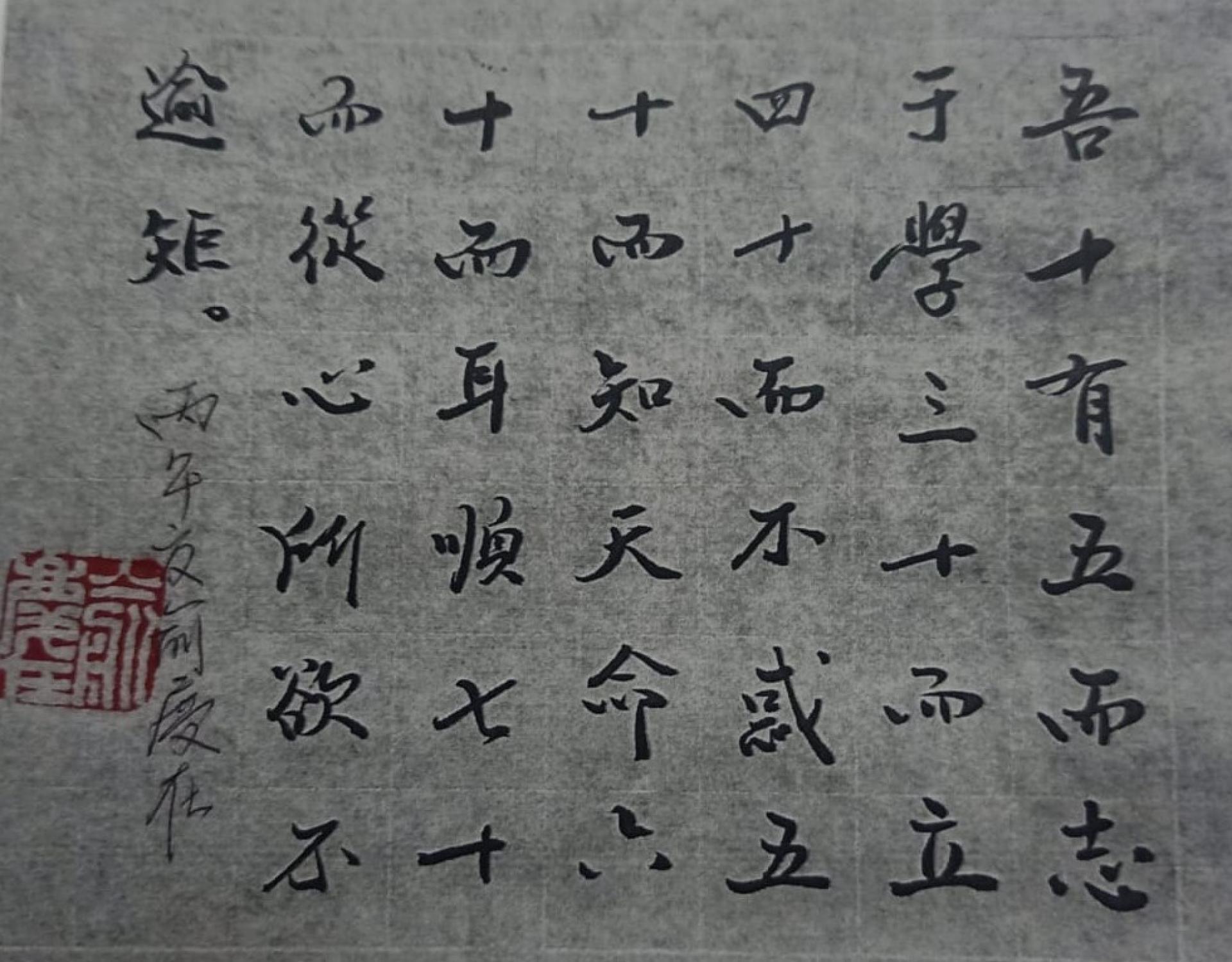
(Bandar Seri Begawan, 29th) Acting President of the Brunei Chinese Culture and Calligraphy Association, Yu Qing, wrote lines from The Analects of Confucius – ‘Wei Zheng’ chapter – in running script calligraphy.
Original text: “At fifteen, I set my heart upon learning; at thirty, I stood firm; at forty, I had no more doubts; at fifty, I knew the will of Heaven; at sixty, my ear was obedient; at seventy, I could follow my heart’s desires without overstepping the line.”
This passage is widely known. Confucius describes the six stages of his life, which can be regarded as one of the earliest and shortest autobiographies in history.
This quote is often used to encourage people to set their ambitions early and to improve personal cultivation through lifelong learning.
In addition, association director Fang Xiufei wrote the idiom "Dong Cheng Xi Jiu" (Success in the East and West) in running script calligraphy.
Originally, "Dong Cheng Xi Jiu" means to succeed everywhere – everything goes smoothly, or to be successful in all directions; in general, it means to achieve success in whatever you do. In modern times, it is also the title of a classic Hong Kong comedy film.
The idiom became widely known due to the 1993 Hong Kong New Year comedy film "The Eagle Shooting Heroes" (Dong Cheng Xi Jiu).
Additionally, association director Zheng Xiaoling wrote the idiom "Heaven rewards diligence" (Tian Dao Chou Qin) in running script calligraphy.
"Tian Dao Chou Qin" means: Heaven will favor and reward those who are diligent; as long as you put in enough effort, you will surely reap appropriate rewards.
This idiom first appeared in the hexagram commentary of the Zhou Yi (I Ching). It conveys the simple truth in traditional Chinese culture that "you reap what you sow." Not only is it used as a motto to inspire individuals to work hard, it also reflects the objective principle that opportunities often come to those who are prepared.
Original text: “At fifteen, I set my heart upon learning; at thirty, I stood firm; at forty, I had no more doubts; at fifty, I knew the will of Heaven; at sixty, my ear was obedient; at seventy, I could follow my heart’s desires without overstepping the line.”
This passage is widely known. Confucius describes the six stages of his life, which can be regarded as one of the earliest and shortest autobiographies in history.
This quote is often used to encourage people to set their ambitions early and to improve personal cultivation through lifelong learning.
In addition, association director Fang Xiufei wrote the idiom "Dong Cheng Xi Jiu" (Success in the East and West) in running script calligraphy.
Originally, "Dong Cheng Xi Jiu" means to succeed everywhere – everything goes smoothly, or to be successful in all directions; in general, it means to achieve success in whatever you do. In modern times, it is also the title of a classic Hong Kong comedy film.
The idiom became widely known due to the 1993 Hong Kong New Year comedy film "The Eagle Shooting Heroes" (Dong Cheng Xi Jiu).
Additionally, association director Zheng Xiaoling wrote the idiom "Heaven rewards diligence" (Tian Dao Chou Qin) in running script calligraphy.
"Tian Dao Chou Qin" means: Heaven will favor and reward those who are diligent; as long as you put in enough effort, you will surely reap appropriate rewards.
This idiom first appeared in the hexagram commentary of the Zhou Yi (I Ching). It conveys the simple truth in traditional Chinese culture that "you reap what you sow." Not only is it used as a motto to inspire individuals to work hard, it also reflects the objective principle that opportunities often come to those who are prepared.