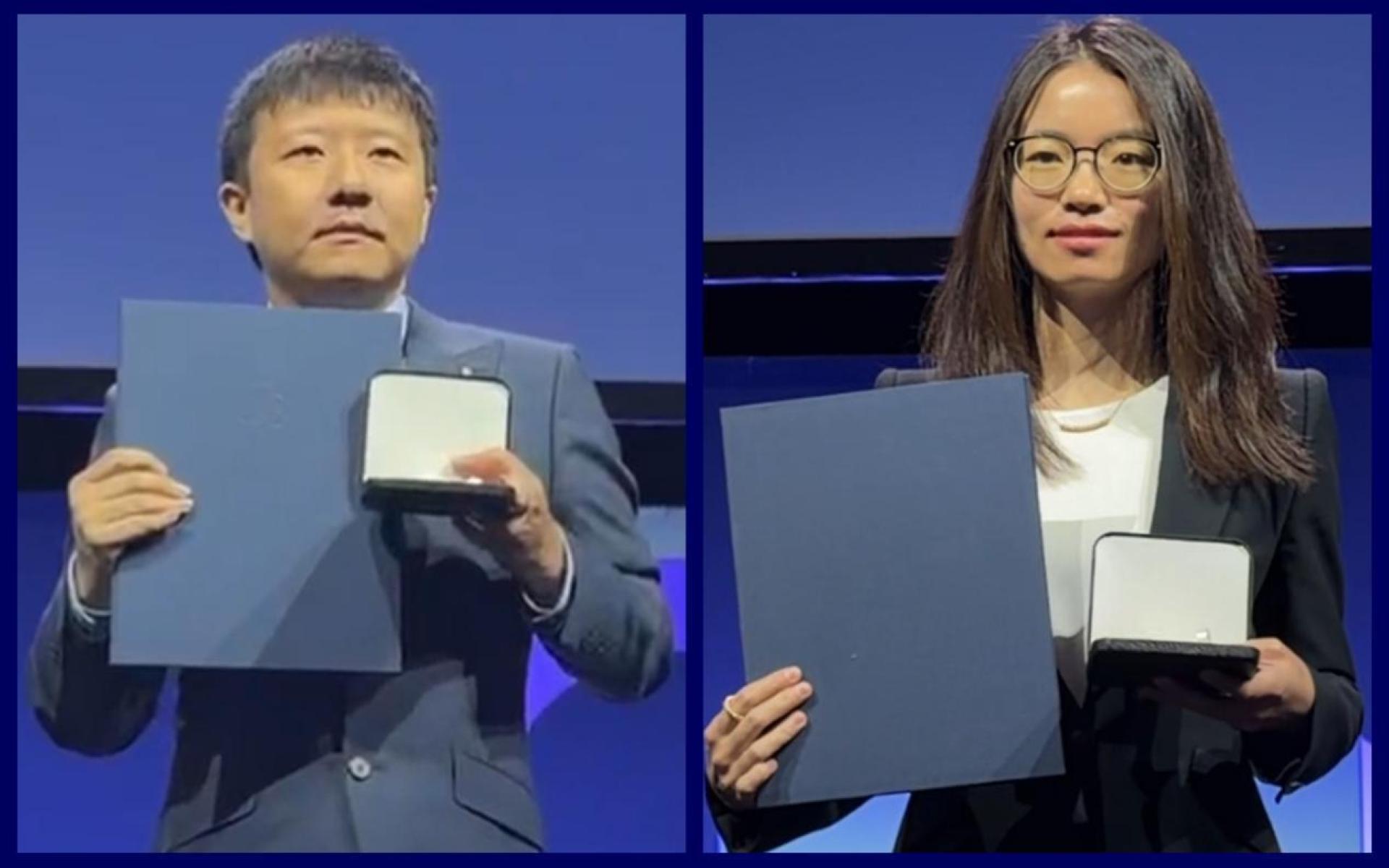
Four mathematicians of Chinese nationality and descent have successively won the Fields Medal, with half of them coming from Guangdong!
At around 9 pm local time on July 23, 2026, the International Congress of Mathematicians opened in Philadelphia, USA, and the “Nobel Prize of Mathematics” — the Fields Medal — was unveiled.
The four awardees are mathematicians Wang Hong, Deng Yu, John Pardon (Bai Jiewen), and Jacob Tsimerman.
Deng Yu and Wang Hong were born in Guangdong and Guangxi respectively, and both entered the School of Mathematical Sciences, Peking University in 2007. This is also the first time that mathematicians with Chinese nationality have won the Fields Medal.

Deng Yu was born in 1989 in Shenzhen, Guangdong Province. He is currently a Professor in the Department of Mathematics at the University of Chicago, mainly researching partial differential equations.
In 2007, Deng entered the School of Mathematical Sciences at Peking University from Shenzhen Senior High School, then transferred to the Massachusetts Institute of Technology and obtained a bachelor’s degree in mathematics. In 2015, he received a Ph.D. from Princeton University.
In 2025, Deng Yu collaborated with Ma Xiao and Zaher Hani to resolve the weak Hilbert's 6th Problem, achieving for the first time the complete logical chain from microscopic particle systems to the macroscopic Boltzmann equation with mathematical rigor. This is one of the 23 problems posed by David Hilbert in 1900, and the entire paper stretched 200 pages.
“Winning this award is recognition of myself, my collaborators’ work, and the significance of our field. Moreover, it may allow me to choose research questions more freely in the future, which is a wonderful thing,” said Deng Yu after winning the award.

In 2006, 16-year-old Deng Yu was studying at Shenzhen Senior High School. He attended the National Mathematics Winter Camp and set a unique record in more than twenty years of the competition: the only person in the event to score a perfect mark, 21 points ahead of the runner-up.
The following year, Deng Yu represented China in the International Mathematical Olympiad and won the IMO gold medal, becoming the third IMO gold medalist from Shenzhen since the city was established.
Asked at what moment he decided to make mathematics his lifelong career, he answered: “It’s hard to say a specific point when I made up my mind. Roughly after the IMO, I felt that this is indeed the most suitable field for me.”
At the 2026 Peking University School of Mathematical Sciences graduation ceremony, Chinese Academy of Sciences academician and Director of Beijing International Center for Mathematical Research, Tian Gang, especially mentioned: “Take our alumni Wang Hong and Deng Yu as an example. Their recent breakthroughs on major mathematical problems embody vividly the spirit of ‘daring to be the first’.”

Before this, there had already been two Chinese-descended Fields Medalists—
The first is Shing-Tung Yau, now teaching at Tsinghua University, who was at the Institute for Advanced Study in Princeton and the University of California, San Diego when he received the award; the second is Terence Tao, born in Australia and now at UCLA.
Shing-Tung Yau is also from Guangdong. He once recalled: “I was born in Shantou, but my ancestors lived in Jiaoling for hundreds of years—both my father and grandfather were born there. The roots of my family are in Jiaoling.”
“At that time, I was simply Chinese, and my overseas mathematician friends also considered me a Chinese. I was very proud.” Yau recalled in his latest article.
In 1982, Shing-Tung Yau was awarded the Fields Medal for solving the Calabi conjecture and the positive mass conjecture. However, due to tense international political situations, the award ceremony was postponed until 1983.
Following Yau, why was Deng Yu able to win the Fields Medal? The answer may be hidden in a set of data.
In January this year, Guangdong published a set of educational “accounts”—
For eight consecutive years, the province’s general public budget for education has only increased and not decreased. In 2024, total local educational funding in the province reached 674.74 billion yuan, still ranking first in the country and up 25.3% from 2020.
From being an agricultural province at the beginning of reform and opening up, Guangdong has transformed into the country’s number one economic province. Its secret is not only the spirit of “daring to venture and try, daring to be the first” in the market, but also that education has always been regarded as a foundational and strategic support.
It can be said that the economy powers education, and education fosters innovation. This virtuous cycle has turned Guangdong into an “incubator” for top innovative talent.
Recently, Beijing Moonshot AI Technology Co., Ltd. released a new generation large model Kimi K3, with a parameter size of 28 trillion. It is currently the largest open-source model in the world, marking a new step for China’s AI model development.
Kimi’s founder, Yang Zhilin, is also from Guangdong. Together with DeepSeek founder Liang Wenfeng from Zhanjiang and prominent AI scientist He Kaiming from Guangzhou, netizens have dubbed them the “three AI heroes.”
People-oriented, investing in people — that’s very much Guangdong!
Just as Shing-Tung Yau hopes, that the young generation of Chinese mathematicians who grew up here can achieve their key breakthroughs at home and forge a path for Chinese mathematics. This is the most crucial step toward becoming a mathematical powerhouse and is the only way for China to become a technological leader. I hope Chinese mathematics will soon be among the world’s best and lead the global development of basic disciplines.