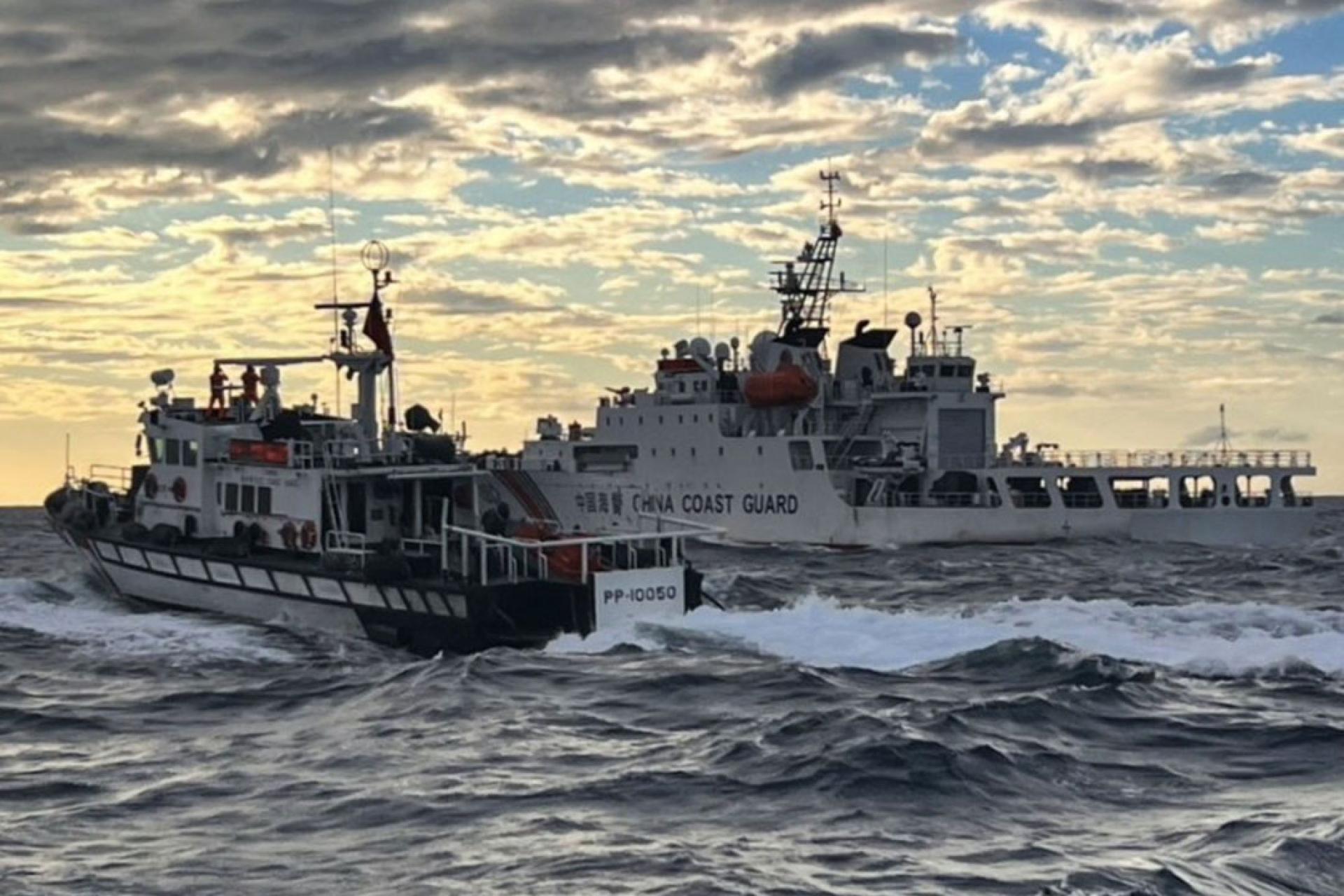
Taiwan's Ministry of National Defense stated on the 30th that several PLA warships and coast guard vessels briefly entered Taiwan's 24-nautical-mile contiguous zone, with the Taiwanese navy and coast guard conducting full-time parallel monitoring.
At a temporary press conference held by the Ministry of National Defense on the evening of the 30th, Lieutenant General Hsieh Jih-sheng, Deputy Chief of the Intelligence Staff, pointed out that as of 3:00 p.m. on the 30th, a total of 71 sorties of PLA military aircraft were detected, 35 of which crossed the median line of the Taiwan Strait and entered the northern, central, and southwestern airspace of Taiwan; 13 PLA warships and 15 coast guard vessels were also detected, of which 11 warships and 8 coast guard vessels entered the 24-nautical-mile contiguous zone, but none entered the 12-nautical-mile territorial sea.
Hsieh Jih-sheng emphasized that for the PLA ships that entered the 24-nautical-mile contiguous zone, the Taiwanese navy and coast guard vessels adopted a "parallel monitoring on the island side" approach to respond.
In response to rumors that the Taiwanese navy's "Ban Chao" ship used fire control radar to lock onto and drive away the PLA's "Urumqi" ship entering the 24-nautical-mile zone, Admiral Chiu Chun-jung, Chief of Staff of the Navy, did not directly confirm this, only stressing that the navy acted in accordance with the "Standard Operating Procedures for Unexpected Situations During Routine Combat Readiness" by taking defensive warning measures and necessary responses toward vessels entering within 24 nautical miles, aiming to warn off and expel them while avoiding the escalation of conflict.
Meanwhile, Lieutenant General Lien Chih-wei, Deputy Chief of Operations and Planning, pointed out that the military's procedures for handling unexpected situations have clearly stipulated different standards for different scenarios.
He made these comments regarding whether the PLA's firing of 27 multiple rocket launchers satisfied the conditions for issuing an air defense alert.
He mentioned two situations: First, if rockets fly over Taiwan's airspace, the commander of the Air Force Combat Command is authorized to use the airborne threat warning system to send out text message alerts to mobile phones; second, if missile landing points threaten the main island of Taiwan or the Penghu area, the Air Force Combat Command commander is equally authorized to issue air defense alerts, send alerts via the airborne threat warning system, and report to all levels of command and notify the troops for necessary responses.
It is understood that the 12-nautical-mile territorial sea represents the extension of national sovereignty and includes waters, seabed, and airspace; the state enjoys full exclusive sovereignty over this area, with foreign ships only having the right of "innocent passage." The 24-nautical-mile contiguous zone extends 24 nautical miles outward from the baseline of the territorial sea (i.e., an additional 12 nautical miles beyond the territorial sea); the state does not have complete sovereignty in this area but does have jurisdiction to prevent illegal acts.