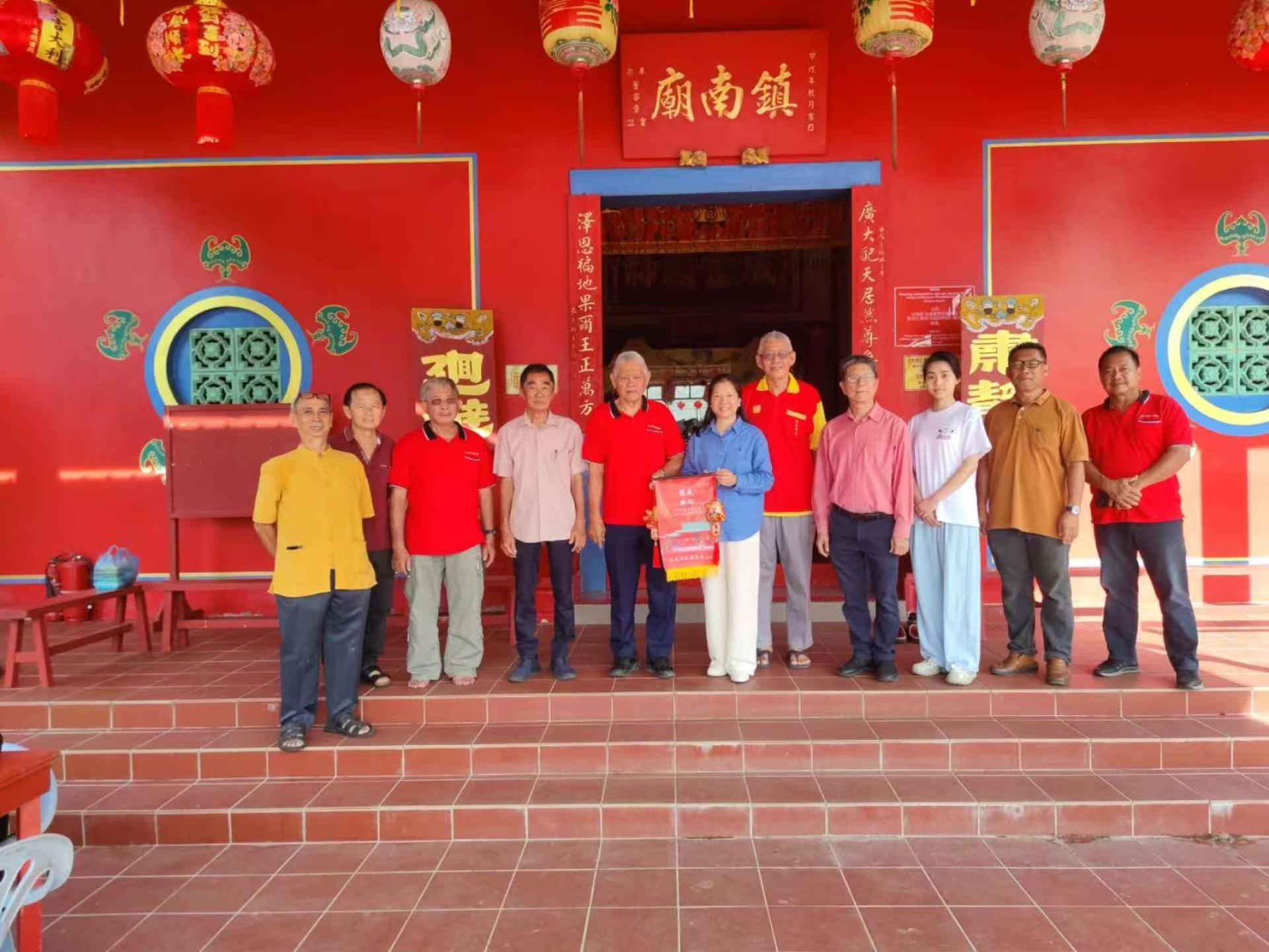
(Bandar Seri Begawan, 14th) Scholars from Guangxi recently visited Brunei to investigate the Zhen Nan Temple and carried out in-depth research and exchanges on the belief and culture surrounding the Lord Guanghai.
Upon arrival, the Guangxi delegation, led by Professor Pan Yanqin, Director of the Brunei Research Institute at the ASEAN College of Guangxi University for Nationalities, accompanied by advisor Shen Renxiang and research assistant Liang Sichang, visited the Zhen Nan Temple. They were warmly received by Chairman and Treasurer Zhao Wenqing along with other committee members and devotees, who arranged a historical introduction and luncheon reception.
The Zhen Nan Temple traces its origins to Mr. Zhao Dedun, who in 1958 brought the icon of Lord Guanghai and other deities from the ancestral temple in Anxi, Fujian, China. The icons were first enshrined in his own residence before being moved to the newly built temple, where worship has since flourished and continued unabated.
In July 1994, due to port expansion and town planning, the Zhen Nan Temple, whose land lease had expired, commenced construction on its current site. Thanks to the concerted efforts of the committee and devotees from all walks of life, the complete construction and relocation of the new temple were finished in less than a month.
On January 19, 1996, in the presence of the distinguished Dato Temenggong Lim Poh, Kapitan Fang Wenting, and committee members and devotees, the inauguration of the new temple was officiated by the distinguished Dato Lim Yucheng.
During their visit, the scholars also called on Teng Yun Temple and Zhen Nan Temple in succession, and by participating in events linked to international Lord Guanghai organizations, gained a deeper understanding of the faith and culture of Lord Guanghai in Brunei. This further allowed them to appreciate the impact of this belief system on local society, as well as its contributions to public welfare and charity sectors.
It is introduced that Lord Guanghai, whose name was Guo Zhongfu (923—938), hailed from Nan'an or Anxi in Fujian. His deification arose from popular tales of 'filial piety' and 'kindness,' and he is venerated by worshippers as the patron saint of emigrants and people living away from home. The belief system is comprehensive, and its spiritual core is highly condensed into the values of 'loyalty, filial piety, benevolence, and righteousness.' It has spread widely throughout Southeast Asia.
At present, international experts and scholars also include systems of belief such as Lord Guanghai and Xuantian Shangdi in their research, with multiple academic symposiums having been held in Xiamen, Taiwan, Malaysia, and other places. This has gradually formed a cross-border dissemination network with ancestral temples as the root and branch temples as offshoots. Among them, Fengshan Temple in Quanzhou is regarded as the key ancestral seat for devotees around the world. In Southeast Asia, there are over 300 temples devoted to related deities.
The Zhen Nan Temple traces its origins to Mr. Zhao Dedun, who in 1958 brought the icon of Lord Guanghai and other deities from the ancestral temple in Anxi, Fujian, China. The icons were first enshrined in his own residence before being moved to the newly built temple, where worship has since flourished and continued unabated.
In July 1994, due to port expansion and town planning, the Zhen Nan Temple, whose land lease had expired, commenced construction on its current site. Thanks to the concerted efforts of the committee and devotees from all walks of life, the complete construction and relocation of the new temple were finished in less than a month.
On January 19, 1996, in the presence of the distinguished Dato Temenggong Lim Poh, Kapitan Fang Wenting, and committee members and devotees, the inauguration of the new temple was officiated by the distinguished Dato Lim Yucheng.
During their visit, the scholars also called on Teng Yun Temple and Zhen Nan Temple in succession, and by participating in events linked to international Lord Guanghai organizations, gained a deeper understanding of the faith and culture of Lord Guanghai in Brunei. This further allowed them to appreciate the impact of this belief system on local society, as well as its contributions to public welfare and charity sectors.
It is introduced that Lord Guanghai, whose name was Guo Zhongfu (923—938), hailed from Nan'an or Anxi in Fujian. His deification arose from popular tales of 'filial piety' and 'kindness,' and he is venerated by worshippers as the patron saint of emigrants and people living away from home. The belief system is comprehensive, and its spiritual core is highly condensed into the values of 'loyalty, filial piety, benevolence, and righteousness.' It has spread widely throughout Southeast Asia.
At present, international experts and scholars also include systems of belief such as Lord Guanghai and Xuantian Shangdi in their research, with multiple academic symposiums having been held in Xiamen, Taiwan, Malaysia, and other places. This has gradually formed a cross-border dissemination network with ancestral temples as the root and branch temples as offshoots. Among them, Fengshan Temple in Quanzhou is regarded as the key ancestral seat for devotees around the world. In Southeast Asia, there are over 300 temples devoted to related deities.