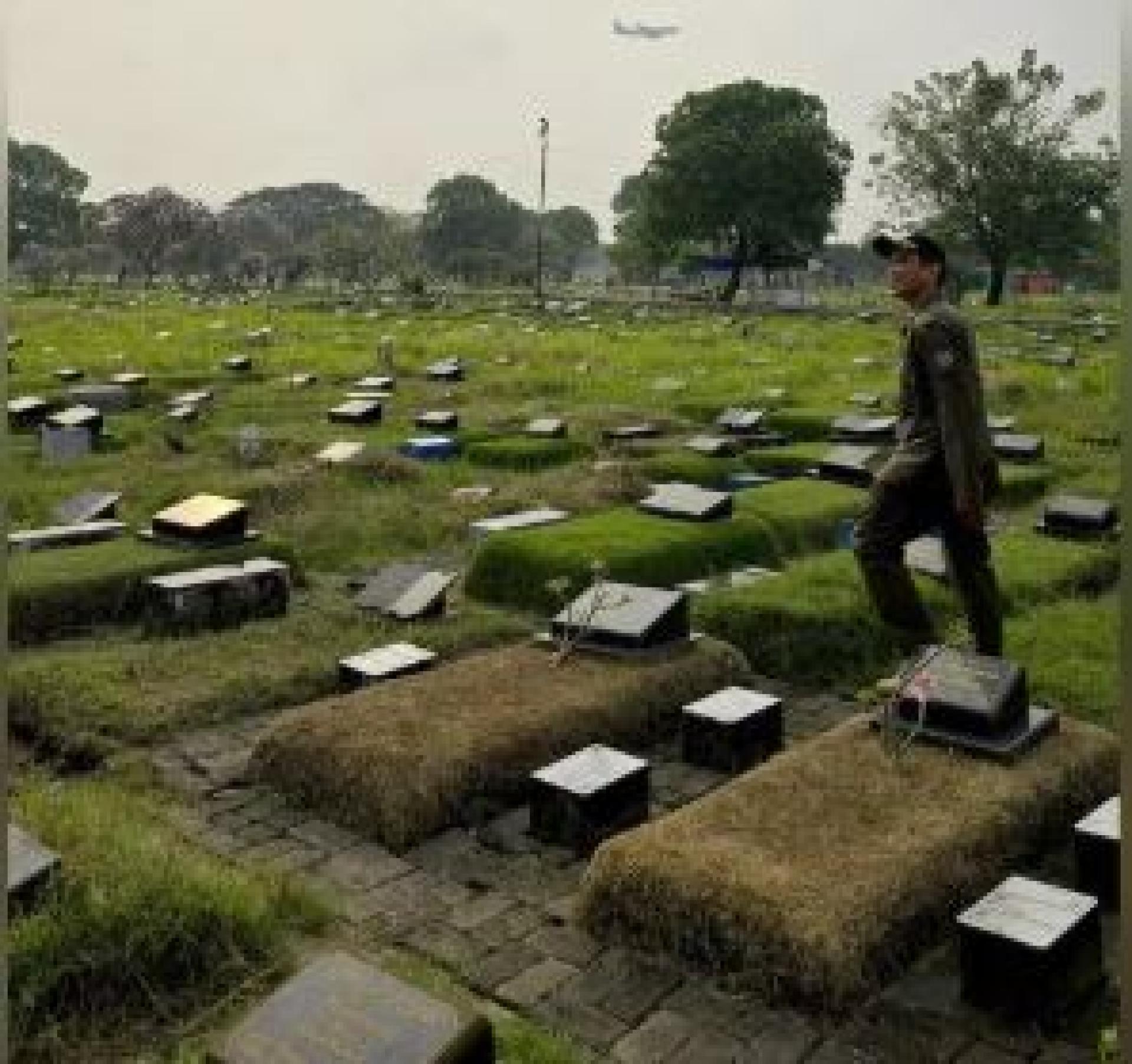
(Jakarta News) Indonesia’s capital Jakarta is facing a severe shortage of public cemetery spaces. The Special Capital Region government has recently launched plans to renovate and expand cemeteries. However, this move has affected poor communities long residing on government-owned land next to the cemeteries, drawing strong attention and heated debate from society and human rights organizations.
According to local media reports, of the city’s 80 public cemeteries, at least 69 are at full capacity, and the remaining 11 have usage rates exceeding 80%. Currently, there are only 118,000 grave plots left, with burial space rapidly running out.
To free up land for cemetery expansion, the regional government plans to relocate and evict several impoverished communities in West and East Jakarta, impacting hundreds of households. Preliminary estimates show that by relocating just two communities in East Jakarta, 280 families would be displaced, which would release land for nearly 2,000 new graves.
Among them, Kampung Budi Luhur in West Jakarta has received relocation notices, as authorities plan to expand the cemetery adjacent to the community. At least 127 families will be affected. Most buildings in this community are semi-permanent houses and bamboo huts built by residents themselves, none of whom hold legal land certificates.
Dirja, Head of the West Jakarta Park Management Agency, confirmed to Antara News Agency that the government will arrange for affected residents to be relocated to public low-cost apartments (Rumah Susun), but declined to disclose the exact resettlement locations or details of the supporting community services.
The sudden relocation plan has left residents feeling at a loss. Lili, a resident who has lived in Kampung Budi Luhur since the 1990s, said that while residents understand that the community is located on government land and that relocation may be unavoidable, so far they have not been informed of clear housing locations, transportation accessibility, or future livelihood guarantees.
He called on authorities not to chase them away “like stray cats”, saying, “We need clear future assurances. We have lived on this land for decades. It is not newly occupied, but our only home.”
Another resident, Seru, believes authorities should show greater empathy and discuss alternative cemetery sites with residents to avoid forcing the community into displacement.
Gugun, coordinator of the human rights group Urban Poor Consortium (UPC), pointed out that the cemetery issue in Jakarta is indeed serious, but solutions should not be built on the sacrifice of marginalized groups.
He stated bluntly, “To build cemeteries for the dead at the expense of the living losing their homes is itself absurd.” He also criticized the special region government for still relying on traditional forced evictions, reflecting a policy lacking in public participation and transparent communication mechanisms, and characterized by a top-down decision-making model with insufficient public feedback.
The human rights organization also emphasized that current tourism and urban development policies should take social equity into account, and not force vulnerable groups to make way for development agendas.
To free up land for cemetery expansion, the regional government plans to relocate and evict several impoverished communities in West and East Jakarta, impacting hundreds of households. Preliminary estimates show that by relocating just two communities in East Jakarta, 280 families would be displaced, which would release land for nearly 2,000 new graves.
Among them, Kampung Budi Luhur in West Jakarta has received relocation notices, as authorities plan to expand the cemetery adjacent to the community. At least 127 families will be affected. Most buildings in this community are semi-permanent houses and bamboo huts built by residents themselves, none of whom hold legal land certificates.
Dirja, Head of the West Jakarta Park Management Agency, confirmed to Antara News Agency that the government will arrange for affected residents to be relocated to public low-cost apartments (Rumah Susun), but declined to disclose the exact resettlement locations or details of the supporting community services.
The sudden relocation plan has left residents feeling at a loss. Lili, a resident who has lived in Kampung Budi Luhur since the 1990s, said that while residents understand that the community is located on government land and that relocation may be unavoidable, so far they have not been informed of clear housing locations, transportation accessibility, or future livelihood guarantees.
He called on authorities not to chase them away “like stray cats”, saying, “We need clear future assurances. We have lived on this land for decades. It is not newly occupied, but our only home.”
Another resident, Seru, believes authorities should show greater empathy and discuss alternative cemetery sites with residents to avoid forcing the community into displacement.
Gugun, coordinator of the human rights group Urban Poor Consortium (UPC), pointed out that the cemetery issue in Jakarta is indeed serious, but solutions should not be built on the sacrifice of marginalized groups.
He stated bluntly, “To build cemeteries for the dead at the expense of the living losing their homes is itself absurd.” He also criticized the special region government for still relying on traditional forced evictions, reflecting a policy lacking in public participation and transparent communication mechanisms, and characterized by a top-down decision-making model with insufficient public feedback.
The human rights organization also emphasized that current tourism and urban development policies should take social equity into account, and not force vulnerable groups to make way for development agendas.