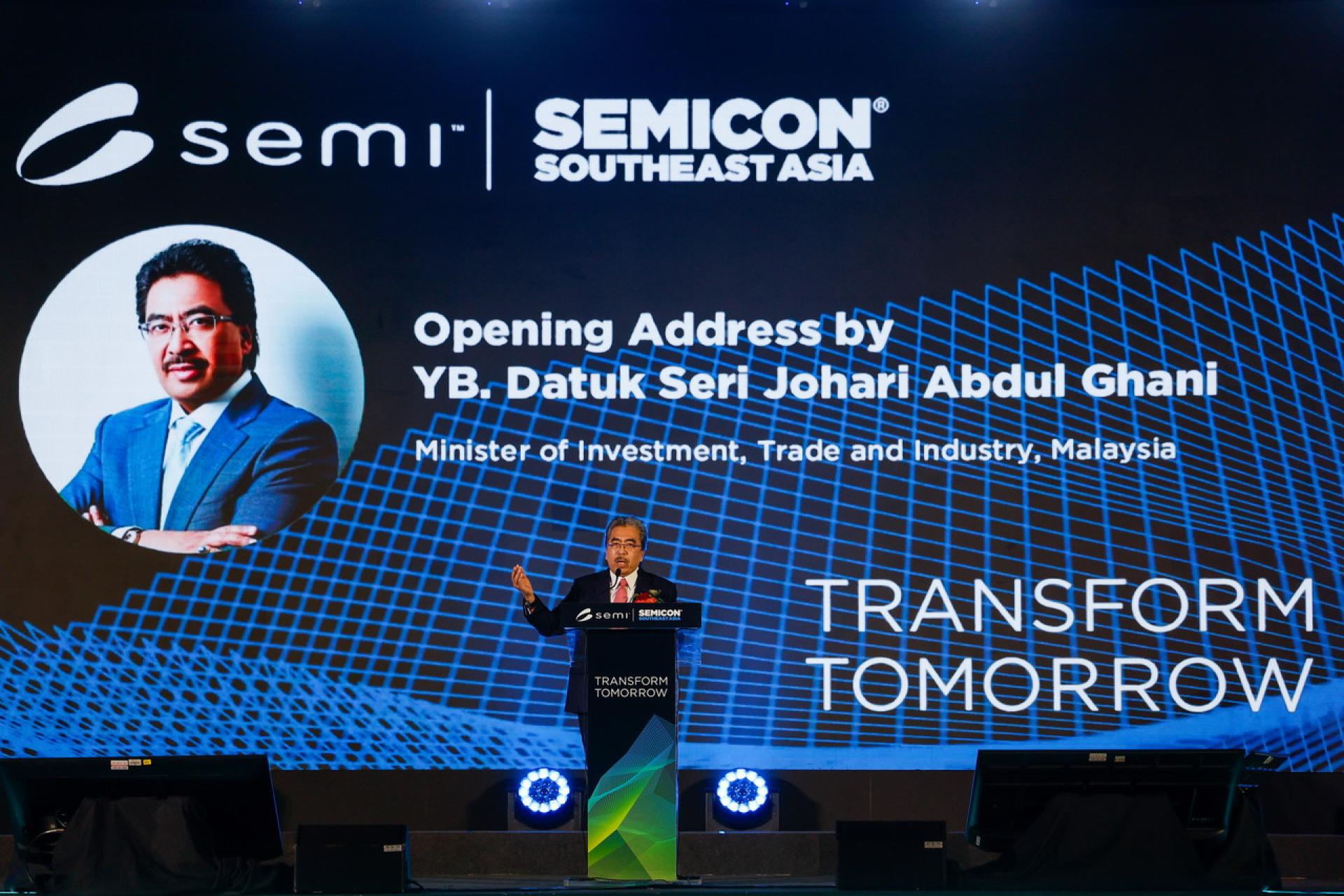
Despite uncertainties in the global landscape, Minister of Investment, Trade, and Industry, Datuk Seri Zohari, said that investor confidence in Malaysia's semiconductor sector remains robust, with businesses continuing to pursue their established plans.
He pointed out that the semiconductor sector is still a key pillar of Malaysia's electrical and electronics industry, with exports in this field reaching about RM711 billion last year, of which semiconductor exports accounted for approximately RM465 billion.
"For me, we must continue to engage with them (the investors), but so far, I believe all (industry players) are eager to keep moving forward."
Speaking to reporters today (5th) after officiating the launch of the 2026 Southeast Asia Semiconductor Expo, he said that Malaysia must strengthen its semiconductor ecosystem to seize future growth opportunities and remain competitive in the ever-evolving global landscape.
Zohari noted that by 2030, the global semiconductor market size alone is expected to reach around US$1 trillion (at an exchange rate of US$1 = RM3.95), presenting a significant opportunity for Malaysia in the future.
He said that Malaysia's semiconductor industry reached a scale of US$630 billion in 2024 and is expected to expand rapidly, mainly driven by the surge in artificial intelligence (AI) infrastructure, including rising demand for high-performance data centers, servers, and network devices to support increasing data flows.
He emphasized that although Malaysia has developed strong capabilities in the backend areas of packaging and testing, it is still necessary to expand into the front-end, such as wafer fabrication.
He said that attracting foreign investment will continue to play a key role in accelerating Malaysia's move towards high-value semiconductor manufacturing.
"Therefore, if we are not yet ready to undertake these operations ourselves, we must invite investors to come in. Infineon is an example—they have already come to Kulim to carry out wafer fabrication."

"For basic IC design, we have received about 25 technical quotas; as for advanced design, there are 7, of which we have allocated 3 to some industry participants so that they can collaborate with local companies."
He also said that in terms of basic IC design allocation, about 5 companies are currently participating, and the related implementation is ongoing.