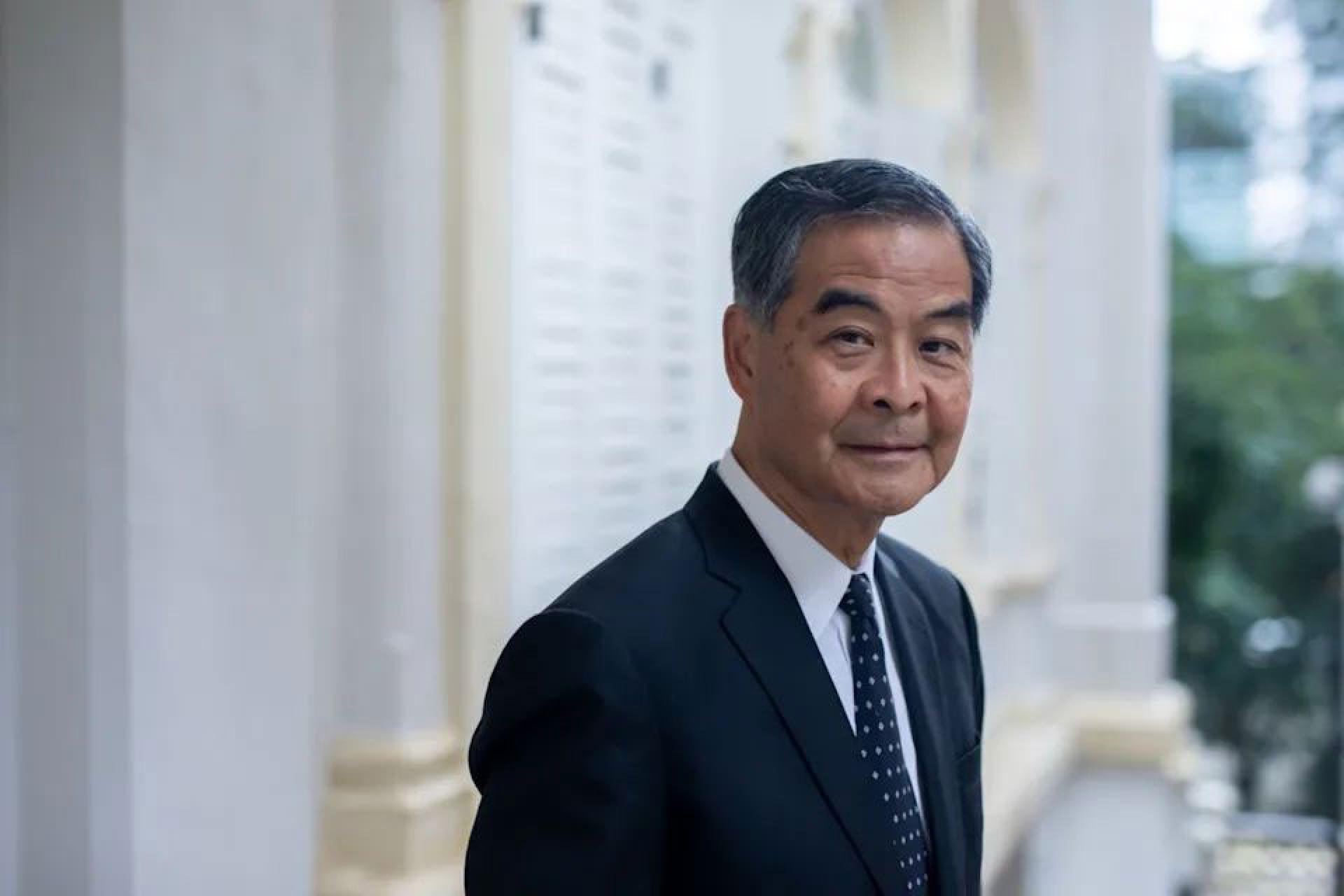
China's National Committee of the Chinese People's Political Consultative Conference (CPPCC) Vice Chairman Leung Chun-ying posted on social media on Monday, pointing out that some new housing estates in Hong Kong have 'only English names and no Chinese names'. He questioned whether developers are abandoning Chinese in order to 'appear high-end', and emphasized that as a bilingual society, both Chinese and English should be valued equally in Hong Kong. He further stated that relying on foreign names to deliberately 'pretend to be foreign to scare people' reflects a distorted cultural mentality that should not be accepted.
He outlined the changes in Hong Kong's real estate industry: in the early years, housing estates first had Chinese names, and the English names were transliterated from Cantonese; later, unrelated foreign language names were added to create an upscale impression. Nowadays, some housing estates targeting Chinese buyers directly forgo Chinese names, with the root cause being developers’ efforts to 'appear high-end'. Ironically, many real estate practitioners have insufficient English proficiency and even mispronounce the foreign estate names.
In recent years, housing estates with only English names include: Sun Hung Kai’s popular Sai Sha project Sierra Sea, Tuen Mun’s Novo Land, the Yuen Long Yoho Town series, Tin Shui Wai Wetland Seasons Park, and Pak Shek Kok’s Silicon Hill; Wheelock’s Cha Kwo Ling KOKO Hills, Kai Tak’s Oasis Kai Tak, and Park Silicon in Sheung Shui, which has released its brochure but not yet set a price; CK Asset’s Lohas Park Sea To Sky, and Hung Shui Kiu’s #LYOS, which not only use all-English names but also even include hashtags.
Centaline Property CEO Wong Dun-king told the media that some housing estates in recent years use names that are either only in English or, if there is a Chinese version, the characters are so obscure they are hard to pronounce. He estimates that this is because the suitable Chinese characters for housing estate names 'have mostly been used up', leaving few variations. Developers might have different strategies according to their sales needs, but he suggests that after the estates are occupied, both Chinese and English names can be provided.
In fact, the naming of Hong Kong's private housing estates has shown distinct features across different eras. Early names tended to use 'Building' or 'Tower', characterized by a simple style. From the late 1970s to the 1990s, as the economy took off, names with 'City', 'Garden', or 'Estate' became popular, such as Taikoo Shing, Whampoa Garden, and Mei Foo Sun Chuen. In the 1990s, names often used 'Peninsula' or 'Manor', such as South Horizons and Kingswood Villas. After the millennium, estate names became increasingly grand, like The Harbourside and Queen's Terrace. In recent years, new developments have been pursuing novelty, with names such as Ocean Pride, Malibu, Ava Court, and K. Summit.