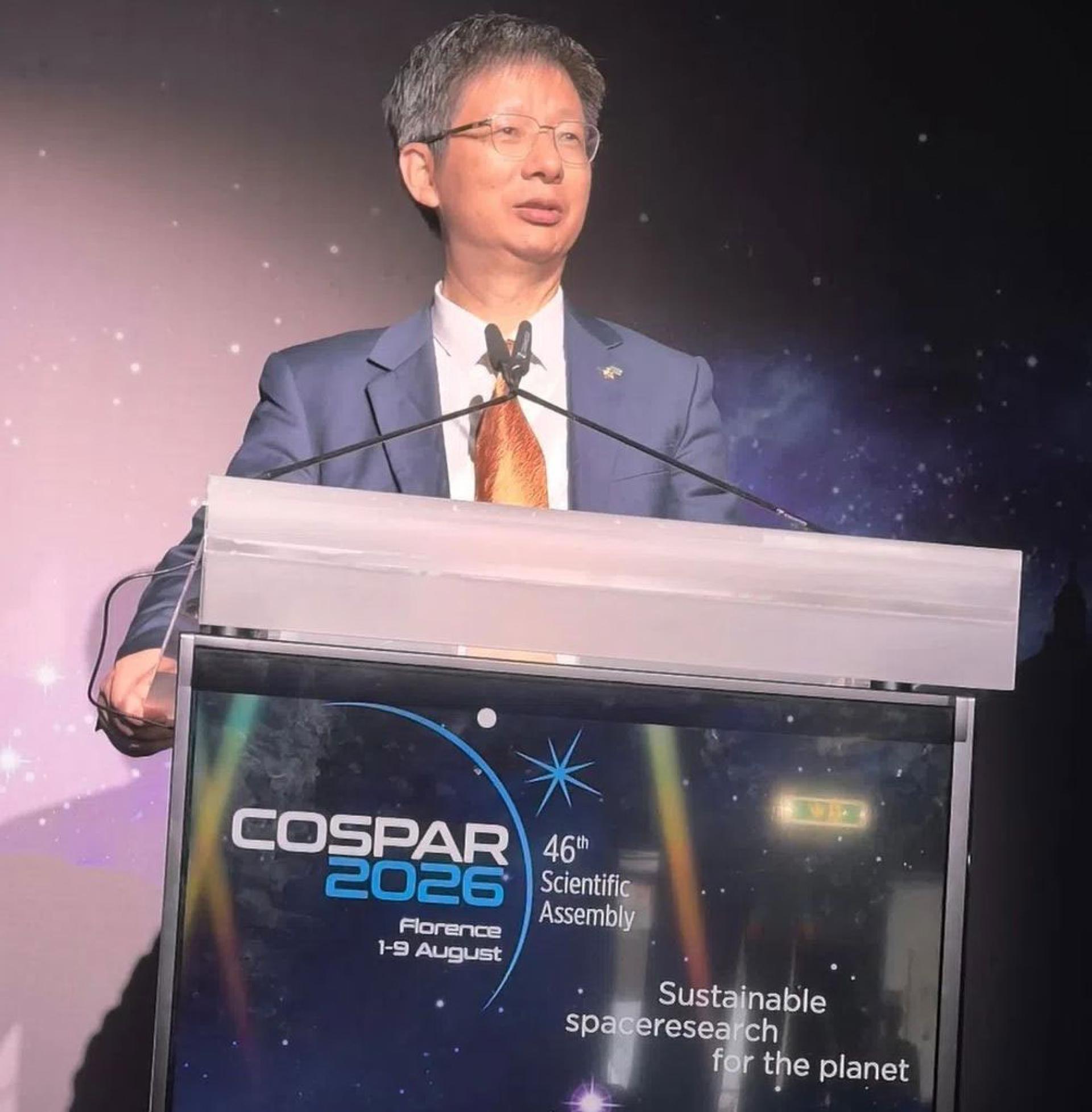
Chinese scientist wins the William Nordberg Medal for the first time.
According to China Central Television (CCTV) News, Wang Jinsong, a researcher from the China Meteorological Administration, was awarded the William Nordberg Medal at the 46th Committee on Space Research (COSPAR) Scientific Assembly held in Florence, Italy, on Monday.
The William Nordberg Medal recognizes outstanding achievements and exceptional contributions in the field of space science applications.
Since the establishment of the medal in 1988, Wang Jinsong is the first Chinese scientist to receive this honor and was simultaneously awarded a minor planet to be named after him.
Wang Jinsong is currently the Director of the National Satellite Meteorological Center of China and the Chief Designer of the Fengyun Meteorological Satellite Program. He led the creation of China's national-level space weather operational system and promoted the sustained development and globalization of Fengyun meteorological satellites.
He led the development of China's first-generation space weather numerical prediction system, as well as the world's first space weather chain prediction artificial intelligence model "Fengyu".
With the joint efforts of Wang Jinsong and his team, China's space weather operations have achieved a leapfrog development from nonexistence to international leadership. With the Fengyun satellite constellation at its core, and the integration of nearly a hundred ground stations, the space weather operational monitoring system has made China the only country besides the United States with full-chain solar-terrestrial space weather operational monitoring capabilities. The related technologies are widely used in major space projects such as Beidou, Chang'e, Tianwen, and Kuafu.
COSPAR is a major international academic organization under the International Science Council. The William Nordberg Medal is one of the important scientific awards established by COSPAR. It is awarded every two years, and since 2022, two scientists are honored at each session. This year, the other recipient is David Sibeck, Chief Scientist of Heliophysics at NASA.