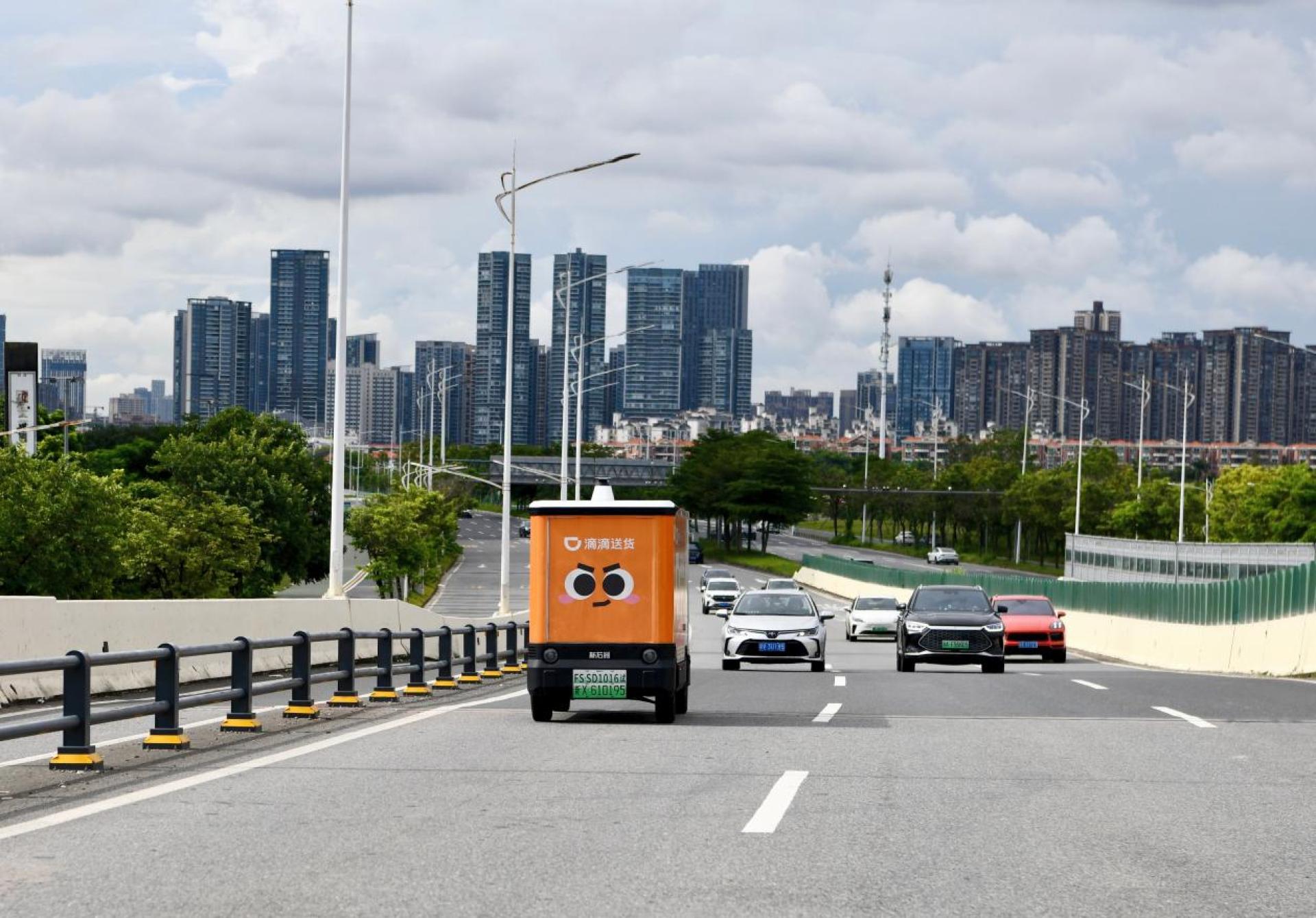
At 2 p.m., an electric vehicle store in Shunde, Foshan, received a request for stock transfer. The store manager didn’t drive or call a delivery driver, but opened a WeChat mini-program and placed an order, just like hailing a ride.
Five minutes later, an unmanned vehicle arrived at the door. Scan code, load goods, confirm departure—the vehicle hit the road on its own.
Over half a month, this store has placed more than 80 orders, and logistics costs have dropped by 60%.
For small and medium businesses, unmanned vehicles provide on-demand delivery similar to ride-hailing; wherever there is demand, the vehicles go.
Behind this is a new logistics model unfolding across Foshan: unmanned vehicle instant delivery service. It turns unmanned vehicles from fixed assets owned by companies into publicly shared transport capacity available on-demand—call up capacity just like a ride, charged by order or mileage.
On the same afternoon, at a YTO Express branch in Nanhai District, Foshan, a courier loaded packages into an unmanned vehicle and tapped “depart.” Twenty minutes later, the vehicle arrived at a community service station 3 kilometers away. Over the course of a year, end-point delivery costs dropped by 30%, and couriers’ repeat running time was reduced by 40%. The time saved is used for picking up parcels and door-to-door deliveries. When package volume spikes in peak seasons, just add more unmanned vehicle trips to quickly increase capacity.
Today, the service scope for unmanned vehicles continues to expand. In Shunde, Foshan, hotpot supply chain companies use unmanned vehicles to run fixed routes, completing centralized deliveries to multiple stores, greatly improving punctuality and operational efficiency. At a fruit distribution center, 10 unmanned vehicles had already delivered bananas and grapes to more than a dozen community stores before dawn—the system automatically generates restocking orders and plans routes based on the previous day’s sales data, with no human scheduling needed at any point.
Unmanned vehicles have entered Shunde’s food & beverage supply chain.

Foshan’s industrial output exceeds 3 trillion yuan, with dense clusters in home appliances, furniture, ceramics, equipment manufacturing, and more. The circulation of parts between factories, transfers between warehouses and stores, and deliveries from wholesale markets to community endpoints together make up immense and frequent logistics demand. Combined with almost 10 million permanent residents packed in communities, commercial zones, and specialized markets, virtually every link from factory to warehouse, from warehouse to store, and from store to consumer is a scenario where unmanned vehicles can take part.

More importantly, in 2025 Foshan issued detailed regulations for functional unmanned vehicle road testing and commercial deployment, clarifying test application, operating standards, and safety requirements, and encouraging exploration of unmanned nighttime logistics delivery and other applications.
Currently, unmanned vehicles are in regular operation across all five districts of Foshan, covering express delivery, retail, cold chain transport, cross-store goods transfer, and more scenarios. In Foshan, a micro-revolution in logistics driven by unmanned vehicles is quietly changing the way goods flow through the city.