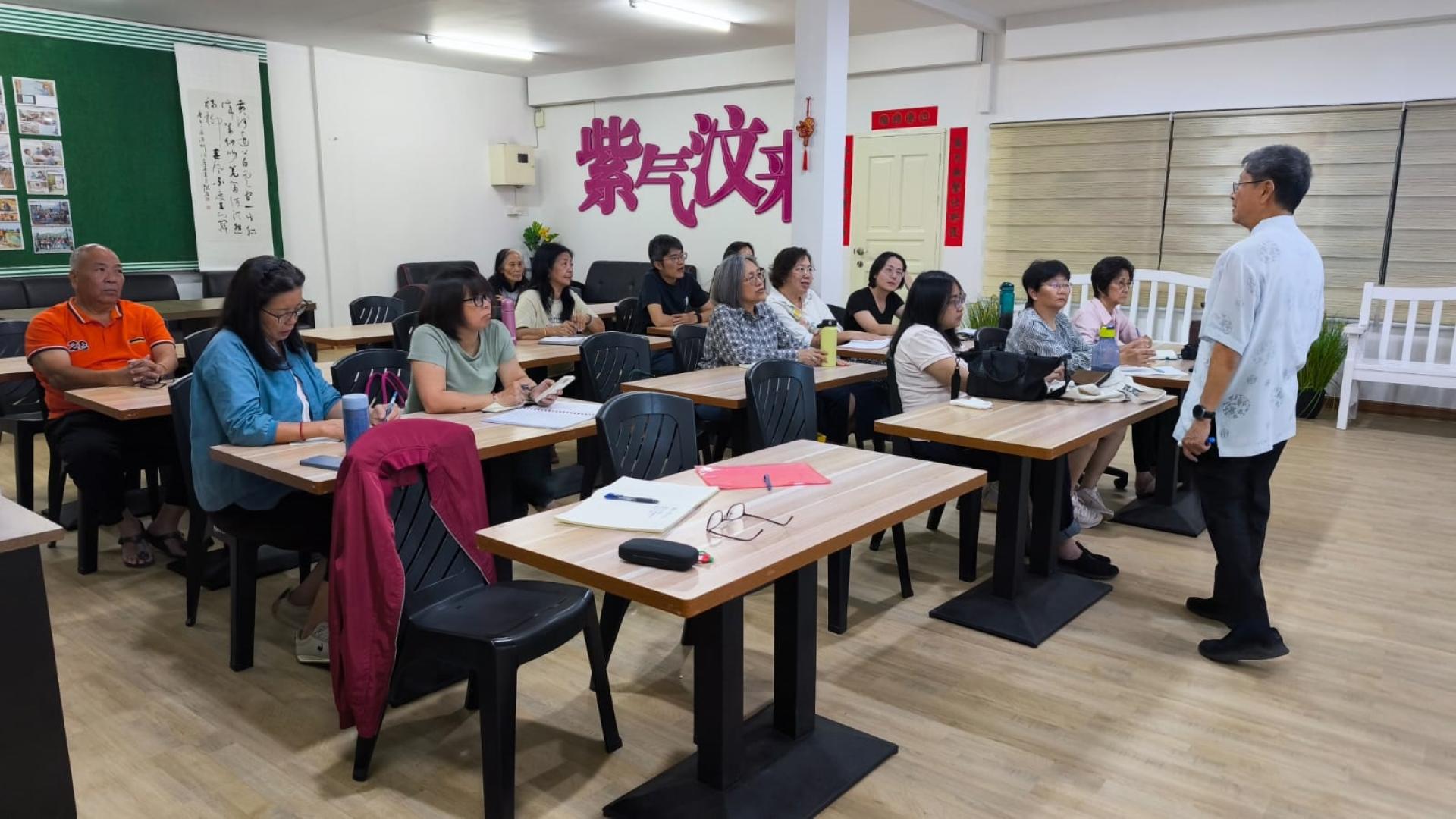
(City of Seremban, 12th) After a series of consecutive holidays including New Year’s Day, Spring Festival, and Hari Raya, the 'Cultural Studies Class' organized by the Ji De Care Association will officially resume classes this Friday. The new academic year brings important adjustments to the timetable in response to students’ needs.
On the first day of resumption, the classroom atmosphere was lively. The 'Chinese History' module, taught by lecturer Shen Renxiang, used slides and handouts to guide students systematically through an overview of Chinese general history, consolidating fundamental historical knowledge.
The 'Explaining Chinese Characters' module focused on the evolution of the character '仑 (lún)', detailing its forms from oracle bone script, bronzeware script, seal script, regular script, to the simplified form, and deeply explaining its original and extended meanings. The lecturer further introduced the basic meanings and cultural connotations of related characters like '伦, 论, 抡, 轮, 纶, 沦,' helping students to better understand the cultural logic behind Chinese characters.
The 'Cultural Folk Customs' module was combined with the Qingming Festival, explaining the relationship between festivals and solar terms, the calculation principles of Chinese and Western calendars, and basic methods of traditional calendar calculation. The class also appreciated Du Mu’s famous poem 'Qingming', exploring the festival’s emotions and cultural significance through poetry.
The 'Special Topics Discussion' module focused on the value of classical literature. Xu Lili discussed the significance of reading classics for contemporary people, offering a systematic explanation of the unique value of Chinese traditional literature through four main arguments, which resonated widely with the students.
Xu Lili pointed out that Chinese traditional literature is the crystallization of the spirit and wisdom of thousands of years of Chinese civilization. From the 'Book of Songs' and 'Analects' to Tang and Song poetry, from historical records to various masterpieces, they not only record historical change but also form the backbone of human civilization. As a vital carrier of culture, traditional literature is both a treasury of knowledge and spiritual nourishment.
Her first point was 'The beauty of the classics nourishes both language and the soul.' She explained that the concise language, beautiful rhythm, and profound imagery of classical literature can enhance one’s expressive abilities and, subtly, purify the emotions and nurture the soul.
Secondly, Xu Lili emphasized 'The power of character in the classics shapes the foundation of virtue.' She believes that values such as benevolence, righteousness, propriety, wisdom, trust, loyalty, filial piety, integrity, and a sense of shame, embodied in the classics of all dynasties, still possess strong moral appeal today, helping readers build stable and positive life beliefs.
Third, she pointed out that 'Traditional literature endows culture with roots and a sense of belonging.' In the face of globalization and informatization, classical works help people understand their cultural identity and gain spiritual belonging through a connection between history and reality.
Finally, Xu Lili stated that 'Classics make the mind broader, more resilient, and gentler.' She explained that reading the classics allows people to broaden their vision through dialogue across time and space, find support in life’s hardships, and face the world with a gentler attitude.
At the end of the program, Xu Lili concluded that classical literature is not a dust-covered heritage but living wisdom. It lights the way on each person’s life path and is worth rediscovering and cherishing in the present.
For students’ convenience, starting this year, the 'Cultural Studies Class' will be held once every two weeks. Class time has been changed to Friday evenings from 8:00 p.m. to 10:00 p.m., with the location unchanged at the Zhu Zhu Commercial Building, fourth floor clubhouse.
The organizers warmly welcome all those interested in Chinese culture to actively participate in this free course for self-enrichment and personal growth.
On the first day of resumption, the classroom atmosphere was lively. The 'Chinese History' module, taught by lecturer Shen Renxiang, used slides and handouts to guide students systematically through an overview of Chinese general history, consolidating fundamental historical knowledge.
The 'Explaining Chinese Characters' module focused on the evolution of the character '仑 (lún)', detailing its forms from oracle bone script, bronzeware script, seal script, regular script, to the simplified form, and deeply explaining its original and extended meanings. The lecturer further introduced the basic meanings and cultural connotations of related characters like '伦, 论, 抡, 轮, 纶, 沦,' helping students to better understand the cultural logic behind Chinese characters.
The 'Cultural Folk Customs' module was combined with the Qingming Festival, explaining the relationship between festivals and solar terms, the calculation principles of Chinese and Western calendars, and basic methods of traditional calendar calculation. The class also appreciated Du Mu’s famous poem 'Qingming', exploring the festival’s emotions and cultural significance through poetry.
The 'Special Topics Discussion' module focused on the value of classical literature. Xu Lili discussed the significance of reading classics for contemporary people, offering a systematic explanation of the unique value of Chinese traditional literature through four main arguments, which resonated widely with the students.
Xu Lili pointed out that Chinese traditional literature is the crystallization of the spirit and wisdom of thousands of years of Chinese civilization. From the 'Book of Songs' and 'Analects' to Tang and Song poetry, from historical records to various masterpieces, they not only record historical change but also form the backbone of human civilization. As a vital carrier of culture, traditional literature is both a treasury of knowledge and spiritual nourishment.
Her first point was 'The beauty of the classics nourishes both language and the soul.' She explained that the concise language, beautiful rhythm, and profound imagery of classical literature can enhance one’s expressive abilities and, subtly, purify the emotions and nurture the soul.
Secondly, Xu Lili emphasized 'The power of character in the classics shapes the foundation of virtue.' She believes that values such as benevolence, righteousness, propriety, wisdom, trust, loyalty, filial piety, integrity, and a sense of shame, embodied in the classics of all dynasties, still possess strong moral appeal today, helping readers build stable and positive life beliefs.
Third, she pointed out that 'Traditional literature endows culture with roots and a sense of belonging.' In the face of globalization and informatization, classical works help people understand their cultural identity and gain spiritual belonging through a connection between history and reality.
Finally, Xu Lili stated that 'Classics make the mind broader, more resilient, and gentler.' She explained that reading the classics allows people to broaden their vision through dialogue across time and space, find support in life’s hardships, and face the world with a gentler attitude.
At the end of the program, Xu Lili concluded that classical literature is not a dust-covered heritage but living wisdom. It lights the way on each person’s life path and is worth rediscovering and cherishing in the present.
For students’ convenience, starting this year, the 'Cultural Studies Class' will be held once every two weeks. Class time has been changed to Friday evenings from 8:00 p.m. to 10:00 p.m., with the location unchanged at the Zhu Zhu Commercial Building, fourth floor clubhouse.
The organizers warmly welcome all those interested in Chinese culture to actively participate in this free course for self-enrichment and personal growth.