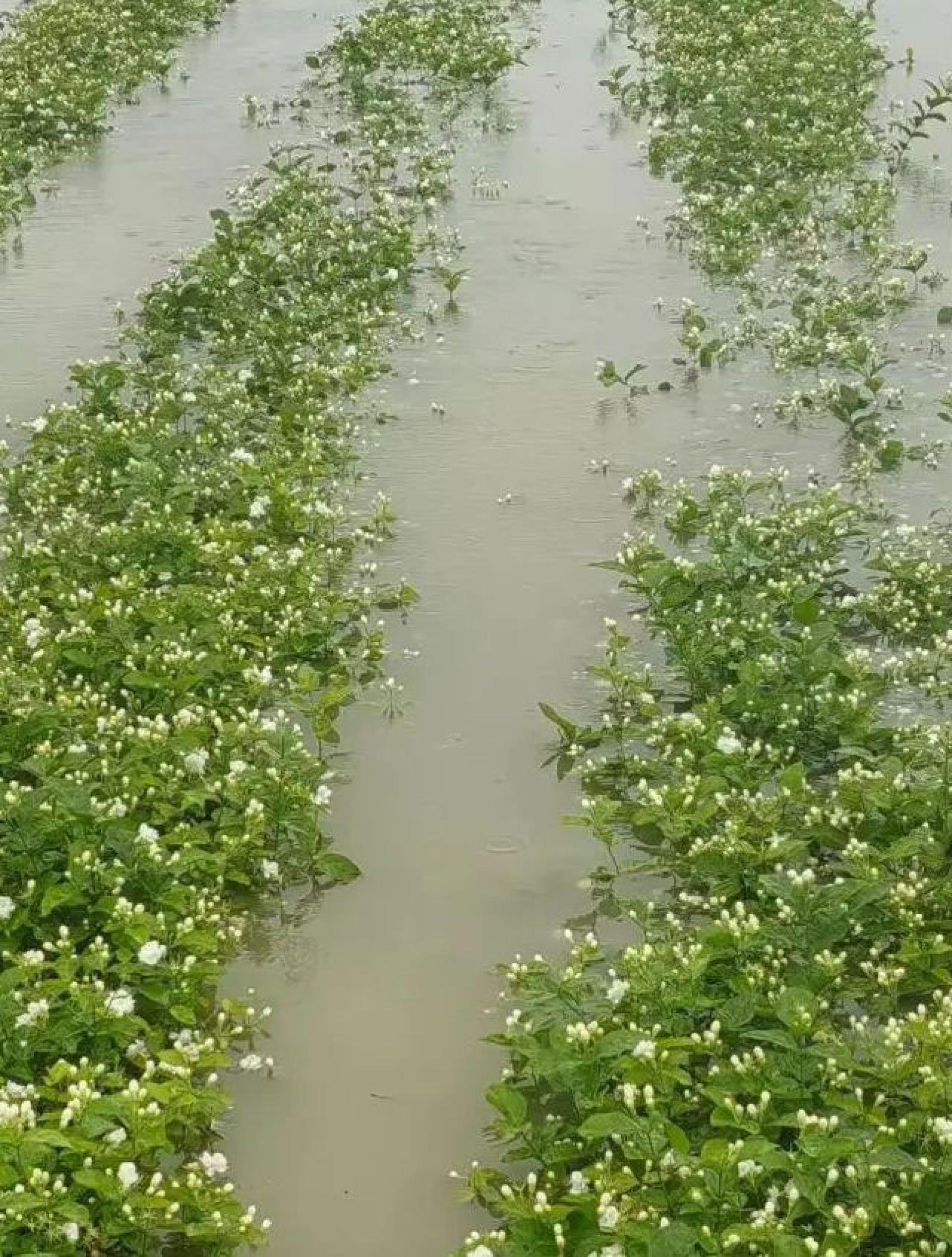
On July 7, a huge breach appeared at the dam mouth of Liulan Reservoir in Hengzhou City, Guangxi, sending floodwaters rushing toward downstream areas and causing heavy losses in the 'World's Jasmine Capital.'
Hengzhou is renowned as the 'World's Jasmine Capital,' with local fresh jasmine flowers and jasmine tea accounting for over 80% of the country's and more than 60% of the world's annual production.
“Nearly 80% of the local jasmine flowers in Hengzhou are independently operated by small farmers, with a small portion grown industrially by large-scale growers.” Meng Rongrong, a staff member at Hengzhou City Tourism Association’s Secretariat, who has worked in the jasmine flower industry for over a decade, roughly estimates that jasmine flowers in Yunbiao Town downstream of Liulan Reservoir are now priceless, with losses beyond calculation.
“If it weren’t raining this month, local farmers would be picking jasmine flowers for tea.” Meng Rongrong told Southern Weekly reporters.
“Out of every 10 jasmine flowers in the world, 6 come from here.” A local merchant engaged in the promotion of the jasmine flower industry near Liulan Village told Southern Weekly reporters the flood has inundated a large number of villages and flower fields in Hengzhou, which will directly impact jasmine production. “Once soaked in water, jasmine flowers are very likely to die.”
“The flowers definitely can’t be saved, and many tea factories are also underwater,” said Meng Rongrong. “It will take at least two or three months for jasmine flowers to return to their pre-flood cultivation levels.”
Meng Rongrong said, “Hengzhou farmers originally depended on jasmine flowers for their livelihood. Now, with their harvest badly affected and houses collapsed, it will be very hard for them to make a living.”