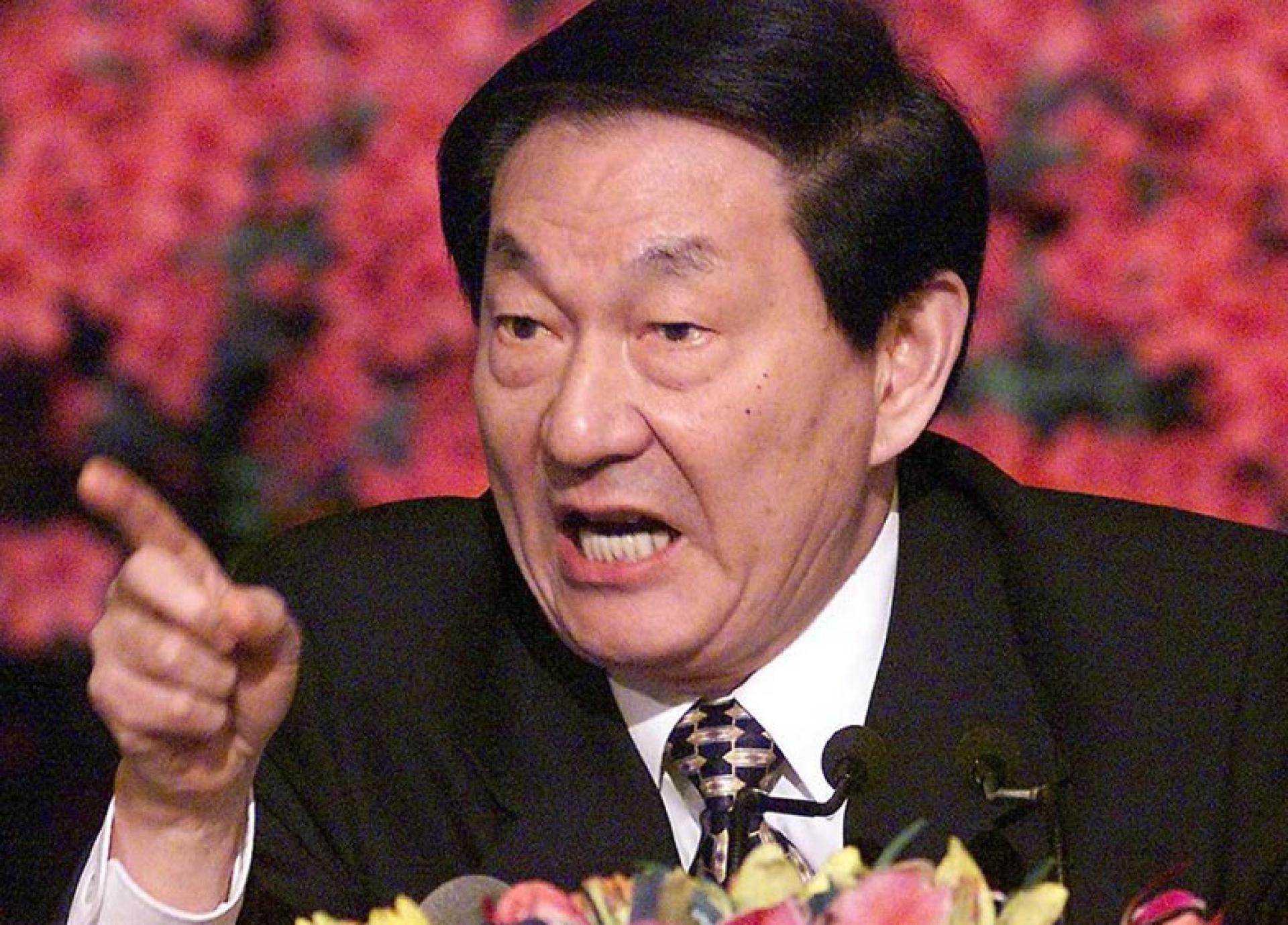
Zhu Rongji, who was always known for being outspoken, is best remembered in Taiwan for his stern warning against "Taiwan independence"—delivered with raised eyebrows and a heightened tone—just three days before Taiwan's first power transition in the 2000 presidential election.
On March 15, 2000, then Chinese Premier Zhu Rongji issued a warning to Taiwan regarding its upcoming election at the premier's press conference during China’s annual "Two Sessions." The threat led to a nearly 400-point drop in the Taiwanese stock market the next day, sparking strong backlash from both the Pan-Blue and Pan-Green camps.
During the press conference, a reporter from Singapore’s Lianhe Zaobao was given the chance to ask Zhu for his views on the DPP candidate Chen Shui-bian’s rise in popularity and momentum.
Zhu Rongji first paused deliberately, then raised his right hand, pointed his index finger skyward, and said slowly: "Taiwan's election is a local election and is the affair of the Taiwanese people themselves. I don't wish to interfere, but we must make it clear: no matter who takes office, Taiwan independence is absolutely unacceptable."
He declared at the time that any form of Taiwan independence would not be permitted, "This is our bottom line," and it is also the heartfelt sentiment of 1.25 billion Chinese people. He said China would never commit to renouncing the use of force for unification: "Whoever supports the One-China principle, we support them. Whoever seeks Taiwan independence, you will not meet a good end."
Zhu Rongji pointed out that after the Opium War of 1840, China's modern history had been one of humiliation and bullying at the hands of foreign invaders. Taiwan too was for many years under the rule and occupation of Japanese militarists. Looking back, China was impoverished and weak, yet still rallied to the call, "Arise, ye who refuse to be slaves," and bravely fought on, wave after wave.
"When the war of resistance erupted in full, I was only nine years old. The songs of national salvation—I still remember them vividly. Whenever I sing those songs, tears come to my eyes and I am filled with the resolve to serve my country with utter devotion and courage."
Zhu Rongji said: "Today the Chinese people have stood up. Can we allow Taiwan, which has always been part of China’s territory, to split away from the motherland? Absolutely not!"
The 2000 presidential election was fiercely contested, with DPP candidate Chen Shui-bian and independent candidate James Soong neck and neck. Though Zhu Rongji’s threats were intended to sway Taiwanese voters, Chen Shui-bian ultimately edged out a narrow victory—by less than three percentage points—to take the presidency from the Kuomintang for the first time.
Zhu Rongji's remarks are now regarded as a "failed intervention" by the Chinese Communist Party to influence Taiwan’s elections. Thereafter, Beijing became more wary of using military intimidation to sway Taiwanese public opinion, and became more restrained in comments about Taiwan's elections.