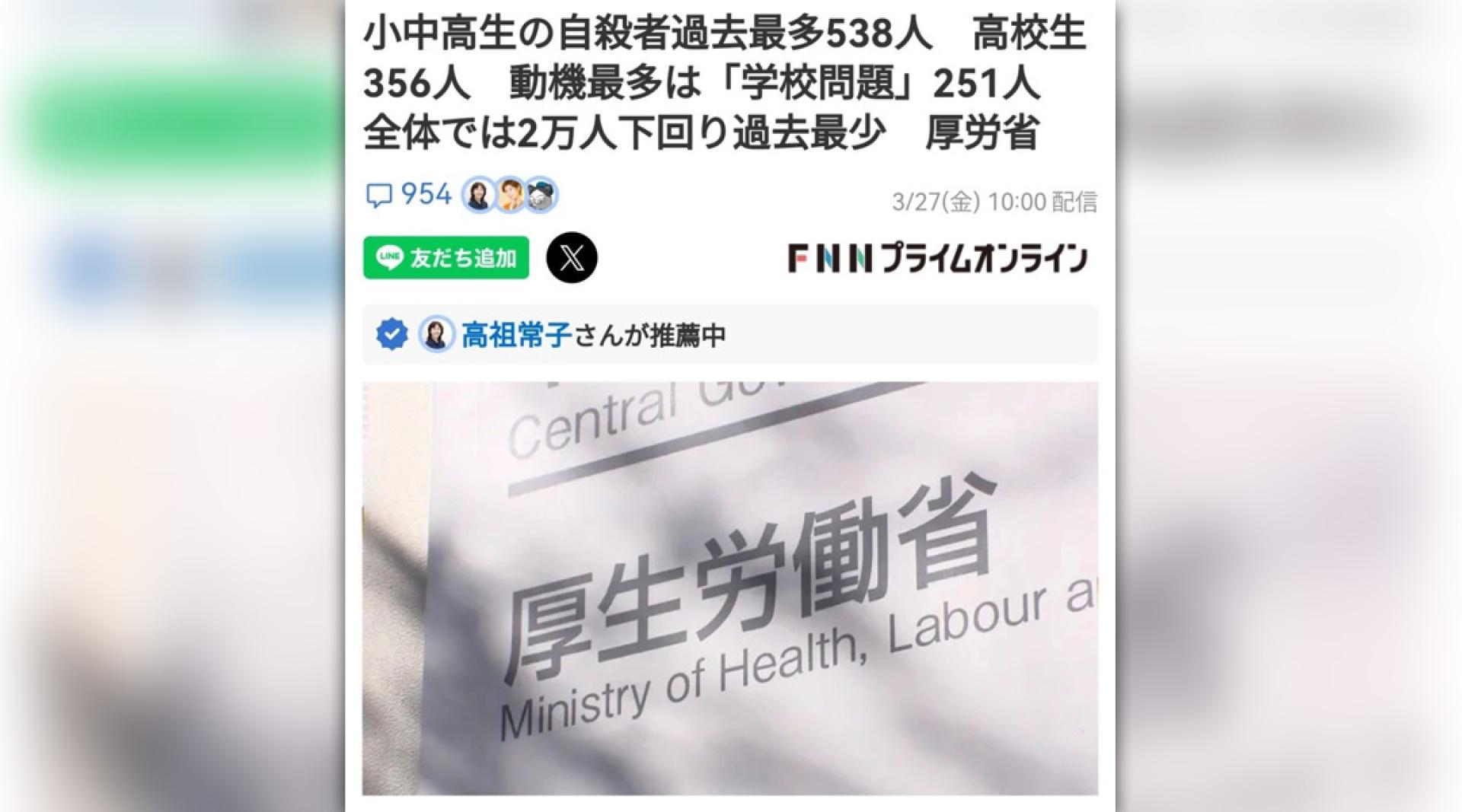
The Japanese Ministry of Health, Labour and Welfare has published the 2025 suicide statistics, revealing a distressing and stark contrast: for the first time ever, the total number of suicides nationwide has fallen below 20,000, reaching 19,188 people—a decrease of 1,132 from the previous year and a historic low since statistics began in 1978. However, the number of suicides among primary and secondary students has instead soared against this trend, setting a new all-time high.
According to the data, in 2025, a total of 538 elementary, junior high, and high school students in Japan died by suicide—9 more than the previous year and marking the second consecutive year at record levels. The breakdown includes 10 elementary schoolers, 172 middle schoolers, and as many as 356 high schoolers, accounting for more than 60% of the toll. Delving into the motives, school-related problems top the list with 251 cases, with academic pressure and bullying being the main triggers; health issues and family problems follow with 174 and 147 cases respectively. Among female high school students, there were 179 suicides—most suffering from depression and other mental health issues.
In the face of the grim trend of rising youth suicide rates, Japan’s Children and Family Agency has announced stronger intervention measures. Starting in April, they will coordinate with schools and medical institutions to build a dedicated support system for children who have attempted suicide. Additionally, there are plans to leverage AI technology to screen at-risk minors by analyzing online search records.
Industry experts and the public widely reflect that, since the popularization of smartphones and social platforms, minors are constantly immersed in environments of evaluation and comparison, with nowhere to release psychological pressure. The current school system has also shown signs of fatigue. It is urgently necessary to change the single-minded emphasis on hard work in education and to convey to children an inclusive attitude that seeking help and taking breaks is completely acceptable—thus building a psychological safety net for youths.