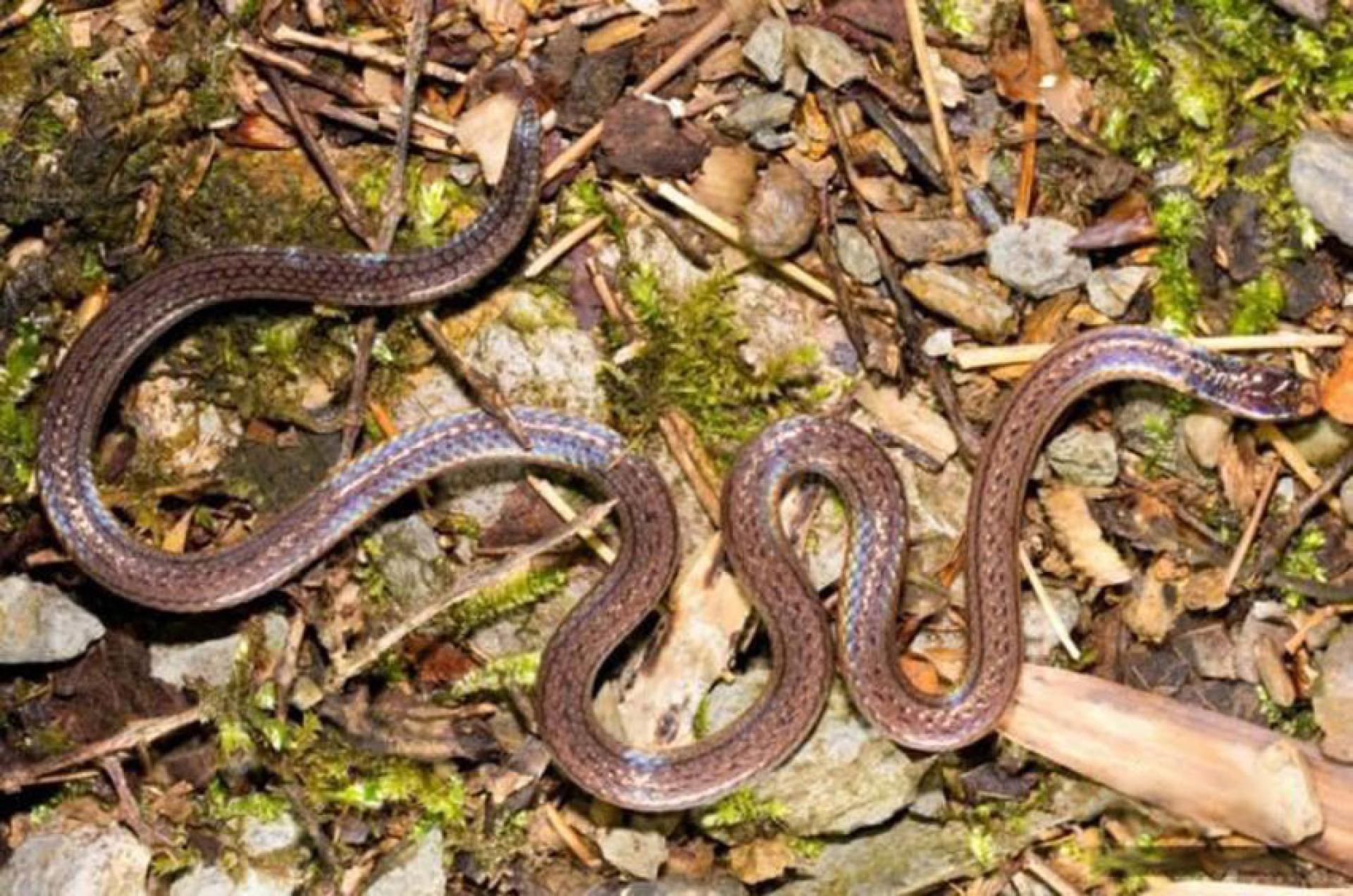
The forestry department of Guangxi introduced on Wednesday that a new species of the genus Pareas (two-headed snakes) in the Pareidae family—named the Guangxi two-headed snake—was recently discovered in the Huaping National Nature Reserve in Guangxi. The discovery has been published in an international zoological taxonomy journal.
This new species was found as part of a comprehensive scientific survey of amphibian and reptile resources in the Huaping Reserve. During a field investigation carried out by a research team from Guangxi Natural Museum in the broad-leaved forest belt at about 760 meters above sea level near the Yinshan Management Station of the reserve, a small, non-venomous snake was unexpectedly captured.
According to the research team, the Guangxi two-headed snake has a slender body, with adults reaching only about 22 centimeters in length. Its back is brownish with seven broken dark longitudinal stripes. The deep-toned halos along the edges of its scales form a distinctive net-like pattern, making it highly recognizable in appearance. As a typical semi-fossorial snake, it moves slowly and is gentle by nature, non-venomous, and non-aggressive. It prefers to rest during the day and become active at night, often hiding under layers of fallen leaves, humus, or among stones, and mainly feeds on earthworms and insect larvae.
Its most distinctive behavior is that when startled, it coils its body into a figure-eight shape or raises its blunt, rounded tail to mimic a head—hence the name “two-headed snake”.
This discovery not only enriches China’s list of amphibian and reptile species, providing crucial material for the phylogenetic study of the genus Pareas, but also underscores the importance of the Huaping Reserve in biodiversity conservation, highlighting the unique charm of the northern Guangxi primeval forest as a "gene bank of species."