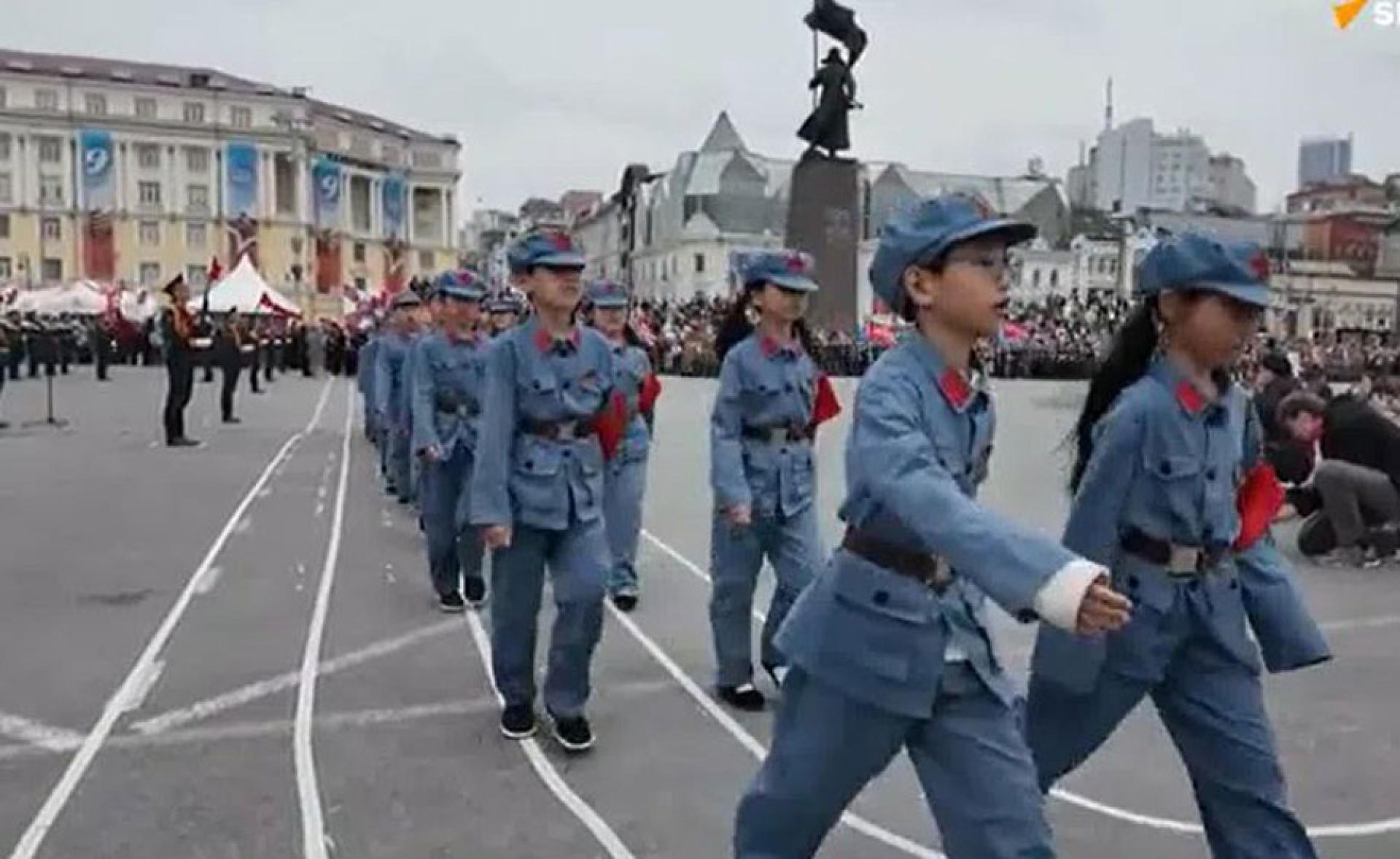
Chinese elementary school students participated in Russia's Vladivostok (Haishenwai) parade marking the 81st anniversary of WWII victory, sparking controversy among Chinese netizens.
Last Sunday (3rd), Vladivostok celebrated the 81st anniversary of World War II victory with an international children's parade. Russian media video footage showed Chinese elementary students dressed in imitation Eighth Route Army uniforms, marching in two columns across the square. Wu Demin, the Chinese Consul General in Vladivostok, attended the event.
Some netizens criticized the move as forgetting the humiliation of history and questioned the educational approach: “Letting children who don’t understand participate—how should history lessons be taught?” Others believe this is an appropriate international commemorative event, as the theme is anti-fascism and a joint celebration of victory by WWII allies.
Experts pointed out that such activities stimulate public sentiment regarding Sino-Russian territorial history, but the authorities are more focused on opposing Japan's new militarism.
Vladivostok, known as Haishenwai, was Chinese territory during the Qing Dynasty. The 1860 “Sino-Russian Beijing Treaty” ceded this area, along with the region east of the Ussuri River, to the then Russian Empire.
In July 2020, the Russian Embassy in China published a post on its official Weibo to commemorate the “160th anniversary of Vladivostok’s founding,” noting that the Chinese meaning of “Vladivostok” is “to rule the East.” This sparked backlash among Chinese netizens, who accused it of offending the feelings of the Chinese people.
Wang Yiwei, Director of the Institute for International Affairs at Renmin University of China, said in an interview that the Russian Empire's aggression against China is a historical memory, but during WWII the two countries were allies. This contradiction between national sentiment and present-day strategic interests has caused the controversy.