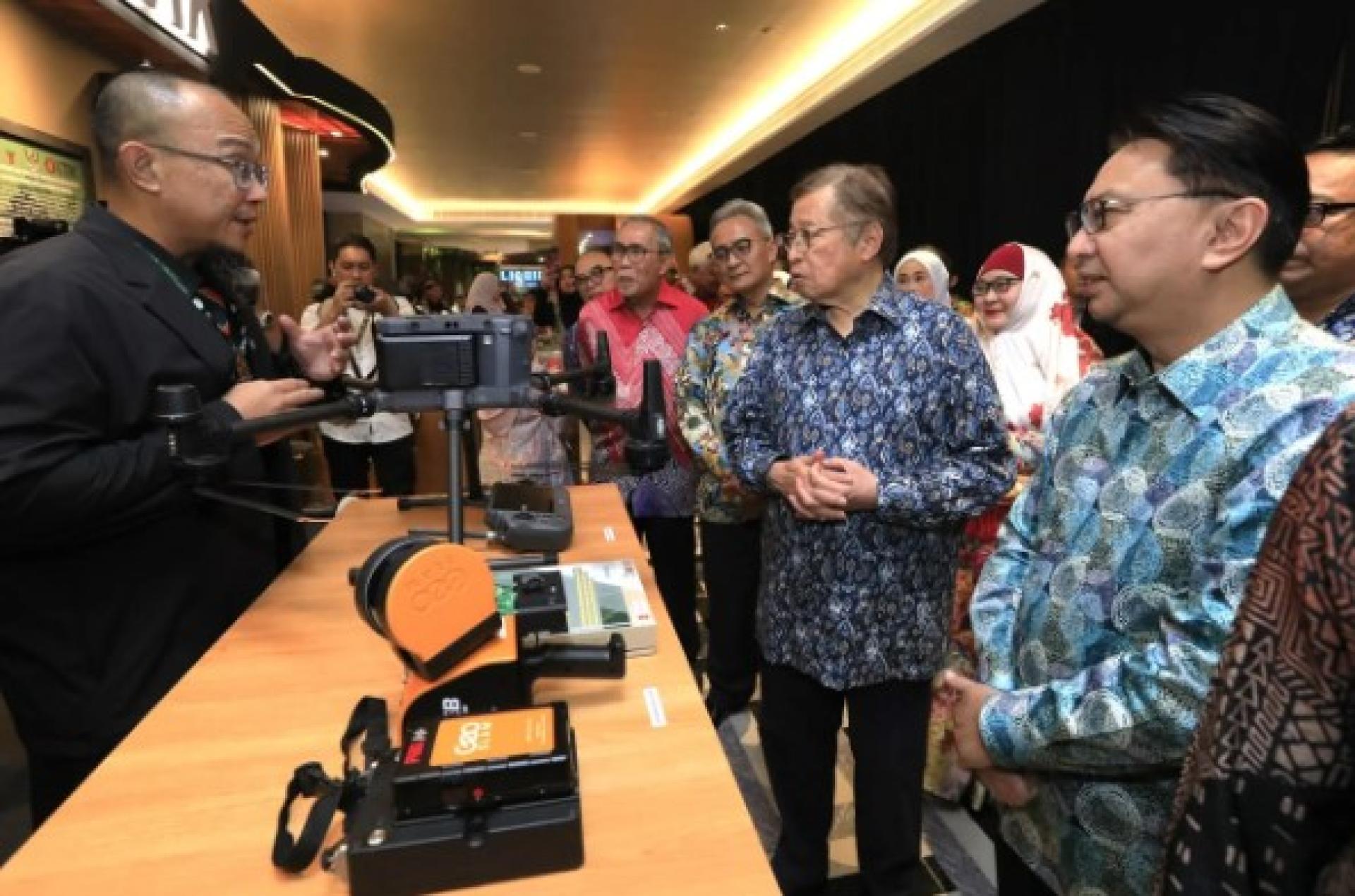
(Kuching, 14th) The Sarawak government is committed to promoting sustainable economic development, achieving economic growth without sacrificing environmental ecology, and aims to make Sarawak a model in the global field of climate change response.
Sarawak Premier Tan Sri Abang Johari stated that this effort is very important because Sarawak’s sustainable development approach focuses on protecting biodiversity while creating new economic opportunities that do not harm the environment.
“The world is currently facing various climate change challenges. Therefore, we must look for solutions to reduce carbon emissions and replace traditional methods with scientific approaches to enhance oxygen production.
“While you are discussing these topics at the conference, some European countries are experiencing extreme heat waves and some Asian countries are facing storms and floods. This is exactly the situation the world is now facing.”
He said this last night while delivering his speech at the opening ceremony of the 21st Malaysian Forestry Conference 2026 held at Pullman Hotel Kuching.
Abang Johari further pointed out that the Sarawak government has also launched the Post Covid-19 Development Strategy 2030 (PCDS 2030), which is based on three main pillars: social inclusivity, economic prosperity, and environmental sustainability.
He said that the issue of climate change is indeed very complex, but Sarawak has unique advantages as the state is located in the equatorial region, with ample sunlight, abundant water resources and a variety of natural resources, all of which can create higher added value for the community.
“All these resources must be managed with caution and in a sustainable way to ensure that economic development can be advanced in tandem with environmental protection.”
Therefore, he said, the Sarawak government also attaches great importance to scientific research in order to uncover new value from Sarawak’s natural resources, no longer limited to the traditional timber production model.
He said that the projects currently being explored include the production of Sustainable Aviation Fuel (SAF) using local bio-resources, as well as searching for medically valuable compounds from Sarawak’s forest reserves.
Abang Johari revealed that the sustainable development initiatives promoted by Sarawak have gradually attracted international attention. At present, Sarawak has been invited to share related experience at international forums held in Bangkok, Paris, India, and several European countries.
“The world is currently facing various climate change challenges. Therefore, we must look for solutions to reduce carbon emissions and replace traditional methods with scientific approaches to enhance oxygen production.
“While you are discussing these topics at the conference, some European countries are experiencing extreme heat waves and some Asian countries are facing storms and floods. This is exactly the situation the world is now facing.”
He said this last night while delivering his speech at the opening ceremony of the 21st Malaysian Forestry Conference 2026 held at Pullman Hotel Kuching.
Abang Johari further pointed out that the Sarawak government has also launched the Post Covid-19 Development Strategy 2030 (PCDS 2030), which is based on three main pillars: social inclusivity, economic prosperity, and environmental sustainability.
He said that the issue of climate change is indeed very complex, but Sarawak has unique advantages as the state is located in the equatorial region, with ample sunlight, abundant water resources and a variety of natural resources, all of which can create higher added value for the community.
“All these resources must be managed with caution and in a sustainable way to ensure that economic development can be advanced in tandem with environmental protection.”
Therefore, he said, the Sarawak government also attaches great importance to scientific research in order to uncover new value from Sarawak’s natural resources, no longer limited to the traditional timber production model.
He said that the projects currently being explored include the production of Sustainable Aviation Fuel (SAF) using local bio-resources, as well as searching for medically valuable compounds from Sarawak’s forest reserves.
Abang Johari revealed that the sustainable development initiatives promoted by Sarawak have gradually attracted international attention. At present, Sarawak has been invited to share related experience at international forums held in Bangkok, Paris, India, and several European countries.