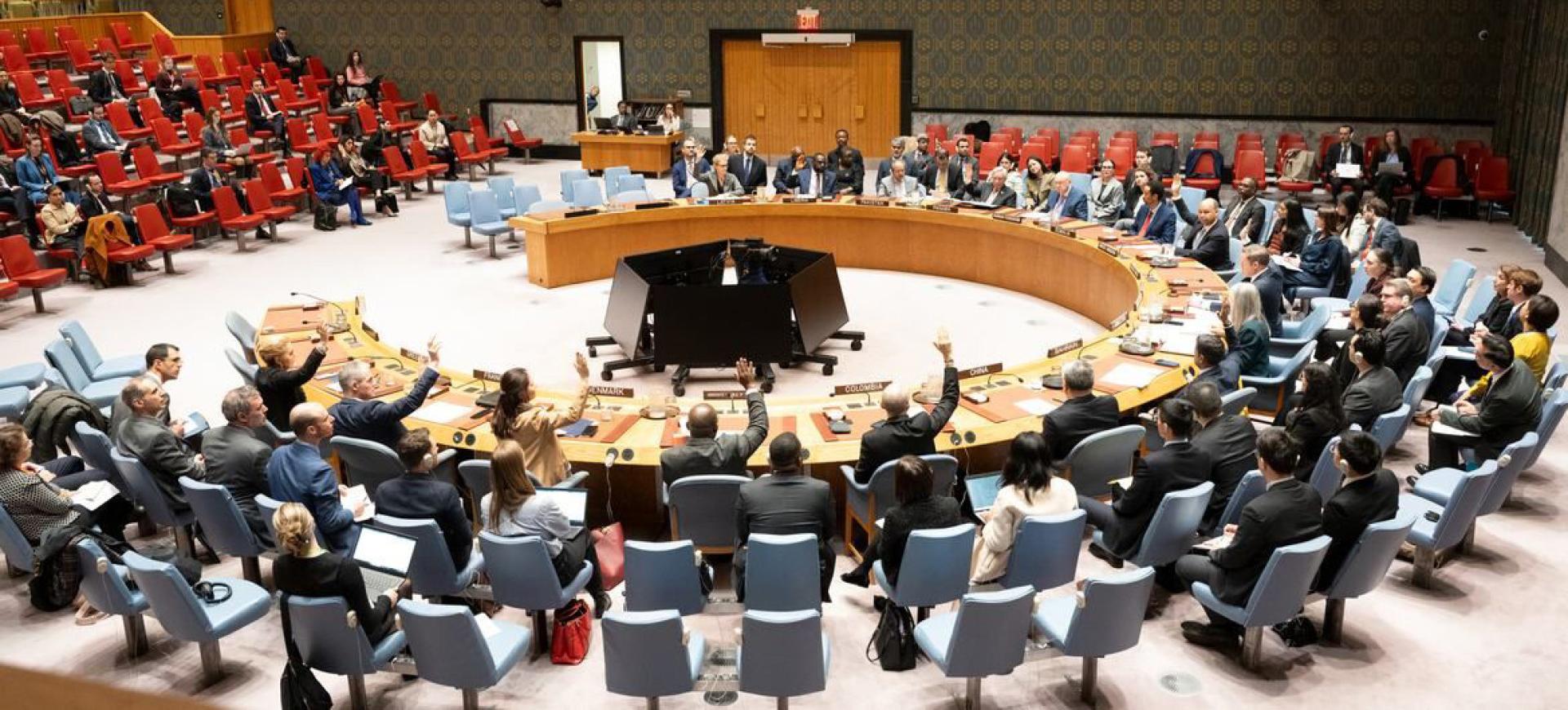
Amid ongoing tensions in the Middle East, the Security Council held a meeting on the 12th to discuss Iran's nuclear program. Russia and China questioned the legitimacy of United Nations sanctions against Iran under the ‘snapback’ mechanism.
At the beginning of the meeting, the Russian and Chinese representatives opposed holding the meeting, arguing that the ‘snapback’ mechanism had not been activated, while France, the United Kingdom, and the United States insisted that this mechanism had in fact been triggered, and sanctions had thus been reinstated.
The Security Council subsequently decided to continue the meeting with a vote of 11 in favor, 2 against (China and Russia), and 2 abstentions (Pakistan and Somalia). On procedural matters, the Security Council requires only a simple majority of nine members, and the veto power of the permanent members does not apply.
US Ambassador to the United Nations, Linda Thomas-Greenfield, stated in her remarks: “Today’s meeting should have been a straightforward routine meeting within the scope of the responsibilities of the 1737 Committee.”
The 15-member 1737 Committee was established under Security Council Resolution 1737 adopted in 2006. It is responsible for overseeing the implementation of sanctions measures against Iran and reports its work to the Security Council every 90 days.
She said: “Regrettably, our colleagues from China and Russia continue to obstruct the work of the Committee.”
She pointed out that on September 19, 2025, the Security Council vetoed the draft resolution to extend Iran’s sanctions exemption, resulting in the automatic resumption of the UN sanctions mechanism. All UN member states should now implement the arms embargo on Iran, prohibit missile technology trade, and freeze financial assets.
Thomas-Greenfield accused China and Russia of not wanting the sanctions committee to function normally, “because they want to protect their partner—Iran—and continue to maintain the currently re-prohibited defense cooperation.”
The Iran Nuclear Crisis Was Triggered By The US Unilaterally Withdrawing From The Deal
Chinese Ambassador to the UN, Fu Cong, pointed out that the United States, the United Kingdom, France, and Germany have long been in violation of the Iran nuclear deal and Resolution 2231, and have lost the right to trigger the snapback of sanctions.
He noted that it was the United States’ unilateral withdrawal from the Joint Comprehensive Plan of Action (JCPOA) that triggered the Iran nuclear crisis. The United States even, before the recent nuclear negotiations concluded, took aggressive military action together with Israel.
He strongly condemned this conduct and urged the United States to immediately reverse its course of action and commit to achieving a negotiated solution consistent with the expectations of the international community.