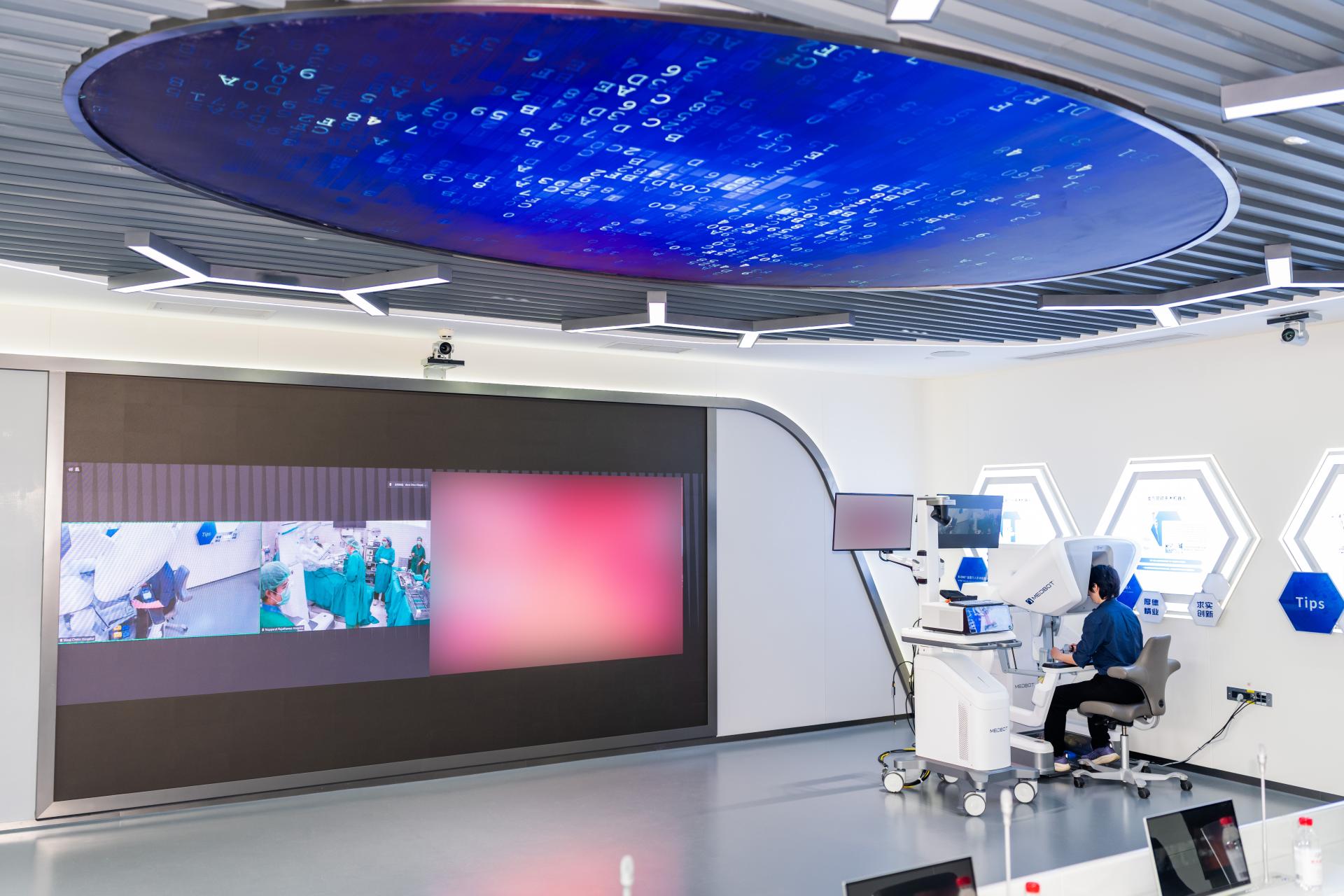
(Chengdu, 22nd, Comprehensive Report) Medical cooperation between China and Thailand has achieved another breakthrough. In Chengdu, Sichuan, doctors utilized 5G communication technology to remotely control a surgical robot, performing surgery on a patient located in Thailand, thus completing the first China-Thailand remote robot-assisted hepatobiliary surgery.
This operation was a collaborative effort linking the team led by Dr. Wu Hong, Vice President of West China Hospital of Sichuan University and Director of the Liver Transplantation Center, and the team led by Dr. Narapong Suntarachai, Chief of General Surgery at Nopparat Rajathanee Hospital in Thailand.
The patient was a 51-year-old female from Thailand, suffering from persistent pain in the right upper abdomen caused by cholelithiasis, and also had underlying conditions such as hypertension, diabetes, and high cholesterol. After comprehensive evaluation by both the Chinese and Thai teams, a remote robotic surgical plan was chosen.
Dr. Wu Hong pointed out that remote robotic surgery places high demands on equipment stability, real-time data transmission, and team collaboration. Cross-border surgery also requires overcoming challenges such as language barriers, time differences, and network latency. During this operation, the 5G network provided stable support throughout, ensuring high-definition, smooth visuals and millisecond-level transmission of operational commands. The procedure was seamless, the patient’s vital signs remained stable, and the surgery was successfully completed.
He stated that the successful implementation of this remote robot-assisted cholecystectomy not only demonstrated the capability of China-made surgical robot systems in complex cross-border medical scenarios, but also established a new model for Southeast Asian patients to "enjoy high-quality medical services without leaving their home country."
It is understood that in recent years, West China Hospital of Sichuan University has been continuously deepening cooperation with ASEAN countries in medical technology, talent training, and telemedicine, promoting cross-border sharing of high-quality medical resources. In the future, the application scope of remote robotic surgery will be further expanded, and regional medical cooperation will be deepened.
The patient was a 51-year-old female from Thailand, suffering from persistent pain in the right upper abdomen caused by cholelithiasis, and also had underlying conditions such as hypertension, diabetes, and high cholesterol. After comprehensive evaluation by both the Chinese and Thai teams, a remote robotic surgical plan was chosen.
Dr. Wu Hong pointed out that remote robotic surgery places high demands on equipment stability, real-time data transmission, and team collaboration. Cross-border surgery also requires overcoming challenges such as language barriers, time differences, and network latency. During this operation, the 5G network provided stable support throughout, ensuring high-definition, smooth visuals and millisecond-level transmission of operational commands. The procedure was seamless, the patient’s vital signs remained stable, and the surgery was successfully completed.
He stated that the successful implementation of this remote robot-assisted cholecystectomy not only demonstrated the capability of China-made surgical robot systems in complex cross-border medical scenarios, but also established a new model for Southeast Asian patients to "enjoy high-quality medical services without leaving their home country."
It is understood that in recent years, West China Hospital of Sichuan University has been continuously deepening cooperation with ASEAN countries in medical technology, talent training, and telemedicine, promoting cross-border sharing of high-quality medical resources. In the future, the application scope of remote robotic surgery will be further expanded, and regional medical cooperation will be deepened.