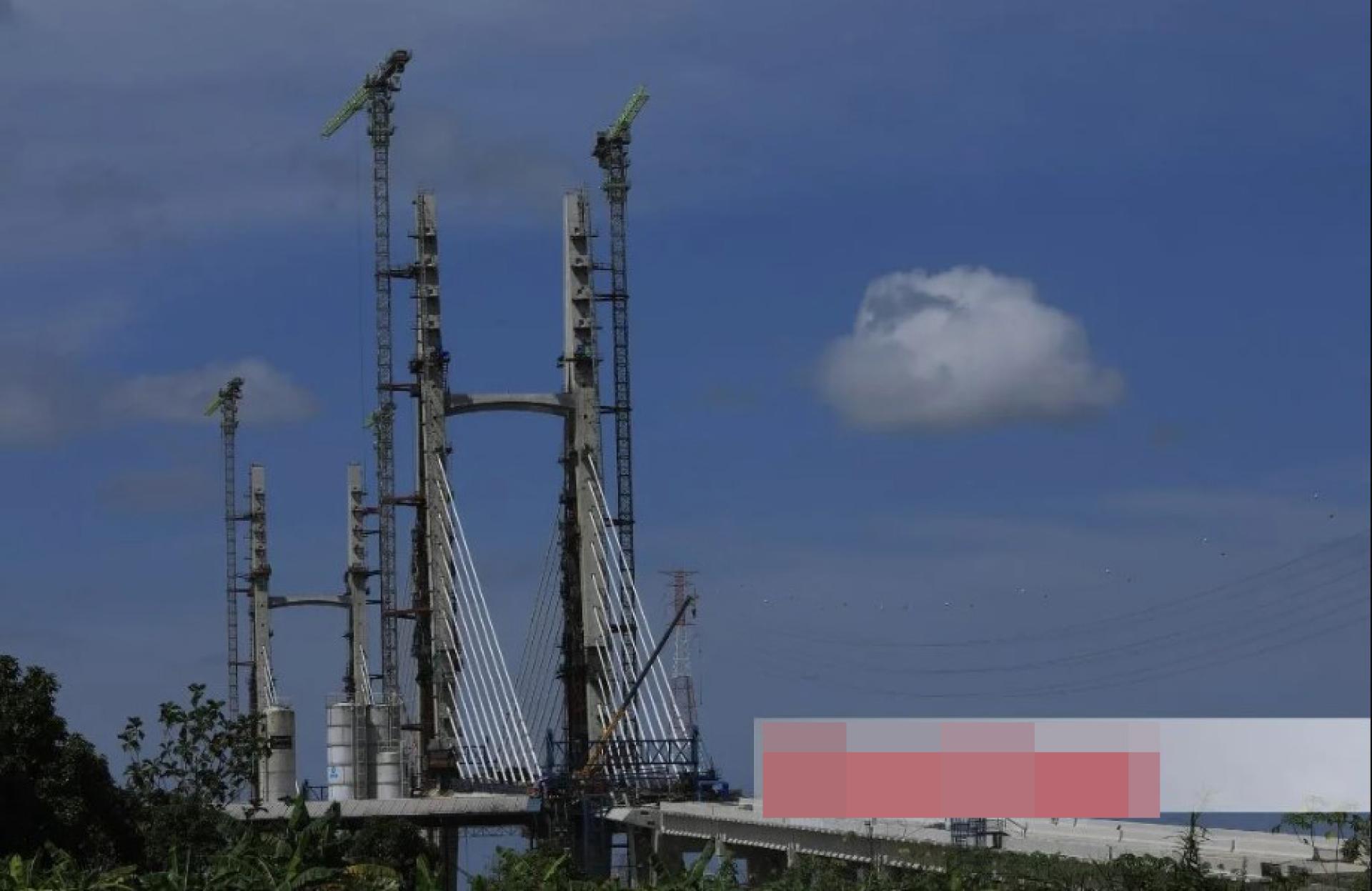
(Kuching, 22nd) With the RM360 million Samarahan–Asajaya Bridge expected to open as early as March this year, commuters traveling between Kota Samarahan, Asajaya, Sadong Jaya and Kuching, Petra Jaya, and Demak Laut will finally welcome long-awaited traffic relief.
This bridge, with a total length of 1.28 kilometers and a deck rising 26 meters above the Sarawak River, is currently over 80% complete. It is anticipated to become a crucial alternative route to ease the chronic peak-hour congestion along the Samarahan–Kuching corridor.
Local residents and business owners said the new bridge, together with the planned connecting roads, is likely to transform daily commuting patterns and improve the economic prospects of the Samarahan and Asajaya areas.
59-year-old Napri Sahari said he is looking forward to another route into the city, noting that with the ever-increasing number of vehicles, Samarahan's traffic congestion has worsened over the years.
He said, “There will finally be another way to get to Kuching. Many young people from Asajaya, Kampung Sambir, Kampung Tambirat, and Kampung Tambey work in the city. You can imagine how many cars pass through Samarahan every day.”
Napri also hopes the authorities will simultaneously improve road infrastructure beyond the bridge, suggesting that some sections be converted into two-way single-lane routes to address existing bottlenecks.
On the other hand, 38-year-old self-employed Lianny Bujang from Moyan said persistent traffic jams often force her to plan her schedule carefully when meeting clients in Asajaya.
She said, “I was once stuck in a traffic jam in Samarahan for two hours. Once the new bridge is open, I hope more drivers will use the alternative route so the main roads become smoother.”
Similarly, 38-year-old Anthea Thomas, a self-employed worker from Mile 12, pointed out that severe traffic congestion often discourages her from traveling between Samarahan and Kuching, even when there are job opportunities.
She said, “With more route choices, people won't have to rely on a single main road. Improved traffic will also bring more opportunities for industries such as insurance.”
In addition, 43-year-old Asajaya hawker Noorlizawati Kasbi said improved road accessibility will help local businesses expand beyond the area.
She said, “If you catch the wrong time, we may be stuck in a jam for up to two hours. If access conditions improve, it will be much easier to transport my prepared food out of Asajaya.” She added that better connectivity is also expected to attract more visitors.
Having operated a prawn noodle business in Asajaya for 12 years and employing 29 staff, Noorlizawati pointed out that Asajaya is often a stopover point for coastal route drivers and hopes the new bridge will further boost visitor flow and local economic activities.
Overall, residents are generally looking forward to the completion of the Samarahan–Asajaya Bridge, hoping it will not only relieve daily commuting pressures but also promote more balanced development between the city and coastal areas, enhancing connectivity, accessibility, and economic opportunities along the corridor communities.
This bridge, with a total length of 1.28 kilometers and a deck rising 26 meters above the Sarawak River, is currently over 80% complete. It is anticipated to become a crucial alternative route to ease the chronic peak-hour congestion along the Samarahan–Kuching corridor.
Local residents and business owners said the new bridge, together with the planned connecting roads, is likely to transform daily commuting patterns and improve the economic prospects of the Samarahan and Asajaya areas.
He said, “There will finally be another way to get to Kuching. Many young people from Asajaya, Kampung Sambir, Kampung Tambirat, and Kampung Tambey work in the city. You can imagine how many cars pass through Samarahan every day.”
Napri also hopes the authorities will simultaneously improve road infrastructure beyond the bridge, suggesting that some sections be converted into two-way single-lane routes to address existing bottlenecks.
On the other hand, 38-year-old self-employed Lianny Bujang from Moyan said persistent traffic jams often force her to plan her schedule carefully when meeting clients in Asajaya.
She said, “I was once stuck in a traffic jam in Samarahan for two hours. Once the new bridge is open, I hope more drivers will use the alternative route so the main roads become smoother.”
Similarly, 38-year-old Anthea Thomas, a self-employed worker from Mile 12, pointed out that severe traffic congestion often discourages her from traveling between Samarahan and Kuching, even when there are job opportunities.
She said, “With more route choices, people won't have to rely on a single main road. Improved traffic will also bring more opportunities for industries such as insurance.”
In addition, 43-year-old Asajaya hawker Noorlizawati Kasbi said improved road accessibility will help local businesses expand beyond the area.
She said, “If you catch the wrong time, we may be stuck in a jam for up to two hours. If access conditions improve, it will be much easier to transport my prepared food out of Asajaya.” She added that better connectivity is also expected to attract more visitors.
Having operated a prawn noodle business in Asajaya for 12 years and employing 29 staff, Noorlizawati pointed out that Asajaya is often a stopover point for coastal route drivers and hopes the new bridge will further boost visitor flow and local economic activities.
Overall, residents are generally looking forward to the completion of the Samarahan–Asajaya Bridge, hoping it will not only relieve daily commuting pressures but also promote more balanced development between the city and coastal areas, enhancing connectivity, accessibility, and economic opportunities along the corridor communities.