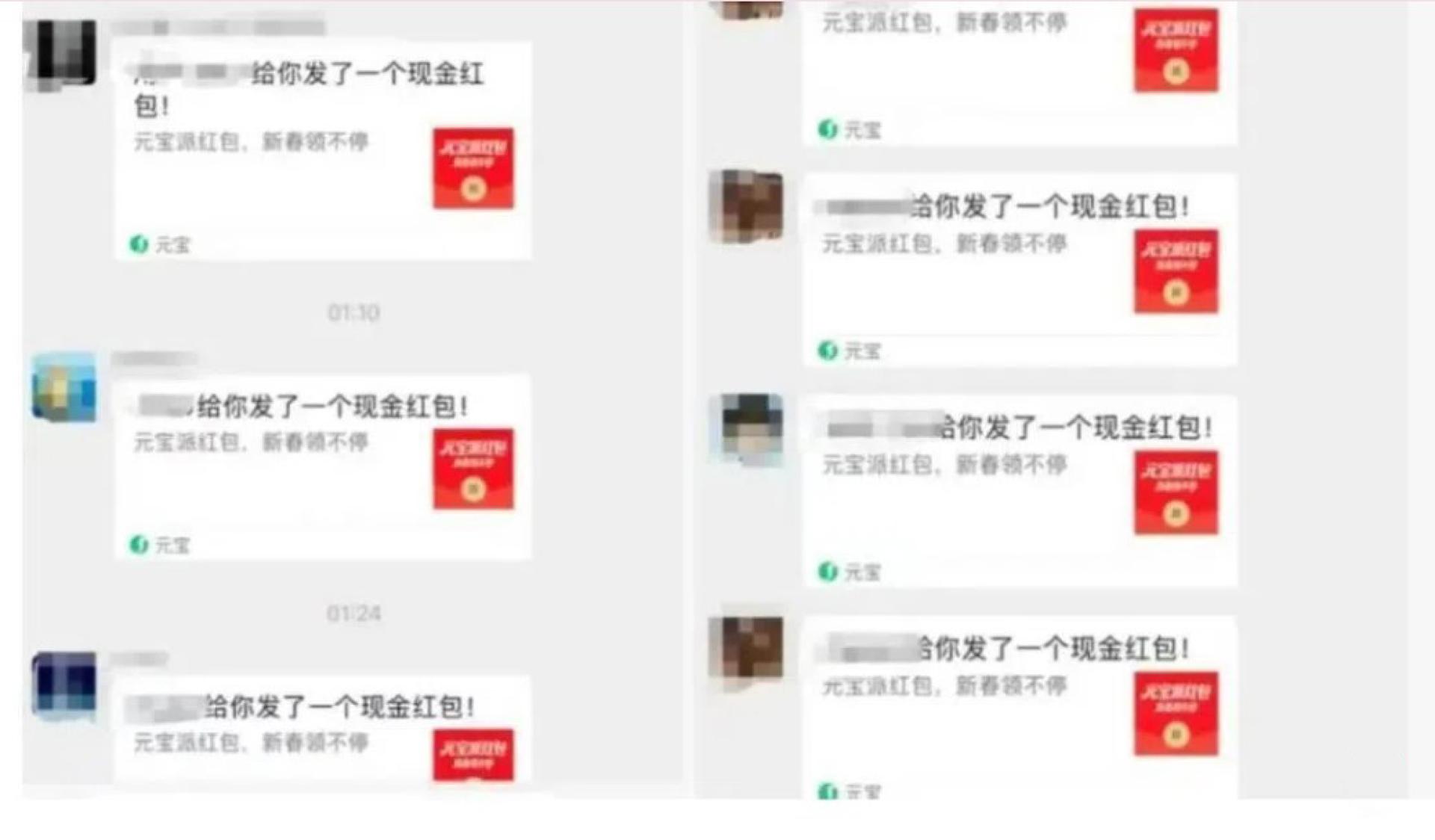
Chinese tech giants Tencent and Baidu, which have been seen by outsiders as falling behind in the competition over artificial intelligence (AI) products, have taken the lead in launching a Chinese New Year red packet battle. They are attempting to replicate the traffic-grabbing strategy from 11 years ago, when WeChat Pay used the red packet feature to take on Alipay. Once again, WeChat groups are awash with red packet fever, but the public’s opinion is sharply divided.
According to reports from China Securities Journal, Jiefang Daily, and Red Star News, Tencent’s AI app “Yuanbao” kicked off its 1 billion yuan (RMB, about 183 million SGD) Chinese New Year red packet campaign on Sunday (February 1). Early that morning, “Yuanbao Red Packet” links were flooding all major WeChat groups. In the Apple App Store free app rankings, Yuanbao quickly surpassed ByteDance’s competing product “Doubao,” rising to first place.
According to the reports, after downloading Yuanbao, users must grant permission to link their WeChat account. In addition to regular cash rewards, Yuanbao has introduced a “sharing red packet,” allowing users to forward it to Tencent’s communication apps WeChat, QQ, etc., clearly aiming to grab more traffic.
Tencent announced the Yuanbao red packet event on January 25th. Founder Pony Ma has high hopes for this, declaring at Tencent’s annual meeting that he hopes Yuanbao can revive the prosperity of WeChat red packets from 11 years ago.
Tencent announced the Yuanbao red packet event on January 25th. Founder Pony Ma has high hopes for this, declaring at Tencent’s annual meeting that he hopes Yuanbao can revive the prosperity of WeChat red packets from 11 years ago.
During the 2015 Chinese New Year, Tencent distributed 500 million yuan in red packets via WeChat’s “Shake” feature. Data shows that 20 million users participated on New Year’s Eve, sending and receiving over 1 billion red packets. In just three months, 200 million bank cards were linked, breaking Alibaba’s Alipay’s previous dominance in China’s payment market.
Baidu’s AI product, Wenxin Assistant, also announced its entry into the “red packet war” on January 25th. Users in Baidu who use Wenxin Assistant have the opportunity to share 500 million yuan in cash red packets, with the campaign running from January 26 to March 12.
Currently, Doubao is the hottest AI app in China, with monthly active users reaching 163 million. Alibaba’s AI product Qianwen has also achieved 100 million monthly actives. Meanwhile, Tencent and Baidu are seen as falling behind in the AI race.
Baidu’s AI product, Wenxin Assistant, also announced its entry into the “red packet war” on January 25th. Users in Baidu who use Wenxin Assistant have the opportunity to share 500 million yuan in cash red packets, with the campaign running from January 26 to March 12.
Currently, Doubao is the hottest AI app in China, with monthly active users reaching 163 million. Alibaba’s AI product Qianwen has also achieved 100 million monthly actives. Meanwhile, Tencent and Baidu are seen as falling behind in the AI race.
According to Caijing Tianxia, ByteDance’s Volcano Engine recently announced it will be the exclusive AI cloud partner for CCTV’s Spring Festival Gala, and Doubao will serve as the core AI interactive platform, providing a variety of features. With Doubao “on the Spring Festival Gala,” the gap between the parties may continue to widen.
Zhong Junhao, secretary general of Shanghai Artificial Intelligence Industry Association, told Jiefang Daily that promoting red packets during Chinese New Year follows the same growth model as the mobile internet era. However, for AI apps, a one-off influx from red packets isn’t enough; normally, users need deep task interactions to develop habits. Otherwise, the huge investment in red packets may only produce a quickly disappearing batch of “zombie users.”
NetEase Technology also published an article stating that this lavish campaign faces the tough challenge of “easy traffic gains, difficult user retention.” “Is this Tencent’s ticket to the AI era, or will it turn out to be the next short-lived ‘Weishi-style’ frenzy?”
WeChat is an example of Tencent losing out in the short video race against Douyin by “throwing money” and failing. Before and after the 2018 Chinese New Year, Weishi invested heavily, invited over 50 celebrities to send video New Year’s greetings to attract users, and connected the WeChat and QQ social networks, boosting daily active users to 45 million at one point. In the end, however, these users did not stick around.
The article says Chinese public opinion about the Yuanbao red packet campaign has gradually polarized. Many users passionately participate, sharing links and completing tasks to earn cash rewards; at the same time, critics point out that while WeChat has long cracked down harshly on incentivized sharing links, it is making an exception for Yuanbao, and this “guarding and stealing at the same time” has directly worsened the WeChat group environment.
According to reports, due to information overload caused by massive numbers of red packet links, some group owners have begun collectively resisting Yuanbao, even instituting group rules such as “post a Yuanbao link and you’ll be kicked from the group.”
China Securities Journal quoted Citigroup's latest research report as saying this red packet war is not just a simple Chinese New Year promotion, but more like an important test for AI assistants advancing toward mass adoption in China. “This is the first nationwide, true-user-density stress test. Whether high daily actives and high frequency can be maintained after the holiday will become the watershed distinguishing between tool-type and platform-level AI.”