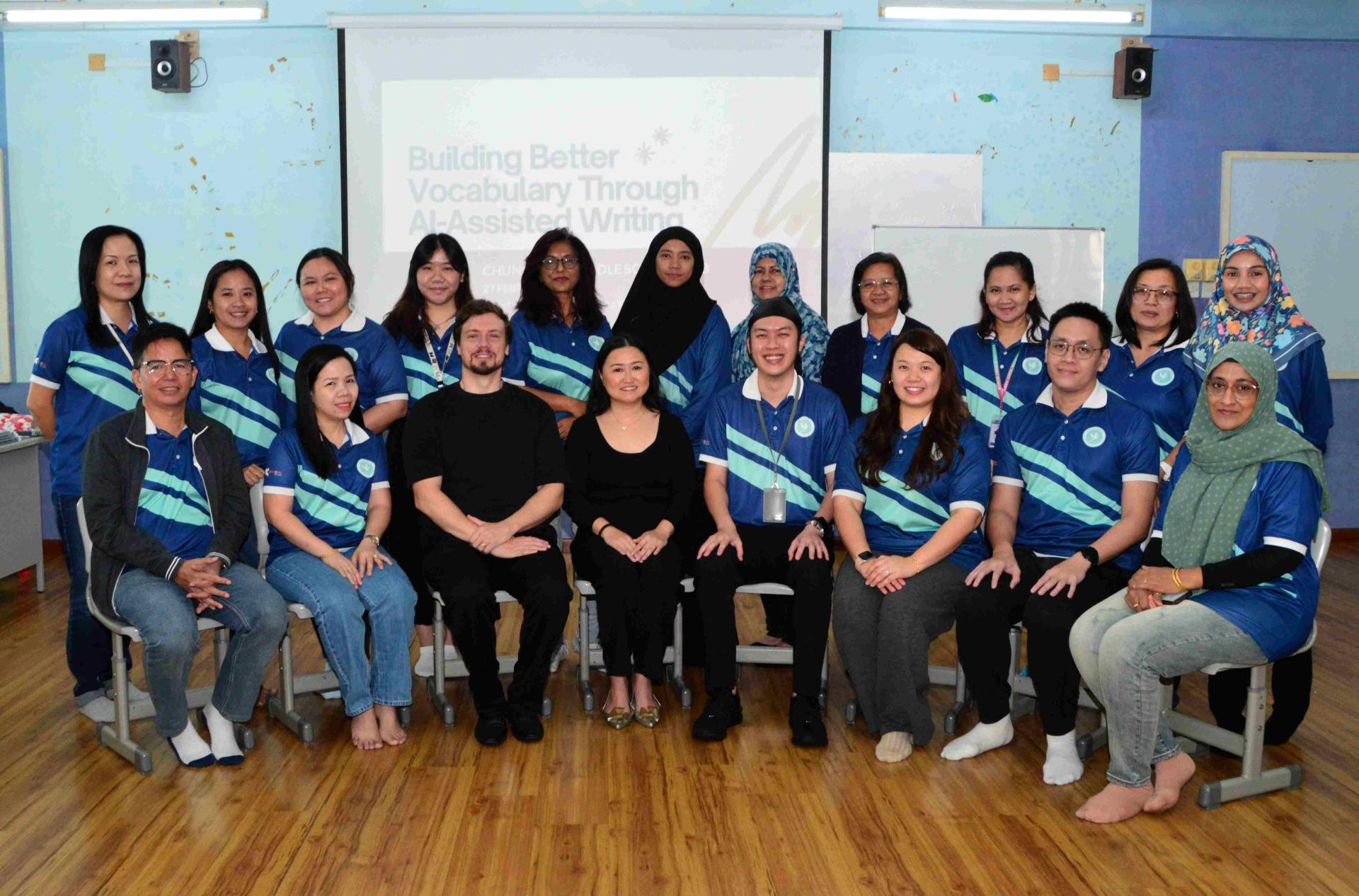
(Bandar Seri Begawan, 3rd) The English Department of Chung Hwa Middle School, Brunei, recently held a successful professional development workshop titled “Enhancing Vocabulary Skills through AI-Assisted Writing.” The session was led by English and Drama teacher, Senior Literacy Mentor, and Education Officer Ms. Guan Pei Yin.
The workshop took place on Friday, February 27th, and aimed to address common issues found in student writing, such as limited vocabulary, repetition, and vague expressions. The speaker pointed out that research shows vocabulary proficiency is a key predictor of writing quality, and that effective vocabulary development requires repeated use in authentic contexts rather than simple memorization.
During the event, teachers had hands-on experience with teaching strategies such as “Word Gradient” and the “Frayer Model” to deepen students’ understanding of word meanings. The workshop also explored how to effectively use AI tools like ChatGPT as “thinking partners” and real-time feedback tools, while emphasizing that AI should assist teaching—not replace the teacher’s role.
In addition, the speaker shared classroom research results involving twelve Year 10 IGCSE ESL students. The research showed that after introducing ChatGPT-assisted writing exercises, students demonstrated greater vocabulary diversity as well as increased motivation and confidence in writing. Participating teachers from Chung Hwa also discussed concerns such as over-reliance on AI, answer accuracy, and academic integrity, emphasizing the necessity of clear guidelines and teacher supervision when using related tools.
The workshop concluded with practical lesson planning, where teachers designed classroom activities integrating pre-teaching of vocabulary, offline writing drafts, and structured AI application—demonstrating the English Department’s ongoing commitment to teaching innovation and responsible use of technology.
During the event, teachers had hands-on experience with teaching strategies such as “Word Gradient” and the “Frayer Model” to deepen students’ understanding of word meanings. The workshop also explored how to effectively use AI tools like ChatGPT as “thinking partners” and real-time feedback tools, while emphasizing that AI should assist teaching—not replace the teacher’s role.
In addition, the speaker shared classroom research results involving twelve Year 10 IGCSE ESL students. The research showed that after introducing ChatGPT-assisted writing exercises, students demonstrated greater vocabulary diversity as well as increased motivation and confidence in writing. Participating teachers from Chung Hwa also discussed concerns such as over-reliance on AI, answer accuracy, and academic integrity, emphasizing the necessity of clear guidelines and teacher supervision when using related tools.
The workshop concluded with practical lesson planning, where teachers designed classroom activities integrating pre-teaching of vocabulary, offline writing drafts, and structured AI application—demonstrating the English Department’s ongoing commitment to teaching innovation and responsible use of technology.