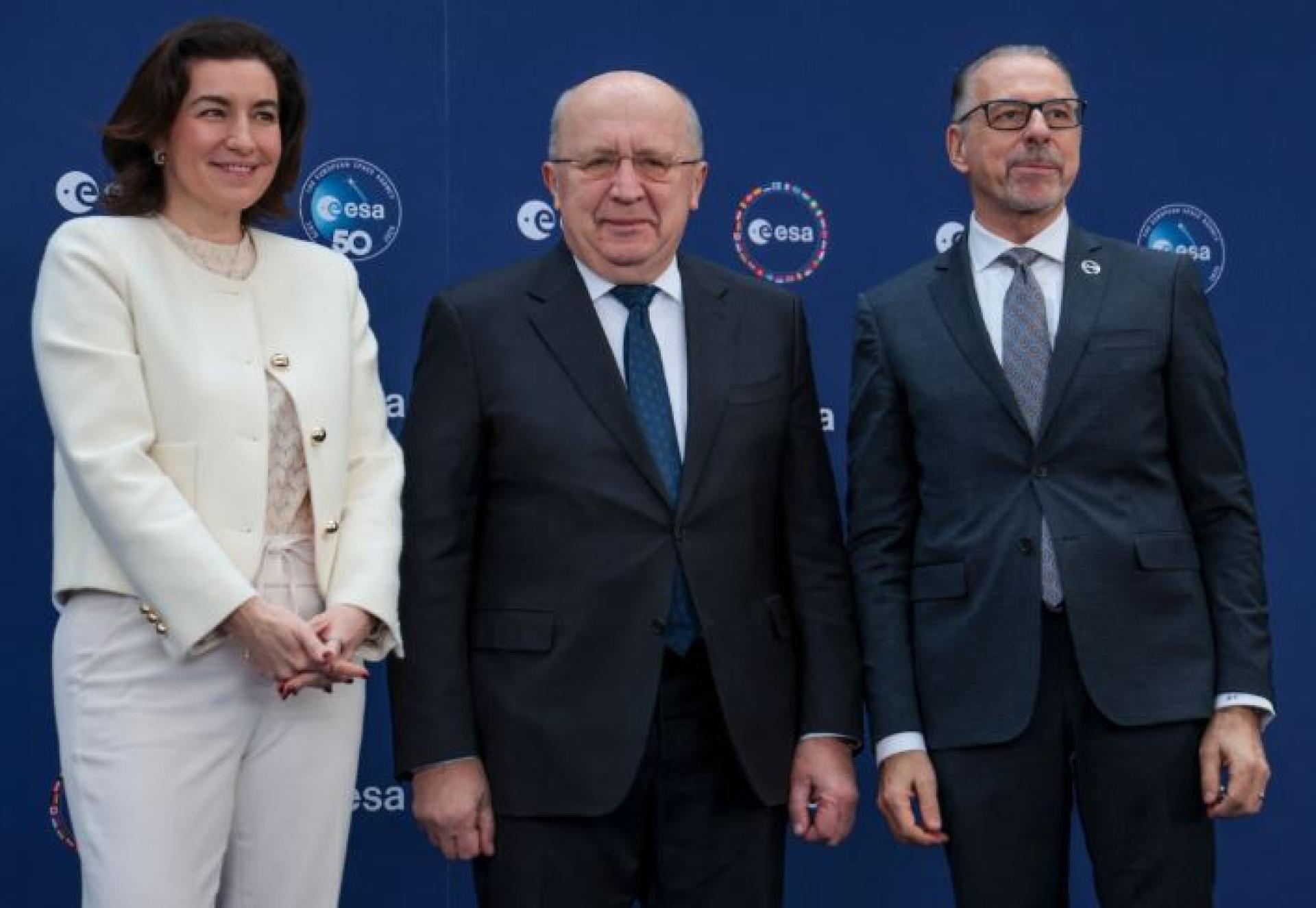
As Europe seeks greater autonomy in the space sector, the European Space Agency (ESA) announced on the 28th that it has secured a record budget of 22.1 billion euros (105.734 billion ringgit), earmarked for the agency's upcoming three-year plan. For the first time, ESA member states have also approved funding for a plan aimed at strengthening defense cooperation—explicitly meeting both military and civilian needs—as well as for drawing up scientific space mission plans. This signifies that the ESA, which has long operated on the principle of 'peaceful use,' is officially stepping into the realm of defense and security.
At the ESA member states’ ministerial council meeting held in Bremen, Germany, ESA’s 23 member countries pledged a budget that is 5 billion euros (23.922 billion ringgit) more than in 2022, meaning the requested total of 22.1 billion euros is nearly fully secured. ESA Director Josef Aschbacher called this an unprecedented situation, representing strong confidence in ESA. The largest contributor to the ESA budget is Germany, with over 5 billion euros, followed by France with 3.7 billion euros (17.702 billion ringgit).
The focus of discussions in Bremen centered on the so-called 'European Space Resilience' program, aimed at integrating existing national space assets to build a military-grade 'system of systems' that will provide secure communications, navigation, surveillance, and Earth observation capabilities, while also supporting civilian missions like climate monitoring.
Although military-related spending accounts for only about 5% of ESA’s total budget, Aschbacher emphasized that this move 'could be the beginning of greater defense investment in the future.'
With China and Russia’s growing activity in space, and the Russia-Ukraine war underscoring the critical role of satellite communications, navigation, and observation in national security, ESA’s plan highlights a clear European consensus to rapidly accelerate efforts towards space sovereignty.
Although ESA was founded with peaceful purposes in mind, Aschbacher said the agency has now been given an explicit mandate for defense and security by its member states. Citing the example of increasing the number of observation and satellite imaging assets for intelligence and surveillance, Aschbacher remarked that if Europe does nothing while China and the US continue building satellite constellations, it risks a repeat of the so-called 'Starlink incident,' where European businesses and interests are threatened by the market dominance of the American 'Starlink' enterprise.