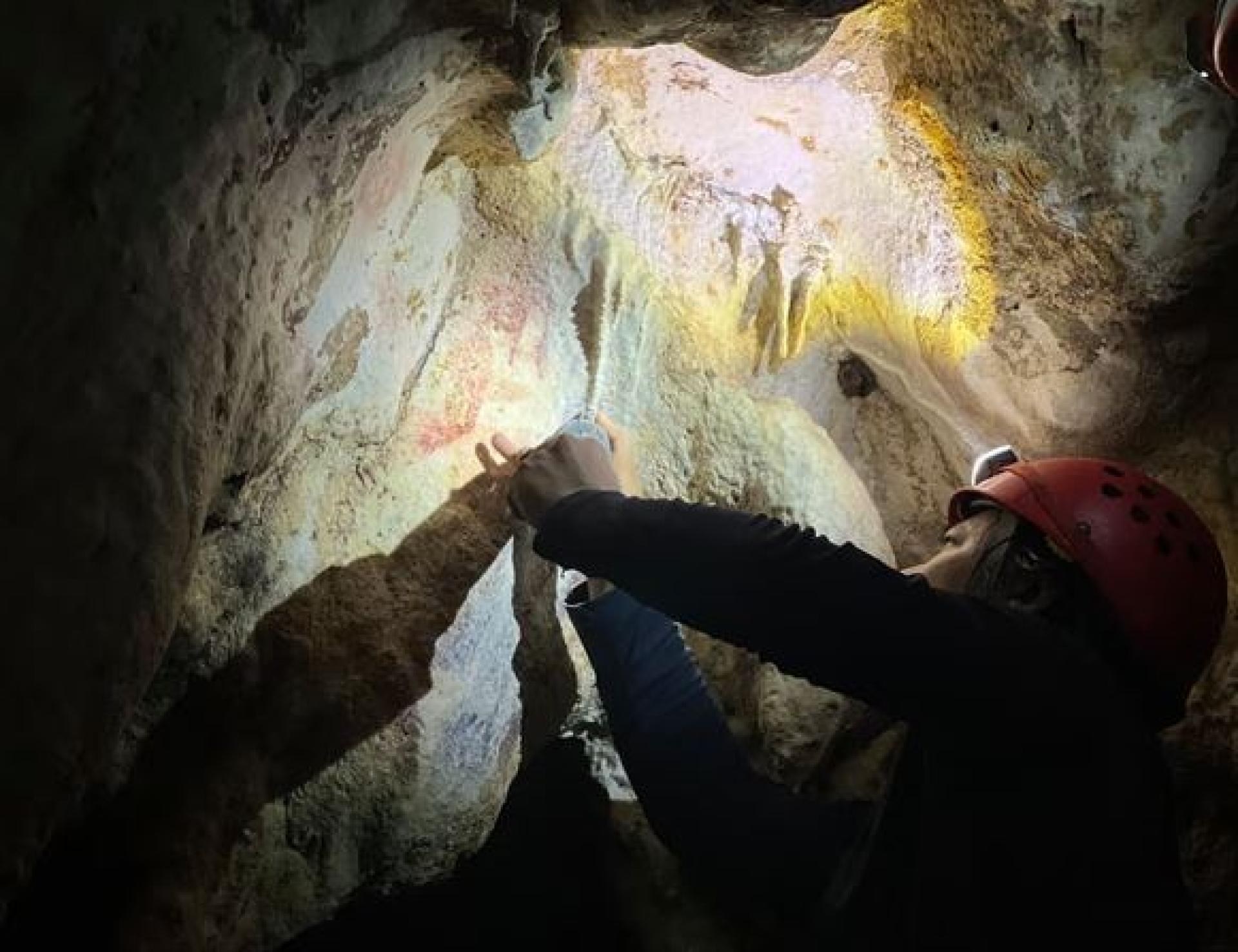
(Jakarta, 22nd) Archaeologists have discovered a cave hand stencil in Sulawesi, Indonesia, dating back at least 67,800 years, believed to be the world's oldest known cave art. The research was published on Wednesday in the prestigious international journal Nature.
This major discovery was accomplished by an international research team comprised of Indonesian and Australian archaeologists. The hand stencil was found in the Liang Metanduno limestone cave on Muna Island in the karst region of Sulawesi.
The researchers used uranium-series dating to analyze minute mineral layers above and below the artwork, confirming the minimum age of the piece—at least 15,000 years older than previously known rock art discoveries in the area.
The study points out that this cave was continuously used for artistic creation over its long history, with related painting activities spanning at least 35,000 years, indicating that early humans had a longstanding and stable tradition of art.
Scientists believe this discovery provides crucial evidence for the study of early human migration into 'Sahul' (the ancient landmass connecting Australia, New Guinea, and Tasmania) and supports the theory that modern humans had reached the region at least 65,000 years ago.
The research team also noted that the creators of the Sulawesi cave art were very likely closely related to the ancestors of Australian Aboriginal peoples. Notably, after the hand stencil was completed, its finger outlines were intentionally narrowed—a globally rare artistic variant that may carry specific symbolic or cultural significance.
The researchers used uranium-series dating to analyze minute mineral layers above and below the artwork, confirming the minimum age of the piece—at least 15,000 years older than previously known rock art discoveries in the area.
The study points out that this cave was continuously used for artistic creation over its long history, with related painting activities spanning at least 35,000 years, indicating that early humans had a longstanding and stable tradition of art.
Scientists believe this discovery provides crucial evidence for the study of early human migration into 'Sahul' (the ancient landmass connecting Australia, New Guinea, and Tasmania) and supports the theory that modern humans had reached the region at least 65,000 years ago.
The research team also noted that the creators of the Sulawesi cave art were very likely closely related to the ancestors of Australian Aboriginal peoples. Notably, after the hand stencil was completed, its finger outlines were intentionally narrowed—a globally rare artistic variant that may carry specific symbolic or cultural significance.