Border Conflict Provides Boost: Anutin Likely to Be Re-elected as Prime Minister of Thailand
Published atFeb 01, 2026 09:56 am
(Thailand, 1st) 'We must say, we are very confident, because we are truly invested in this election.' Thailand's caretaker Prime Minister Anutin appeared very confident about the upcoming general election to be held on February 8 during an interview with 'Global Decoder.' However, most scholars interviewed believe that Anutin's Bhumjaithai Party is unlikely to win an absolute majority of the 500 seats in the lower house, and may not even become the party with the most seats. According to polls, the opposition Move Forward Party, which campaigns on democracy, reform, and innovation, is expected to become the largest party in the lower house. But even if it wants to form a cabinet, and its leader Pita Limjaroenrat aspires to become Prime Minister, the election result alone may not decide the matter.
In the intricate world of Thai politics, 'winner takes all' is not a hard rule; precise political maneuvering is what truly matters. How will various political parties form alliances? What impact will the Thai-Cambodian border conflict have on the election? There was earlier speculation in Thailand that this election would be held in March, but Anutin suddenly dissolved parliament and called an early election, a move not unrelated to the Thai-Cambodian border conflict. Thitinan Pongsudhirak, a political science professor at Chulalongkorn University, told 'Global Decoder' that Anutin is attempting to leverage the patriotic sentiment and nationalist atmosphere triggered by the conflict to win votes. 'For the Bhumjaithai Party, on one hand, it is betting on nationalism; on the other, it relies on royalism. In their view, this is the crucial bargaining chip to continue governing and holding on to power after the election.'
According to the Thai Constitution, the general election will select 500 lower house seats, 400 of which are constituency seats and 100 party-list seats; party-list seats are allocated according to each party’s share of the vote. These 500 MPs in the lower house will then vote to elect the new Prime Minister. This election is exceptionally fierce, with more than 3,000 candidates competing for the 400 constituency seats; and a record 94 candidates vying for Prime Minister. According to the latest poll released at the end of January, Pita Limjaroenrat is in the lead with 31.96% support, while Anutin is second with 20.15%. However, the path for Pita's party to form a government and govern may turn out to be contrary to the poll results.
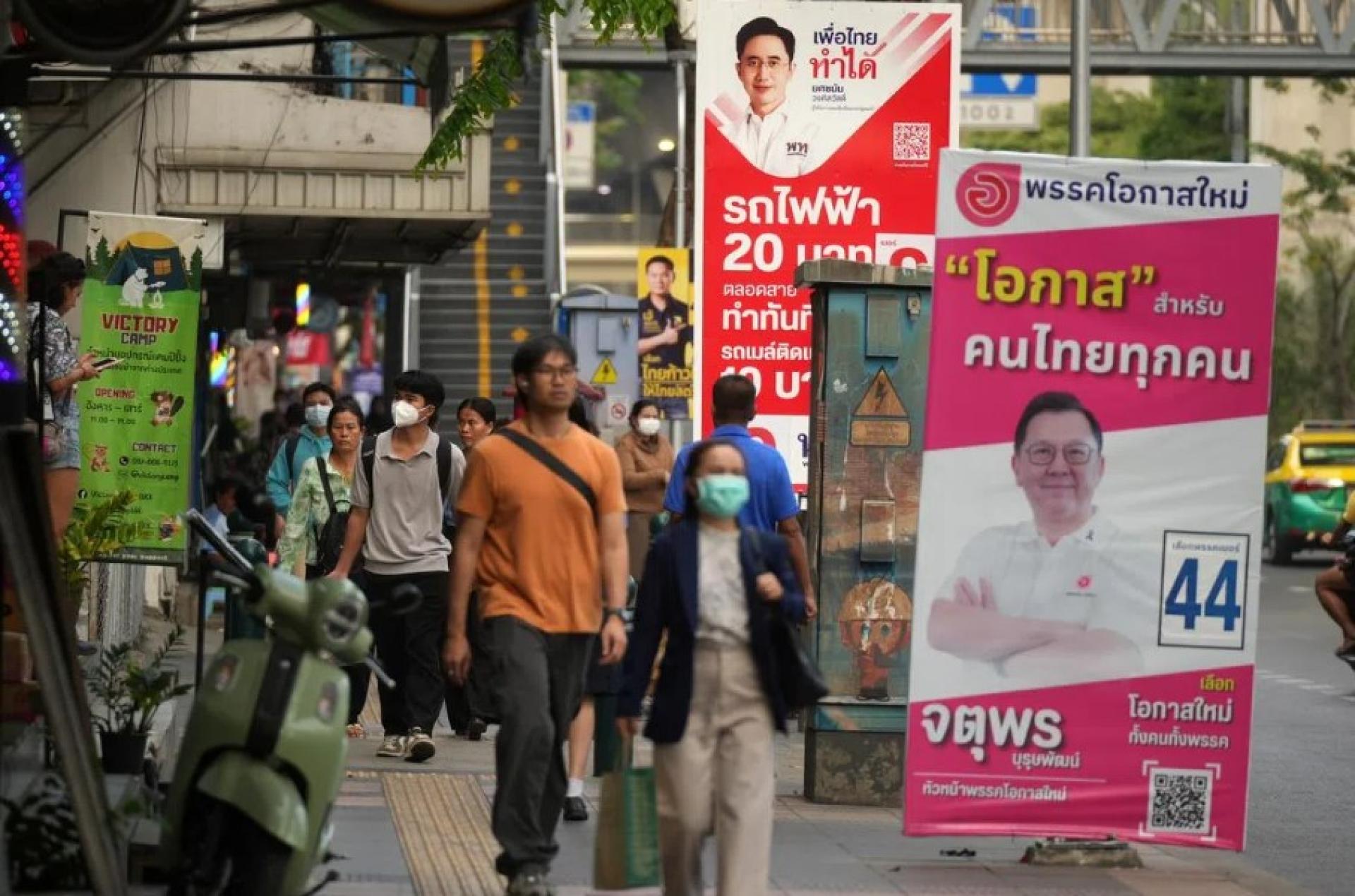
Thai political scholar and former editor-in-chief of 'The Nation' newspaper, Supalak Ganjanakhundee, told 'Global Decoder': 'In the end, Bhumjaithai Party, Pheu Thai Party, and some other small parties will likely work together to form a coalition government, and this is almost a certainty. Because Move Forward Party is seen by the elites as too progressive, even radical to some extent.' Since no single party is likely to form a government on its own, how the parties ally and form coalitions has become a key thing to watch. Thailand has already had three prime ministers in the past three years; what are local voters' expectations for this election? In border areas like Sa Kaeo, Surin, and Buri Ram, which suffer from the ravages of war and are adjacent to Cambodia, how does the election atmosphere differ? Follow 'Global Decoder' to gain further insight into the situation on the ground. 曼谷街头随处可见各政党的竞选旗帜与海报。
This article has been translated using our AI technology. While we strive for accuracy,
AI translations
may contain errors. For the most precise information, please refer to the original article.