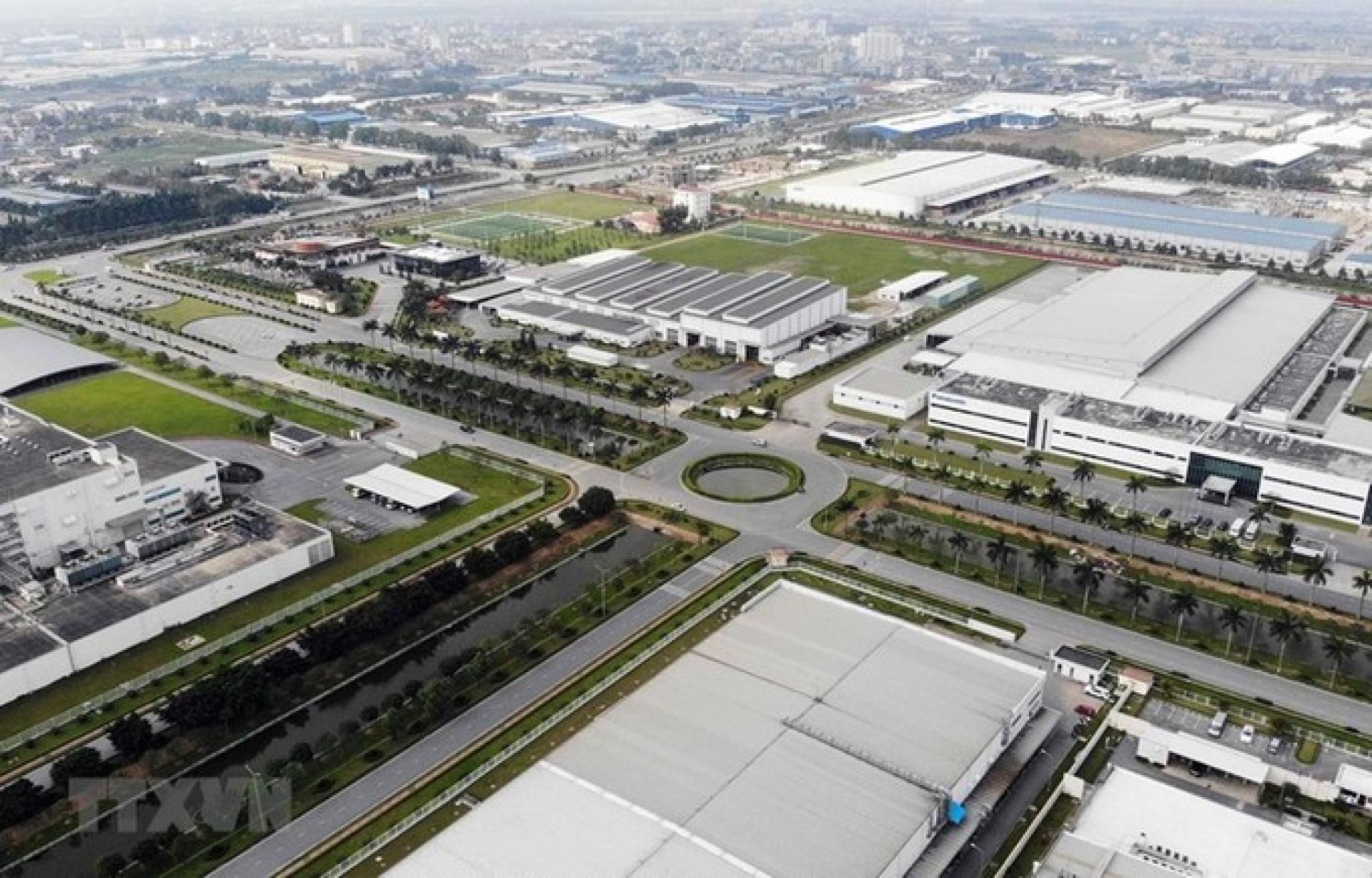
(Hanoi, 7th) According to the Vietnam News Agency, with the ongoing development of various infrastructure projects and the continuous expansion of supply chains, Northern Vietnam’s industrial real estate market is expected to enter a new round of accelerated growth starting in 2026. Among these, the green industrial park model is gradually becoming a key standard for foreign direct investment (FDI) companies when selecting locations.
According to the development plan from 2026 to 2029, Northern Vietnam is expected to add about 5,050 hectares of industrial land, nearly 1 million square meters of high-standard factories (RBF), and more than 656,000 square meters of high-standard warehouses (RBW). In 2026 alone, supply of high-standard factories is expected to increase by over 643,000 square meters, providing ample space for expansion in the electronics, semiconductor, and high-tech industries.
Meanwhile, construction of the Gia Binh International Airport, the expansion of the North-South Expressway, and the development plans for free trade zones connected to deep-water port systems are all seen as important driving forces in transforming the North into a regional green manufacturing and logistics center.
Nguyen Phuc Thuan, Leasing Director of Cushman & Wakefield Vietnam, stated that foreign investors are becoming more prudent and diverse in their investment decisions. Besides rental costs, investors are increasingly emphasizing whether a project has long-term expansion potential, comprehensive infrastructure, and a clear legal framework. In this new phase of development, the level of infrastructure readiness and investment environment transparency are as crucial as land reserves.
Furthermore, Environmental, Social, and Corporate Governance (ESG) standards as well as supply chain emission reduction requirements are gradually becoming key prerequisites for multinational investment. Nguyen Phuc Thuan pointed out that this trend is prompting industrial park developers to accelerate transformation and promote ecological development of parks, including the application of renewable energy, improvement of water resource utilization efficiency, and strengthening of intelligent operational management.
Cushman & Wakefield Vietnam’s General Manager Bui Trang also noted that the period from 2026 to 2028 will be a critical phase for industrial park competition and selection. Industrial parks with green standards, sound planning, and efficient logistics connectivity are more likely to attract high-quality foreign investment, while parks that stick to traditional models and lack sustainable development strategies will face greater competitive pressure.
Industry insiders believe that the outlook for 2026 is founded on robust growth in 2025. According to Cushman & Wakefield’s Q4 2025 “Marketbeat” report, the total industrial park land supply in Northern Vietnam had reached nearly 23,990 hectares, up 42.8% year-on-year; the average rental rate was US$135 per square meter (for the entire lease term), up 3.8% year-on-year.
As investment gradually expands from core areas to satellite provinces such as Hung Yen, Ninh Binh, Hai Phong, and Phu Tho, Northern Vietnam is increasingly forming a closely linked production and logistics belt. Unlike the past, when investment was concentrated in a few traditional industrial centers, the new round of investment is trending toward industrial cluster layouts, building an integrated industry ecosystem from component manufacturing, assembly, warehousing and logistics to export.
Currently, Hai Phong and Bac Ninh continue to serve as regional hubs due to their deep-water port advantages and electronic high-tech industry clusters; meanwhile, places like Ninh Binh, Hung Yen, and Phu Tho are becoming strategically important land reserve areas to meet industrial expansion needs for the next 5 to 10 years.
Analysis points out that this layered layout not only helps optimize enterprise cost structures but also alleviates infrastructure pressure on traditional industrial centers. As the global supply chain restructuring continues, Northern Vietnam’s green production belt is expected to become a key node in the regional production network, and over the next decade, gradually transition from a processing and manufacturing hub to a high-tech production center.
Meanwhile, construction of the Gia Binh International Airport, the expansion of the North-South Expressway, and the development plans for free trade zones connected to deep-water port systems are all seen as important driving forces in transforming the North into a regional green manufacturing and logistics center.
Nguyen Phuc Thuan, Leasing Director of Cushman & Wakefield Vietnam, stated that foreign investors are becoming more prudent and diverse in their investment decisions. Besides rental costs, investors are increasingly emphasizing whether a project has long-term expansion potential, comprehensive infrastructure, and a clear legal framework. In this new phase of development, the level of infrastructure readiness and investment environment transparency are as crucial as land reserves.
Furthermore, Environmental, Social, and Corporate Governance (ESG) standards as well as supply chain emission reduction requirements are gradually becoming key prerequisites for multinational investment. Nguyen Phuc Thuan pointed out that this trend is prompting industrial park developers to accelerate transformation and promote ecological development of parks, including the application of renewable energy, improvement of water resource utilization efficiency, and strengthening of intelligent operational management.
Cushman & Wakefield Vietnam’s General Manager Bui Trang also noted that the period from 2026 to 2028 will be a critical phase for industrial park competition and selection. Industrial parks with green standards, sound planning, and efficient logistics connectivity are more likely to attract high-quality foreign investment, while parks that stick to traditional models and lack sustainable development strategies will face greater competitive pressure.
Industry insiders believe that the outlook for 2026 is founded on robust growth in 2025. According to Cushman & Wakefield’s Q4 2025 “Marketbeat” report, the total industrial park land supply in Northern Vietnam had reached nearly 23,990 hectares, up 42.8% year-on-year; the average rental rate was US$135 per square meter (for the entire lease term), up 3.8% year-on-year.
As investment gradually expands from core areas to satellite provinces such as Hung Yen, Ninh Binh, Hai Phong, and Phu Tho, Northern Vietnam is increasingly forming a closely linked production and logistics belt. Unlike the past, when investment was concentrated in a few traditional industrial centers, the new round of investment is trending toward industrial cluster layouts, building an integrated industry ecosystem from component manufacturing, assembly, warehousing and logistics to export.
Currently, Hai Phong and Bac Ninh continue to serve as regional hubs due to their deep-water port advantages and electronic high-tech industry clusters; meanwhile, places like Ninh Binh, Hung Yen, and Phu Tho are becoming strategically important land reserve areas to meet industrial expansion needs for the next 5 to 10 years.
Analysis points out that this layered layout not only helps optimize enterprise cost structures but also alleviates infrastructure pressure on traditional industrial centers. As the global supply chain restructuring continues, Northern Vietnam’s green production belt is expected to become a key node in the regional production network, and over the next decade, gradually transition from a processing and manufacturing hub to a high-tech production center.