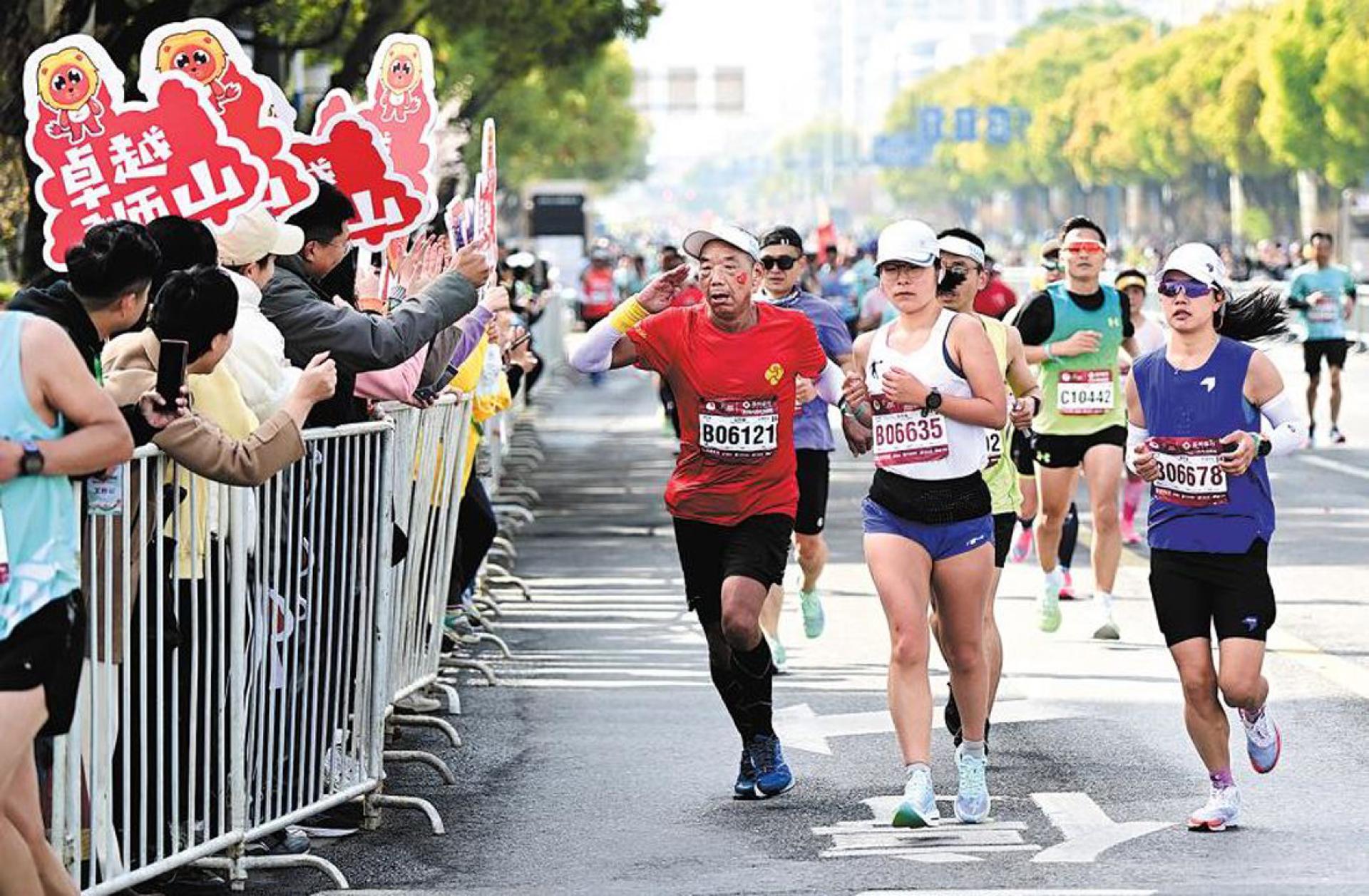
In April, more than 20 marathons took place across China, from top-tier cities down to counties, maintaining the road running craze. According to the public account 'Lazy Bear Sports', the Chinese Athletics Association recently released the 2025 China Marathon Event Blue Book. The data shows: China’s marathon scene is entering a new era of “fewer but higher quality” events. While the total number of races has dropped, both the economic benefits and runners’ performance have seen breakthroughs.
In 2025, China will host a total of 594 marathon events nationwide, a decrease of 14.7% compared to the 696 in 2024. The main contraction comes from 83 fewer half marathons. However, the number of certified events by the Chinese Athletics Association (categories A and B) rose slightly to 341, compared to the previous year. This key “decline and growth” dynamic is due to a new regulation issued by the Association in October 2025, raising the threshold for organizing events and eliminating those with chaotic processes and weak organization, thus accelerating the concentration of resources toward professionally certified races.
Despite the overall drop in the number of events, the total participation still reaches 6.3987 million person-times, with a steady increase in the average number of participants per event. Zhejiang, Shandong, and Jiangsu rank as the top three provinces for event numbers, with Zhejiang leading at 46 events. In terms of timing, March and April account for 208 events, making up 35% of the annual total; certified events are more concentrated in November, with 76 held during that month.
Runner Progression: Surge in Sub-Three-Hour Finishes
The runners themselves are also seeing notable improvements. In 2025, certified marathon events saw a total of 2.6027 million finishers, including 740,900 full marathon finishers and 1.8618 million half marathon finishers—both numbers grew significantly compared with 2024. The average finish time for full marathons was 4:06:04, nearly a 1-minute improvement year-on-year. The number of sub-three-hour finishers reached 21,997, a 22% annual increase; sub-three-and-a-half-hour finishers totaled 88,691. The base of elite runners continues to grow, and the overall level of recreational runners is on the rise.
By gender and age, men account for nearly 80% of runners, with those aged 35–39 having the highest participation rate. By the end of 2025, the total number of full marathon finishers will reach 932,500, and half marathon finishers will hit 2.9024 million, indicating a sustained expansion of China’s road running population. Runners are also participating more frequently: the average number of full marathons finished per participant is 1.9, and for half marathons, 1.6. Running is gradually becoming a way of life.
Marathon + Tourism Drives 26.3 Billion in Revenue Overall
"Marathon + tourism" has become the trend. In 2025, non-local participants traveled an average distance of 516 km to compete, with the proportion of long-distance runners rising. According to the Blue Book’s statistics for 284 category A certified races, these events brought a direct economic impact of 18.51 billion RMB (10.727 billion MYR), a 16.8% annual increase. The total economic stimulation reached 45.4 billion RMB (26.31 billion MYR), with tax revenues of 1.34 billion RMB (770 million MYR), and 183,000 jobs created. Spending on food, accommodation, transport, sightseeing, shopping, and entertainment contributed 20.11 billion RMB (11.654 billion MYR), accounting for 44.3% of the overall stimulation effect.
Take the 2025 Beijing Marathon as an example: the event expanded its scale to 32,000 runners, producing a direct economic impact of 746 million RMB (432 million MYR)—a 33% annual increase—and a total stimulation effect of 2.375 billion RMB (1.376 billion MYR). A report from the Economic Department of China’s General Administration of Sport highlighted that a large city marathon can generate 600–700 million RMB (348–406 million MYR) in economic benefits.
Figures show that China’s marathon scene is evolving from a “nationwide carnival” to a deep integration of professionalism, mass participation, and industrialization. Those running on the course are not just athletes, but symbolize a city’s expanding economic reach and brand influence.