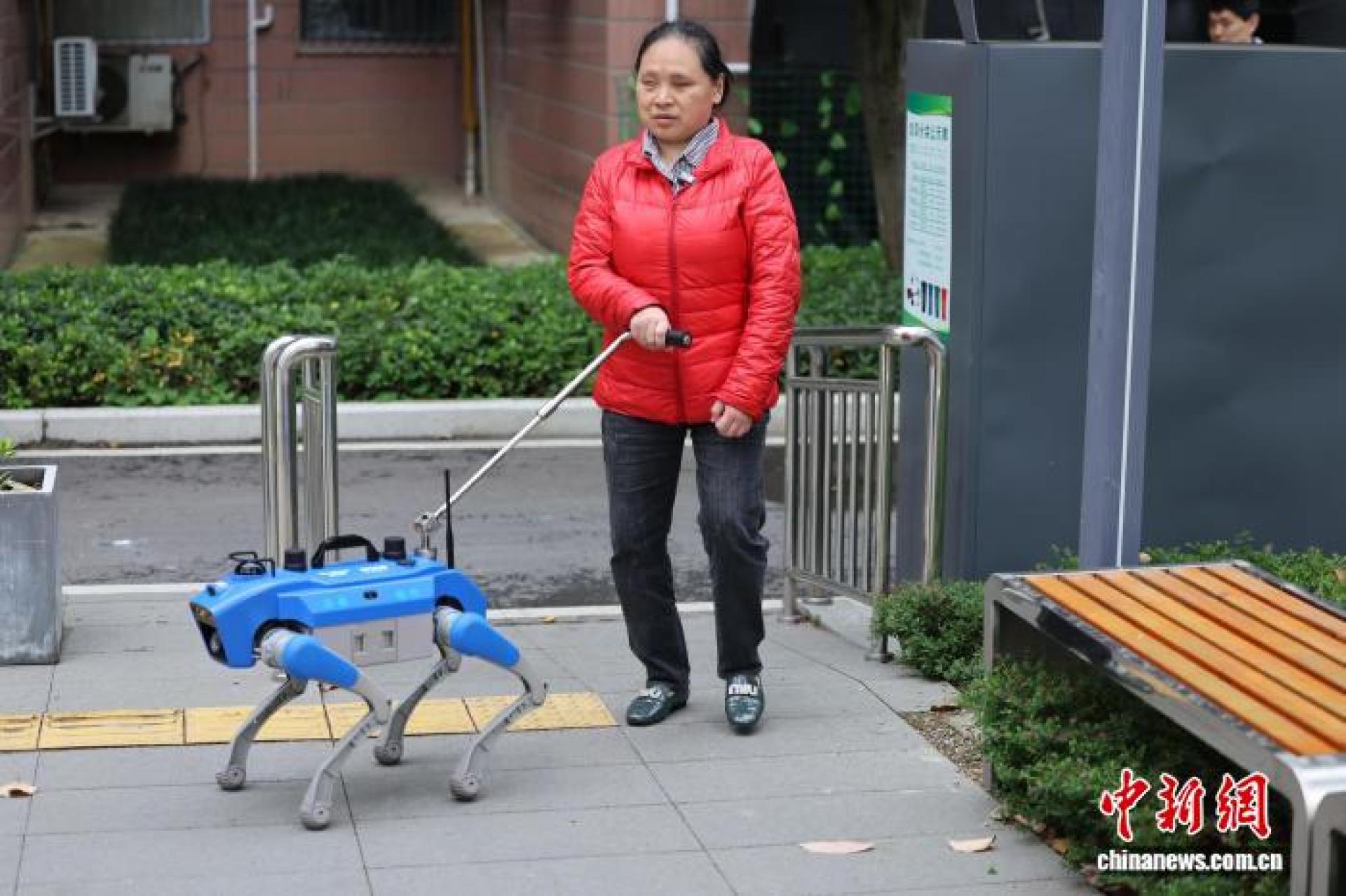
“Xiaowen, Xiaowen.” “I'm here.” “Please take me to the community activity center.” ... Recently, in a certain community in Jinjiang District, Chengdu City, Sichuan Province, after a brief conversation, the four-legged smart guide dog “Xiaowen” stepped forward, steadily leading the visually impaired Wang Xu, automatically avoiding parked vehicles and passing pedestrians on the road, and even gave a voice prompt before stepping up stairs.
“All my life, I have been afraid to go out alone and must always have someone lead me outside.” Having lived in a world of darkness for 60 years, Wang Xu has always lacked a sense of security in the bustling city. But after participating as a volunteer in multiple tests for the smart guide dog, she has gradually built up trust in this robotic dog. “Maybe one day, I can walk out with ‘Xiaowen’ by myself, go to the subway station or a friend's house, and no longer have to trouble my family for help.”
It is understood that this smart guide dog is equipped with an integrated system combining LiDAR, depth cameras, ultrasonics, and more, creating centimeter-level precision navigation across its environment. It can achieve 360-degree real-time environmental sensing and intelligently predict and avoid both static and dynamic obstacles simultaneously, thus greatly improving convenience and safety for the visually impaired while traveling.
In recent years, China’s technological support for people with disabilities has accelerated rapidly and in ever-widening areas. For instance, brain-computer interface technology is used in autism treatment, smart bionic hands help people with limb disabilities “grow hands” again, and exoskeleton robots help paralyzed individuals stand up again ... Technology is reshaping the lives of people with disabilities with unprecedented power.
Zhang Xiao, another visually impaired person who participated in several smart guide dog tests, usually relies on mobile navigation and a white cane for travel. But she frankly said the cane can only detect obstacles below. “For example, if there’s a parked car ahead, the cane might pass through the gap between the wheels, making me think the road is clear. But if I keep walking, I could bump my head into the car.”
But “Xiaowen” gave 59-year-old Zhang Xiao a completely new experience. “When there are obstacles like cars or electric bikes, it just goes around them, and it even reminds me before climbing stairs. The navigation is also very accurate.” Zhang Xiao smiled and said, “And walking with a smart guide dog is really cool. My visually impaired friends all look forward to having their own ‘Xiaowen’.”
Why not choose a real guide dog? That’s because there’s a huge gap between the number of blind people in China applying for guide dogs and the number of qualified guide dogs available. Data from the Chengdu Blind Association show that there are currently 43,919 visually impaired people in Chengdu, but only 4 guide dogs in the city. The vast majority of the visually impaired rely mainly on white canes and similar tools when going out.
The company developing the smart guide dog, Chengdu Touchqian Technology, has its Chairman Li Zonglin stating that the final product version will be officially released in October this year, with about 2,000 units delivered in December. “We have already received partnership interests from Saudi Arabia, Malaysia, and South Korea.”
In Li Zonglin’s view, smart guide dogs may offer more options for the visually impaired. Although the product is still being tested and improved, he hopes that “Xiaowen” will eventually become an all-around “cyber puppy”, one that can not only take visually impaired people on safe explorations of the wider world, but also interact with them more, so that the warmth of technology can better nurture the lives and hearts of friends with disabilities.