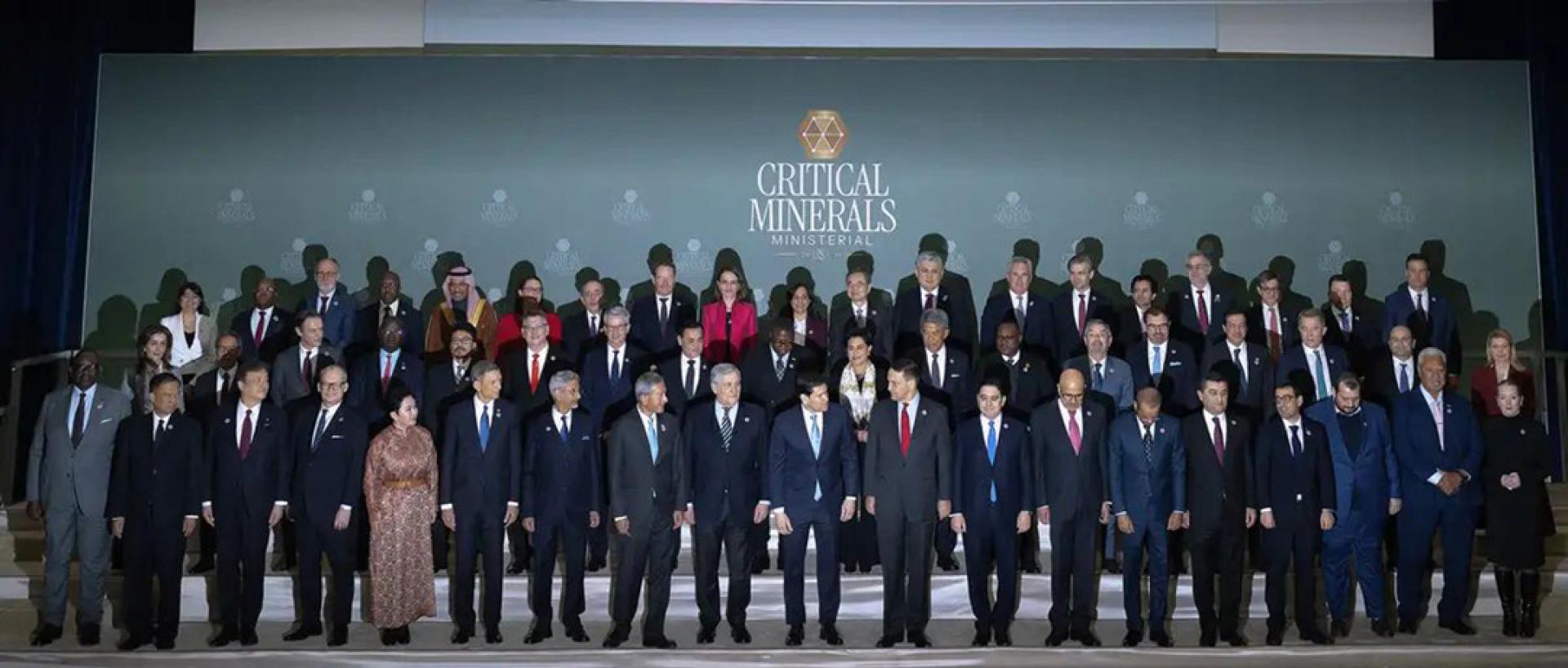
A multilateral meeting covering 55 partners announced the establishment of a multinational key minerals trade alliance to counter China’s influence. The US, EU, and Japan issued a joint statement after the meeting, announcing the creation of a strategic partnership aimed at strengthening the security of key mineral supplies. The Chinese Ministry of Foreign Affairs responded, saying it opposes any country using 'small group' rules to disrupt the international economic and trade order.
The 'Key Minerals Ministerial Meeting' was held Wednesday at the US State Department. The US proposed strengthening the related 'Minerals Security Partnership,' meaning the formation of a multinational critical mineral trade alliance, and establishing a price floor for key minerals. Secretary Rubio stated after the meeting that the US currently has 55 partners, with most countries having signed on.
Setting a Price Floor
The State Department said the meeting hosted representatives from 54 countries and the European Commission, including Australia, Canada, South Korea, Japan, the Philippines, India, Ukraine, Jordan, Kazakhstan, Kenya, and more. Many countries openly expressed support and discussed a price floor, which is said to be aimed at preventing any country from undercutting prices through dumping, thereby weakening the profits of Western companies.
The US, EU, and Japan also announced a critical minerals partnership after the meeting, likewise intended to strengthen resilience in the key minerals sector. According to their statement, the memorandum of understanding signed among the US, EU, and Japan aims to identify areas of cooperation to stimulate demand and achieve supply chain diversification. Specific measures will support new mining, refining, production, and recycling projects, and will be promoted through establishing price floors or providing subsidies, among other ways. The three sides will also accelerate R&D in the relevant fields. The statement says the overall goal of the program is to reduce dependence on key mineral supply chains dominated by China.
According to the International Energy Agency (IEA), China refines about 47% to 87% of the world’s copper, lithium, cobalt, graphite, and rare earths. These materials are used in critical industries such as defense technology, semiconductors, renewable energy equipment, and batteries.
South Korea: Hopes to Cooperate with China for Rare Earth Supply
In response to the US's formation of the so-called key minerals alliance, Chinese Foreign Ministry spokesperson Lin Jian stated on the 5th that maintaining an open, inclusive, and mutually beneficial international trade environment is in the common interest of all countries, and all parties have a responsibility to play a constructive role in maintaining global key mineral production and supply chain stability and security. At the same time, we oppose any country using 'small group' rules to disrupt the international economic and trade order.
South Korea will serve as chair of the key minerals trade mechanism until June this year. However, its trade ministry stated on Thursday that it hopes to strengthen cooperation with China in the key mineral supply chain, ensuring stable access to rare earths for advanced technologies. The ministry said the government will establish a direct line and joint committee with the Chinese authorities to help Korean companies import Chinese minerals more quickly and reliably.