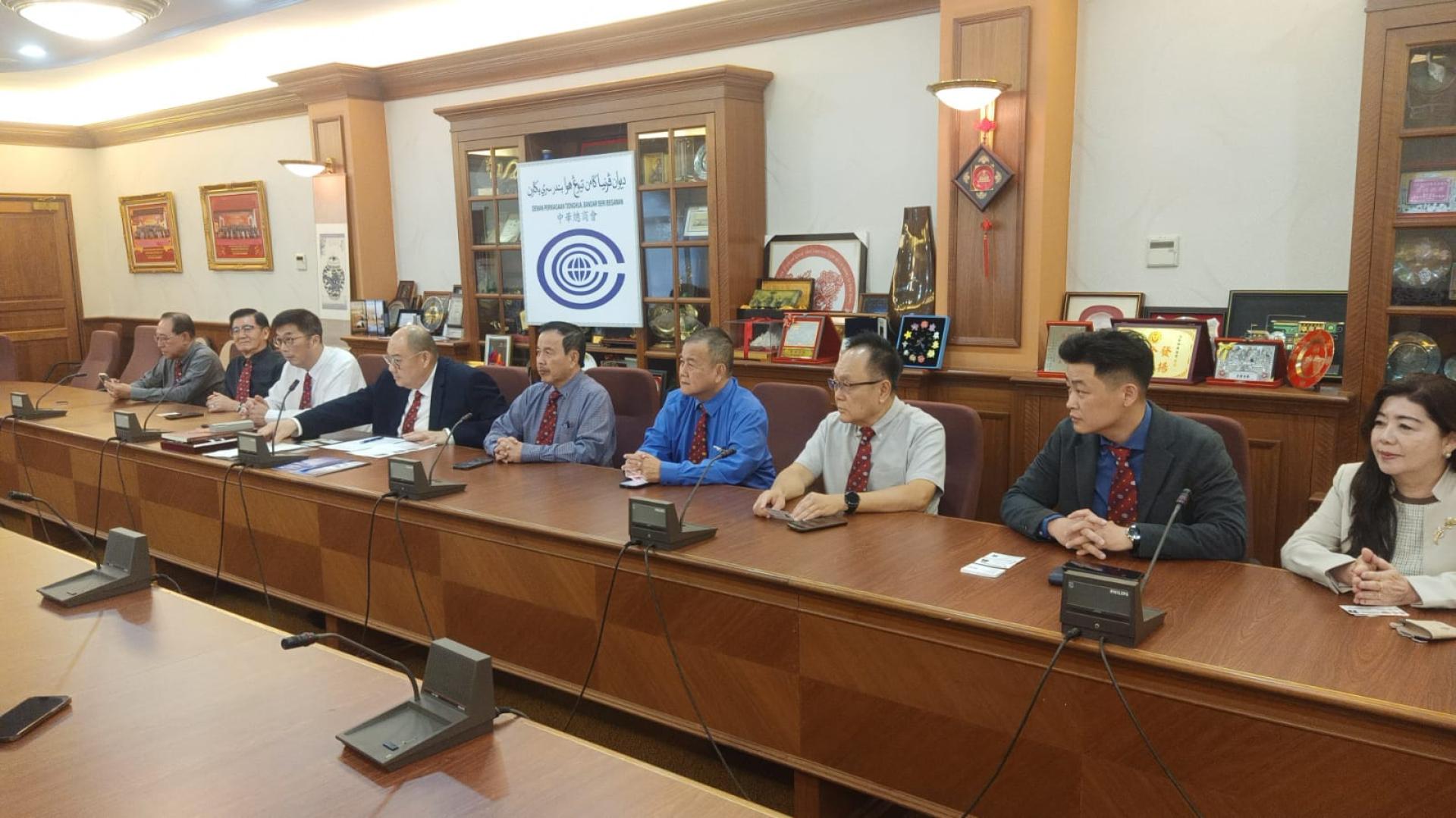
(Bandar Seri Begawan, 21st) Lin Hanzhang, President of the Chinese Chamber of Commerce Bandar Seri Begawan (BSB CCC), stated that the chamber was established with the aim of safeguarding members’ interests, strengthening business links with other chambers, promoting industrial and business development, fostering national economic prosperity, and assisting in social education and welfare causes.
During a recent reception for Chen Wen, chief representative of the Zhejiang Provincial Business Representative Office in Singapore (Southeast Asia), and his delegation, Lin Hanzhang, on behalf of the chamber’s board of directors, welcomed the visitors and introduced the chamber’s development history and future directions for cooperation.
He said that the chamber has a history of 79 years since its founding, having been officially established in 1947, with its predecessor being the "Chinese Association." With changes in the social structure and the continuous development of business activities, the chamber later changed its name to the "Chinese Chamber of Commerce."
He pointed out that in 2005, considering the chamber’s location in the national capital—which serves as the cultural, political, and economic center of the country—coupled with a continuously growing population, the Chinese business community generally felt it was necessary to strengthen economic unity and cooperation. As a result, with members’ consensus, the name was officially changed to the "General Chamber of Commerce."
He said that the chamber currently has about 1,000 members, including corporate members, special members, and individual members, covering all industrial and business sectors in Brunei, such as food and beverage, tourism, computer technology, automobile spare parts, construction, real estate, logistics, insurance, law, jewelry, transportation, professional services, and import-export trade.
Lin Hanzhang stated that in addition to safeguarding members’ rights and interests, the chamber is also committed to strengthening exchanges and cooperation with domestic and foreign chambers, promoting industrial and commercial development, and maintaining close cooperation with the government to jointly advance the implementation of national policies.
He pointed out that Brunei’s economy has mainly depended on natural gas and oil resources in the past, but in recent years the government has actively promoted economic diversification, including the agriculture, aquaculture, finance, transportation, tourism, and food industries, in order to reduce reliance on oil and gas resources.
He said that the Brunei government is also actively encouraging foreign direct investment to expand the nation’s economic scale, create more job opportunities, and move towards the national development vision of 2035.
Lin Hanzhang said that the chamber looks forward to in-depth exchanges with the delegation from the Zhejiang Provincial Business Representative Office in Singapore (Southeast Asia), to jointly explore development opportunities, seek greater potential for cooperation, and promote closer economic and commercial cooperation between both parties.
He concluded by thanking the delegation for their visit and expressed hope that this exchange would yield fruitful results and usher in a new chapter of cooperation between the two sides.
He said that the chamber has a history of 79 years since its founding, having been officially established in 1947, with its predecessor being the "Chinese Association." With changes in the social structure and the continuous development of business activities, the chamber later changed its name to the "Chinese Chamber of Commerce."
He pointed out that in 2005, considering the chamber’s location in the national capital—which serves as the cultural, political, and economic center of the country—coupled with a continuously growing population, the Chinese business community generally felt it was necessary to strengthen economic unity and cooperation. As a result, with members’ consensus, the name was officially changed to the "General Chamber of Commerce."
He said that the chamber currently has about 1,000 members, including corporate members, special members, and individual members, covering all industrial and business sectors in Brunei, such as food and beverage, tourism, computer technology, automobile spare parts, construction, real estate, logistics, insurance, law, jewelry, transportation, professional services, and import-export trade.
Lin Hanzhang stated that in addition to safeguarding members’ rights and interests, the chamber is also committed to strengthening exchanges and cooperation with domestic and foreign chambers, promoting industrial and commercial development, and maintaining close cooperation with the government to jointly advance the implementation of national policies.
He pointed out that Brunei’s economy has mainly depended on natural gas and oil resources in the past, but in recent years the government has actively promoted economic diversification, including the agriculture, aquaculture, finance, transportation, tourism, and food industries, in order to reduce reliance on oil and gas resources.
He said that the Brunei government is also actively encouraging foreign direct investment to expand the nation’s economic scale, create more job opportunities, and move towards the national development vision of 2035.
Lin Hanzhang said that the chamber looks forward to in-depth exchanges with the delegation from the Zhejiang Provincial Business Representative Office in Singapore (Southeast Asia), to jointly explore development opportunities, seek greater potential for cooperation, and promote closer economic and commercial cooperation between both parties.
He concluded by thanking the delegation for their visit and expressed hope that this exchange would yield fruitful results and usher in a new chapter of cooperation between the two sides.