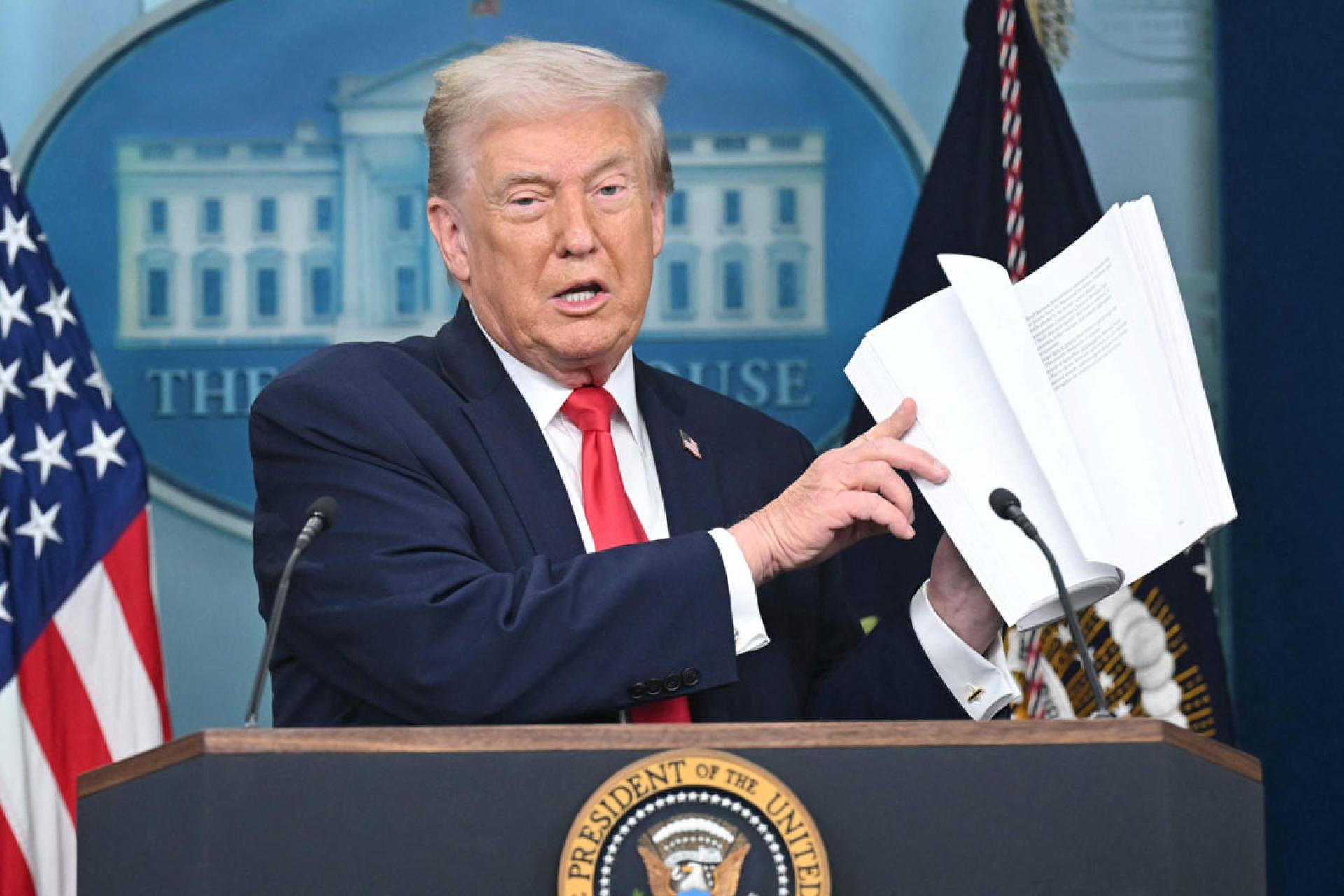
On the occasion of his first year in office, U.S. President Donald Trump held a marathon press conference lasting over an hour and a half in the White House briefing room on the 20th, addressing a wide array of topics ranging from foreign affairs and defense to the economy and his personal political evaluations.
He was noncommittal regarding possible U.S. action to acquire Greenland, once again questioned whether NATO allies are treating the U.S. fairly, reiterated his dissatisfaction over not receiving the Nobel Peace Prize, and defended his tariff policies.
This press conference, coinciding with the one-year anniversary of Trump's inauguration, was regarded as a key opportunity for him to fully restate his foreign and security policy positions. During his remarks in the White House pressroom, Trump touched on immigration policy, economic performance, the situation in Venezuela, and repeatedly mentioned former President Biden to contrast his own policies with those of his predecessor. The entire briefing lasted over 104 minutes, far longer than typical routine briefings, and its content appeared wide-ranging and lengthy.
Greenland Issue: You’ll Know
During the Q&A session, the topic of Greenland became one of the focal points. A reporter asked directly how far the U.S. might go in acquiring Greenland. Trump did not specify particular actions, only responding, "You'll know."
Earlier that day, he posted a doctored image on his social media, in which he is holding an American flag standing on Greenland, with U.S. Vice President Vance and Secretary of State Rubio standing behind him.
Ending Multiple Wars: Deserving of the Nobel Peace Prize
Trump was also asked about his message to the Norwegian Prime Minister, and his feelings about not receiving the Nobel Peace Prize. He said bluntly, "I've lost a lot of respect for Norway," emphasizing that he “very strongly” believes Norway has real control over the Nobel Peace Prize.
He stated that he had "solved eight wars," and that resolving international conflicts is “very easy” for him.
He said, “I didn’t do it for the Nobel Peace Prize. No matter what they say, Norway has enormous control over the Nobel Peace Prize, even though they deny it.”
He pointed out that he deserved the Nobel Peace Prize for ending multiple wars, rather than the award going to Venezuelan opposition leader Machado.
He said, “You know, I actually should get the Nobel Peace Prize for each war, but I’m not saying that. I saved millions of people, and don’t let anyone tell you Norway isn’t in charge of it all.”
However, he also praised Machado for giving him the Nobel medal, calling her “a good lady,” and said the prize had lost its "prestige."
NATO Must Treat America Fairly
On defense and security issues, Trump reiterated his contributions to NATO, stressing that the U.S. shoulders huge expenditures within the alliance and again questioned whether NATO members would fulfill their collective defense commitments to protect the U.S. in the event of an attack.
He said, “We spend huge sums on NATO, and I know we would definitely go save them, but I really doubt if they would come save us. NATO must also treat us fairly.”
According to NATO’s Article 5, an attack on any member state is considered an attack on all. This clause has been triggered only once, after the 9/11 terrorist attacks in 2001, when European allies joined U.S. military action in Afghanistan.
If Tariffs Illegal, Will Find ‘Other Ways’ to Increase Revenue
Additionally, Trump said he was "anxiously awaiting" the court decision on tariffs, admitting that if he loses, the government may need to return the massive sums it has collected in tariffs.
The U.S. Supreme Court on the 20th had yet to rule on whether Trump could lawfully pursue his tariff policy based on the International Emergency Economic Powers Act (IEEPA) of 1977.
Regardless, Trump remained confident that tariff policy benefits the U.S.
He emphasized: “Because of tariffs, we have enormous national security and tremendous revenue, otherwise ‘China would steal our lunch.’”
He warned that if the Supreme Court rules the tariffs illegal, the U.S. government will take “other measures” to increase revenue.