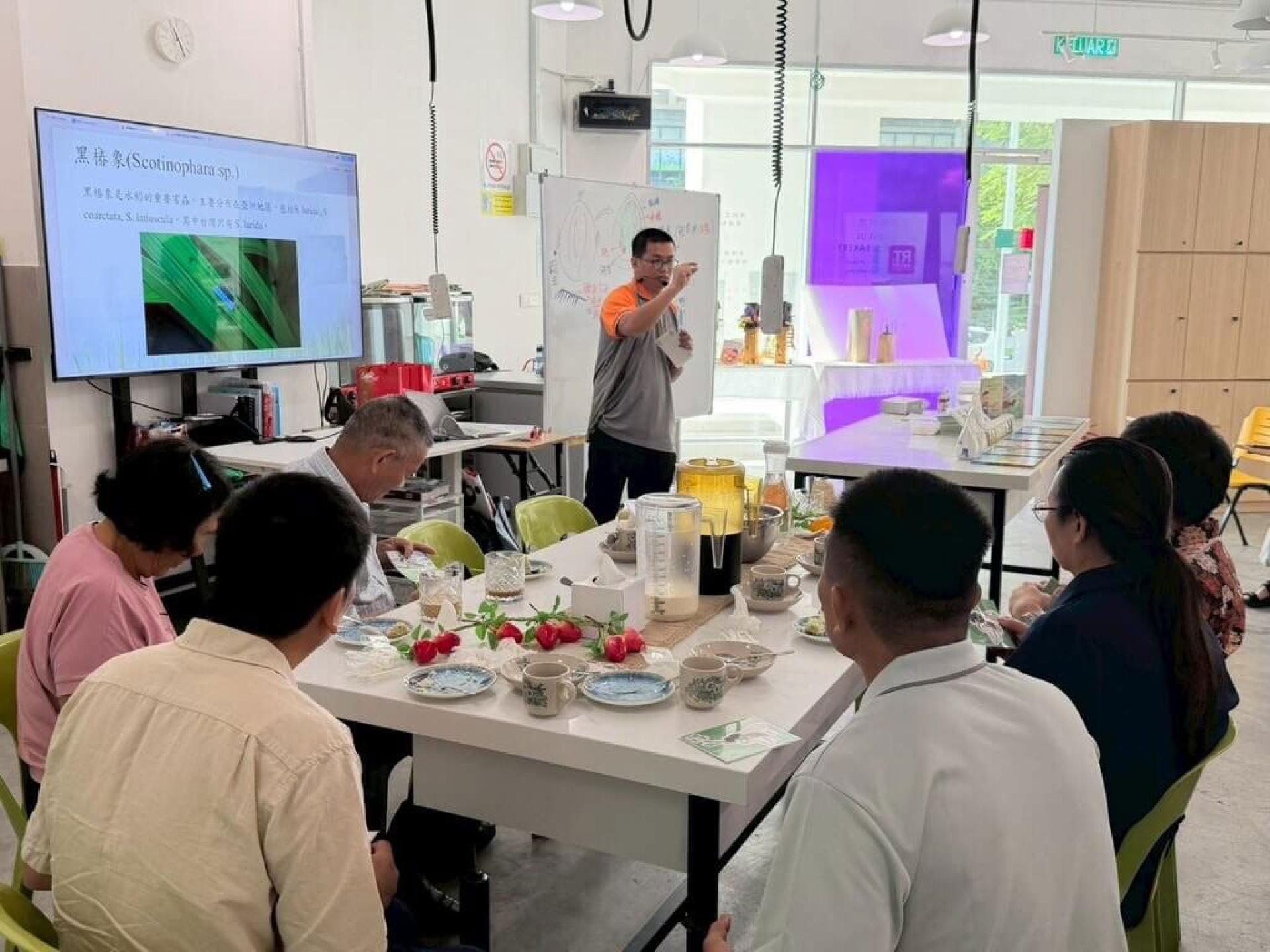
Malaysia is actively enhancing food security and developing smart agriculture. A delegation of young Taiwanese farmers has traveled deep into Malaysian rural agricultural areas to share food and agriculture education, and in particular to promote the organic agricultural method of the 'Three Black Treasures of the Fields,' aiming to reduce the use of chemical pesticides, increase crop yield, and facilitate agricultural technology exchanges.
The exchange group, consisting of local young farmers from Taiwan, recently visited places such as Klang and Sekinchan in Selangor, as well as Bentong in Pahang. They visited Chinese-language primary schools, farmers’ groups, and baking academies to introduce food and agriculture education from Taiwan, organic rice cultivation, and applications of rice and grain flours, while also exchanging agricultural techniques and industry development experiences with local farmers.
Lu Quanxin, a Taiwanese young farmer who went to Malaysia for the exchange, told CNA in an interview on Wednesday that in recent years Taiwan has integrated field ecological observation and biological control concepts—specifically rice black bugs, black egg parasitoid wasps, and Metarhizium anisopliae (a black entomopathogenic fungus)—into what they call 'the Three Black Treasures of the Fields.' Among them, the rice black bug is a common pest in organic rice fields, the black egg parasitoid wasp parasitizes its eggs, and the black fungus infects pests and inhibits their reproduction. This approach reduces chemical pesticide use and promotes eco-friendly farming and food-agriculture education.
In addition to food and agriculture education, the delegation also introduced smart agricultural technologies to Malaysia. He pointed out that agriculture in Taiwan commonly employs crop protection drones for fertilization, pest and disease control, and field management, as well as seeding and rice planting machines to improve operational efficiency. In comparison, some rice-growing areas in Malaysia still use direct seeding methods. If drone and other smart agricultural equipment continues to be promoted, it is expected that rice production efficiency can be further improved.
Fan Zhixi, a winner of the 7th Taiwan Top 100 Young Farmers Award who also joined the exchange, said in an interview that Malaysia's rice production enjoys natural advantages such as contiguous farmland and relatively few typhoons. However, in areas such as pesticide management, digital field monitoring technology, dissemination of agricultural knowledge, and farmer training, there is still room for further development. He noted that Taiwan and Malaysia can continue to deepen cooperation in smart agriculture and talent cultivation in the future.