The 30th Rim of the Pacific Military Exercise (RIMPAC) kicked off on Wednesday, gathering participation from 31 countries, making it the largest in history.
Commander Jablon, in response to a question from a CNA reporter, said, "The US military pursues 'peace through strength.' Deterrence is how we maintain peace through strength."
This exercise, as the world's largest international maritime joint military drill, is organized by the US Pacific Fleet, with South Korea taking the role of maritime operations commander for the first time.
Over 25,000 personnel from 31 countries are participating, with Taiwan not included on the invitation or participation list.
The US Navy's USS Roosevelt aircraft carrier leads the drills. At the Joint Base Pearl Harbor-Hickam, ships from various countries are docked, kicking off over a month of combined exercises starting from the 24th.
RIMPAC was first held in 1971 and is conducted biennially. This year marks the 30th edition, serving as a platform for the US military and allies to conduct joint maritime training.
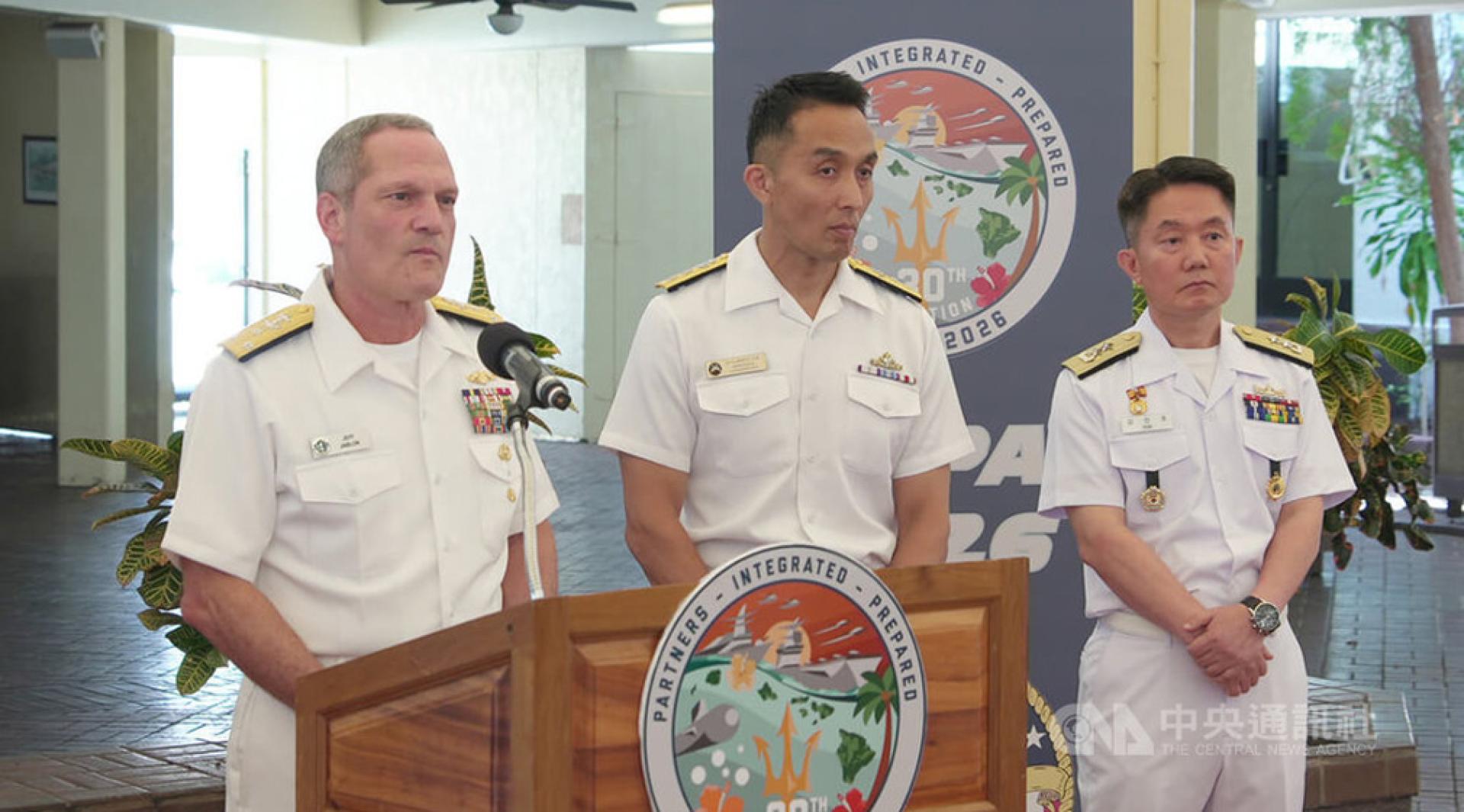
Joint Task Force Commander Jablon (Jeffrey Jablon) and generals from multiple nations attended the opening press conference on Wednesday. After a brief opening speech, they answered questions from more than ten media outlets, with half of the reporters being from Taiwan.
A CNA reporter led with a question regarding Taiwan Strait security: "Although Taiwan does not formally participate in RIMPAC, the security of the Taiwan Strait draws worldwide attention. How does this exercise convey a credible deterrence message to any potential aggressor?"
Jablon replied that this exercise is not targeted at any specific country or aimed to deter any one nation. This year’s theme is "Partners, Integration, and Readiness." The most important objective is to enhance partner interoperability for carrying out maritime missions together and maintaining a free and open Indo-Pacific.
Jablon added that the US military believes in "peace through strength" and "no one wants war. Deterrence is our way of maintaining peace through strength. Our goal is peace."
The United States possesses the world's most powerful military force. With recent months of military conflict in the Middle East, the public is concerned whether it has affected RIMPAC’s preparations. Jablon answered, "Let me tell you directly, there has been no impact." He said that the size of US forces deployed for RIMPAC this year is roughly the same as in the past, and they are ready to jointly train with allies.
In his opening speech, Jablon said this year marks the 250th anniversary of US independence and the 30th RIMPAC exercise. The most important aim is to strengthen the readiness of participating forces to maintain maritime security and regional stability in a free and open Indo-Pacific.
This year’s RIMPAC includes 31 surface ships, 5 submarines, and 197 military aircraft.
Vice Admiral Jablon currently serves as Deputy Commander of the US Pacific Fleet and acts as Joint Task Force Commander for this exercise, with Chile and Japan serving as deputy commanders. A Canadian officer is in charge of air operations, and for the first time in history, a South Korean naval officer is serving as maritime operations commander.
Observers interpret these arrangements as a sign that South Korea is assuming a greater responsibility for regional security, and that US defense policy is shifting toward requiring allies and partners to take primary responsibility for their own defense, while the US provides critical but limited support.
Jablon stated that the division of leadership roles in RIMPAC reflects the shared responsibility among allies and partners.