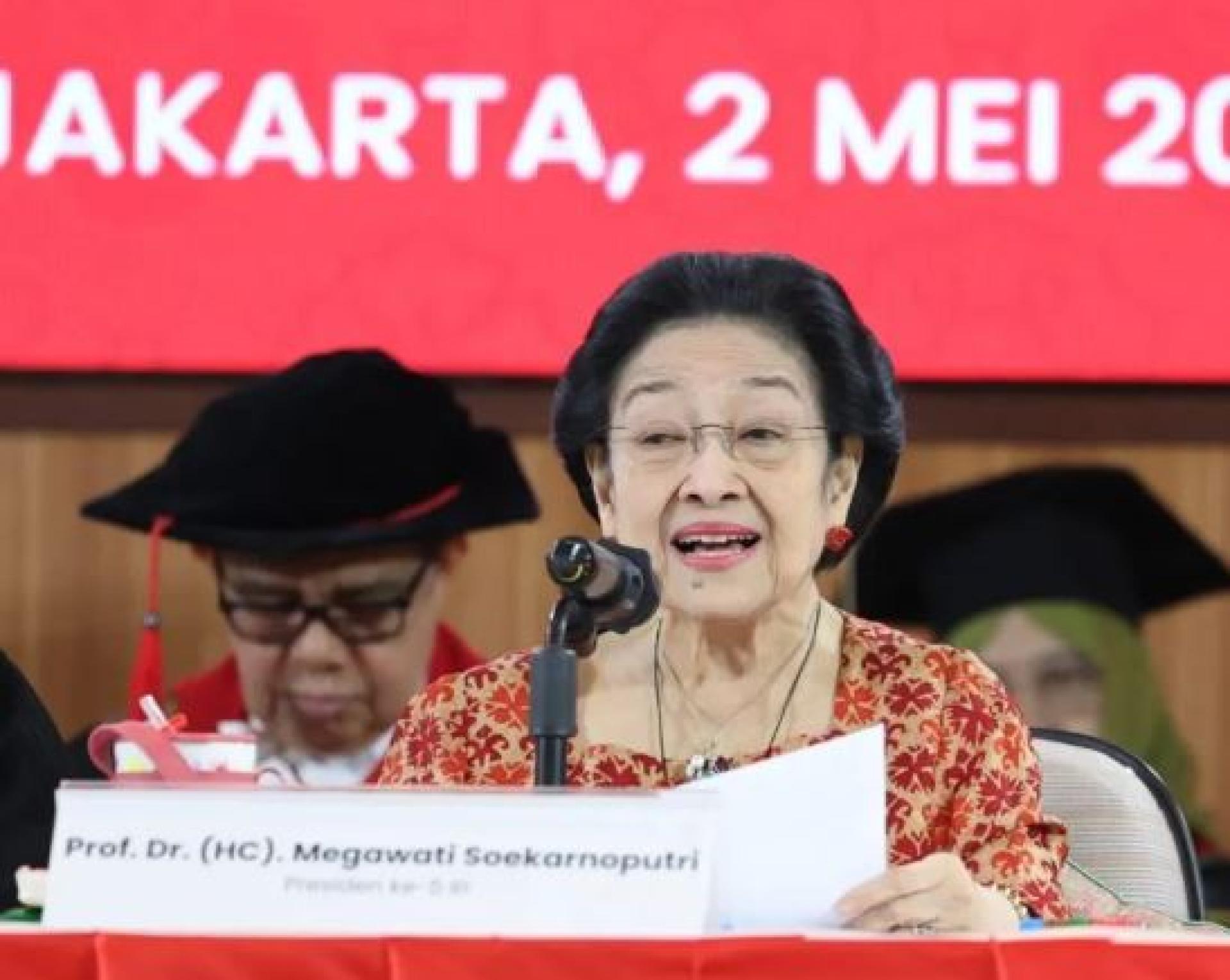
Indonesia’s fifth president Megawati Soekarnoputri emphasized that amid the current phenomenon of “excessively complex regulations”, it is imperative to reestablish Pancasila as the core foundation of the national legal system to prevent the law from deviating from substantive justice.
Speaking at the retirement ceremony of constitutional law professor Arief Hidayat at Borobudur University in Jakarta, she pointed out that the current legal system tends to stack statutes and provisions, but is gradually losing its values and humanistic spirit.
“Pancasila must be the source of all laws. We have long been trapped in a misconception that increasing legal provisions equals the perfection of the rule of law, but in fact, this approach often distances law from justice, morality and humanity.”
She criticized the phenomenon of hyper-regulation, asserting that the law has gradually lost its essential function as a tool to realize fairness and justice, and has become mere “piles of words.”
She stated that the law should not be just static provisions, but must be a living “action” that embodies the nation’s conscience and social values.
Megawati also praised Arief Hidayat’s view that Indonesia as a state of law should not be merely a “country of laws,” but must be built upon fundamental national values.
She quoted Indonesia’s founding president, Soekarno, emphasizing that law should serve as a tool for the people and must be liberating, preventing abuse of power.
She pointed out that Pancasila carries the spirit of the independence struggle, so the legal system should be people-centered to ensure that institutions guarantee fairness—not just satisfy procedural requirements.
She stressed that the direction of law should focus on “substantive justice,” rather than merely following procedural rules; whenever procedures fail to bring fairness, we must return to justice itself.
The event gathered many figures from Indonesia’s legal and political circles, including Constitutional Court Chief Justice Suhartoyo, several university professors, former ministers, and party leaders.
“Pancasila must be the source of all laws. We have long been trapped in a misconception that increasing legal provisions equals the perfection of the rule of law, but in fact, this approach often distances law from justice, morality and humanity.”
She criticized the phenomenon of hyper-regulation, asserting that the law has gradually lost its essential function as a tool to realize fairness and justice, and has become mere “piles of words.”
She stated that the law should not be just static provisions, but must be a living “action” that embodies the nation’s conscience and social values.
Megawati also praised Arief Hidayat’s view that Indonesia as a state of law should not be merely a “country of laws,” but must be built upon fundamental national values.
She quoted Indonesia’s founding president, Soekarno, emphasizing that law should serve as a tool for the people and must be liberating, preventing abuse of power.
She pointed out that Pancasila carries the spirit of the independence struggle, so the legal system should be people-centered to ensure that institutions guarantee fairness—not just satisfy procedural requirements.
She stressed that the direction of law should focus on “substantive justice,” rather than merely following procedural rules; whenever procedures fail to bring fairness, we must return to justice itself.
The event gathered many figures from Indonesia’s legal and political circles, including Constitutional Court Chief Justice Suhartoyo, several university professors, former ministers, and party leaders.