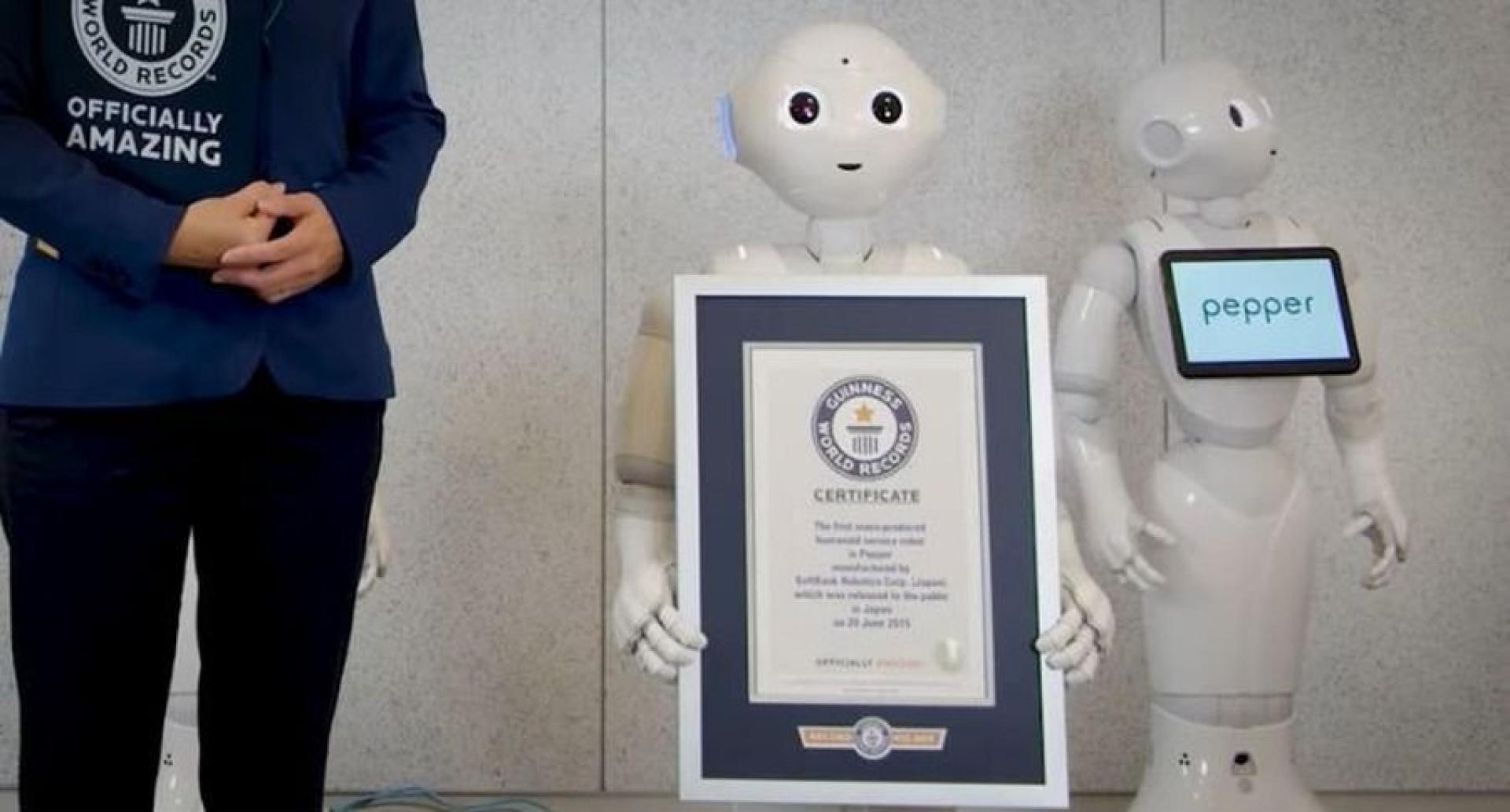
World’s First Mass-Produced Humanoid Robot Certified by World Records
Published atFeb 04, 2026 10:06 pm
SoftBank Robotics Corporation of Japan has announced that its humanoid robot “Pepper” has been certified by Guinness World Records as the world’s first mass-produced humanoid robot.
Since its debut in 2014, this 121-centimeter-tall robot, with its friendly appearance, has seen widespread use in commercial guidance, caregiving companionship, and educational fields, demonstrating the early commercial success of humanoid robots. The world’s first full-sized humanoid robot “Bolt” with a peak speed of 10 meters per second.“Bolt” completes the 100-meter dash in just 10 seconds
Meanwhile, the Humanoid Robotics Innovation Institute at the Hangzhou International Science and Innovation Center of Zhejiang University in China has recently partnered with Mirror Image Technology and Kelda Group to officially unveil “Bolt,” the world’s first full-sized humanoid robot capable of reaching a peak speed of 10 meters per second. At 175 centimeters tall and weighing 75 kilograms, its name is inspired by the renowned sprinter Usain Bolt. In demonstration footage, Bolt is seen running steadily and swiftly on a treadmill, reaching a top speed of 10 meters per second, which means it can complete a 100-meter dash in just 10 seconds—setting a new world record for full-sized humanoid robot speed.
The development team systematically enhanced the robot’s explosive power, dynamic balance, and agility through innovative joint design and all-dimensional power system optimization. Previously, the team’s quadruped robot “Black Panther II” broke Boston Dynamics’ record with a score of 10.3 meters per second. This time, their successful technology transfer to the humanoid field demonstrates a continued leading edge in motion control.
The team hopes that Bolt can become a “smart training partner” for athletes, helping to achieve breakthrough results through real-speed confrontation training and promoting the deep integration of technology and sports. At the same time, this breakthrough opens up broader application prospects for future emergency response, industrial inspection, and other scenarios.
This article has been translated using our AI technology. While we strive for accuracy,
AI translations
may contain errors. For the most precise information, please refer to the original article.