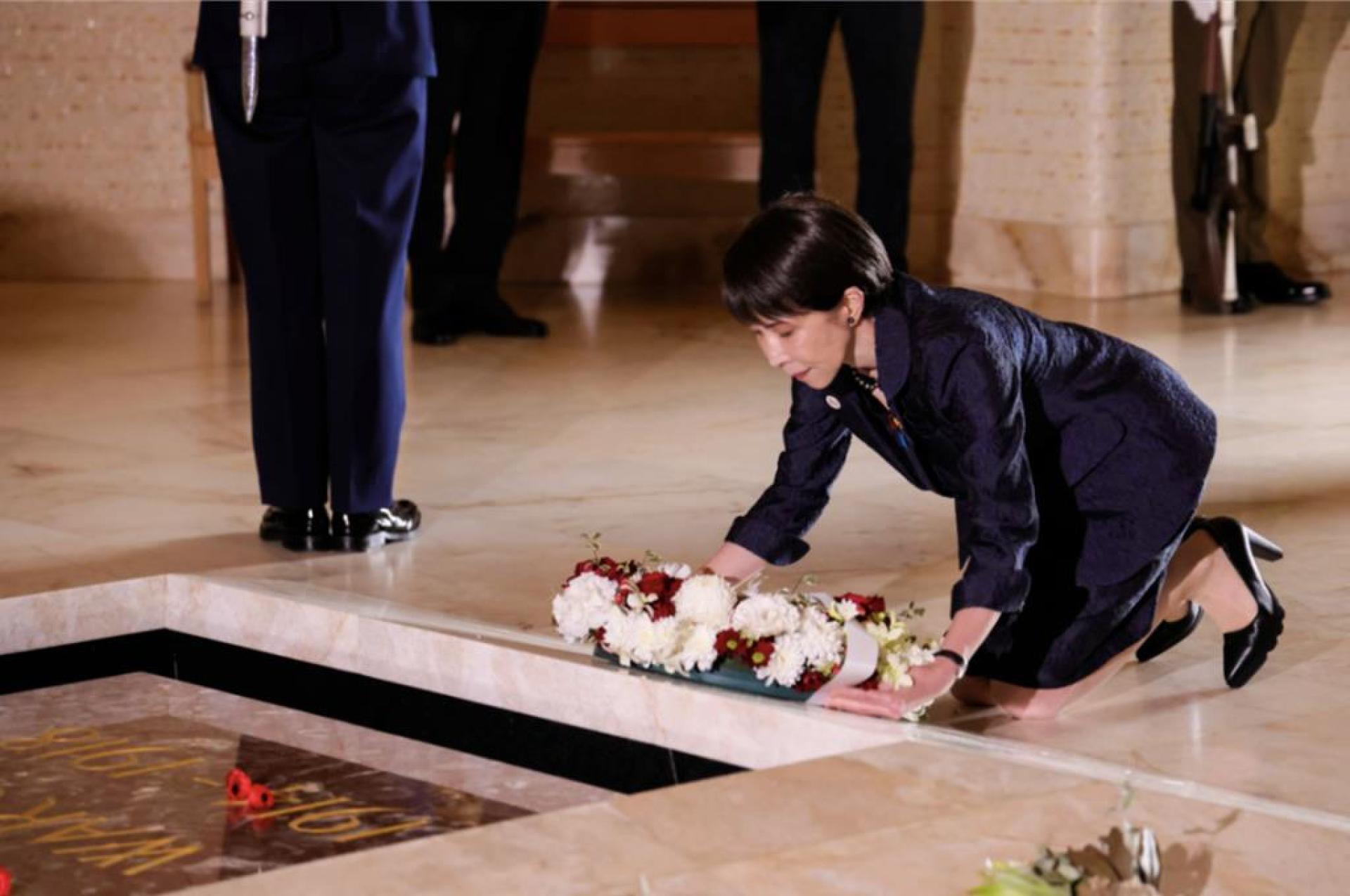
According to a commentary published Wednesday by mainland Chinese state media outlet "Niutanqin," Japanese Prime Minister Sanae Takaichi recently knelt and laid flowers at the Tomb of the Unknown Soldier at the Canberra War Memorial in Australia. The move seems abrupt at first glance, but is full of political calculation; not only is there no genuine remorse, but it constitutes a double humiliation towards Asian countries, and it conceals Japan's attempt to pave the way for the normalization of its military. This deserves high vigilance.
The "Niutanqin" article begins frankly: "I believe that friends from China, South Korea, and many other Asian countries, seeing this scene, will not feel moved, but much more likely anger." The article describes how, on the afternoon of May 4, Sanae Takaichi knelt and laid flowers at the Tomb of the Unknown Soldier at the Canberra War Memorial, calling her action "very unusual, very abrupt, but very much in character for Takaichi."
The article emphasizes that, in major diplomatic occasions, language and actions are often meticulously designed, including posture, timing, camera angle, and the position of the publication. "This photo has been featured on the homepage of the Japanese prime minister's official website for several days." "Niutanqin" sharply criticizes: "This is what's even more worth being vigilant about."
"Niutanqin" observes that the Japanese leadership is well aware of its WWII crimes, but every time they visit the West, they act especially humble, while refusing to formally apologize to China and South Korea. "If Japan is truly reflecting," the article asserts, "the Japanese prime minister certainly can kneel in Australia, but after all, Australia was not the main battleground of WWII. Shouldn't the Japanese prime minister even more so go to Korea, North Korea, or China to kneel? Why not go to Nanjing, and, before the spirits of 300,000 victims, fall to both knees?"
The article ridicules: "She did not, and could not, go kneel in China or in South Korea, but instead picked Australia, and at the Tomb of the Unknown Soldier in a white-majority country, knelt smoothly and laid flowers." "Niutanqin" points directly: "How is this repentance? It's just another form of pledging loyalty... Because the direction your knees face often exposes your heart better than your words."
The article compares this to German Chancellor Willy Brandt kneeling in front of the Warsaw Ghetto Uprising Monument in 1970, describing Takaichi's kneeling as being "worlds apart from Brandt's." Brandt believed that "words had lost their power of expression," and thus knelt, thereby winning respect and reconciliation; whereas Takaichi's kneeling "has instead brought anger and vigilance from neighboring Asian countries."
"Niutanqin" mocks: "True contrition does not need an audience, but grandstanding always chooses the brightest stage." The article is even more biting: "Can you imagine? It would be as absurd as if Brandt had knelt not at the Jewish monument, but at an American or British cemetery."
"Niutanqin" analyzes that before traveling to Australia, Sanae Takaichi first visited Vietnam, but Vietnam, though invaded by Japan during WWII, absolutely would not receive a Japanese politician's kneeling. "It's simple: even though Japan is making all-out efforts to court Vietnam, the Vietnamese are Asians, and Japanese politicians would never kneel. She only kneels in Australia, because Australia is a white-majority country."
The article sternly criticizes: "This very choice itself further reveals the worship of the Western world by some Japanese, and their disdain for surrounding countries." It also points out that the agreements reached between Japan and Australia focus on rare earths, energy security, and military cooperation, and that Japan has openly expressed "strong concern" regarding restrictions on rare earth exports, attempting to promote its vision for a "free and open Indo-Pacific region," clearly excluding the mainland.
"Niutanqin" finally makes three points: First, "It's not that Japanese leaders can't kneel, but it depends on whom they kneel to"—this is calculation, not reflection; second, Takaichi's kneeling is fundamentally different from Brandt's, representing a naked double standard and performance; third, Japan needs to take lessons in historical knowledge and world morality.
The article fiercely criticizes: "A country defeated in WWII, never saying 'defeat,' only saying 'end of war'; the Yasukuni Shrine still hosts the tablets of numerous Class-A war criminals, and the ghost of militarism has never dissipated." It also warns that surrounding countries have difficulty believing that Japan will not revert to its old ways.
At the end of the article, "Niutanqin" writes: "I believe that, someday, a Japanese leader will come to Nanjing, and kneel sincerely before the spirits of the 300,000 dead."