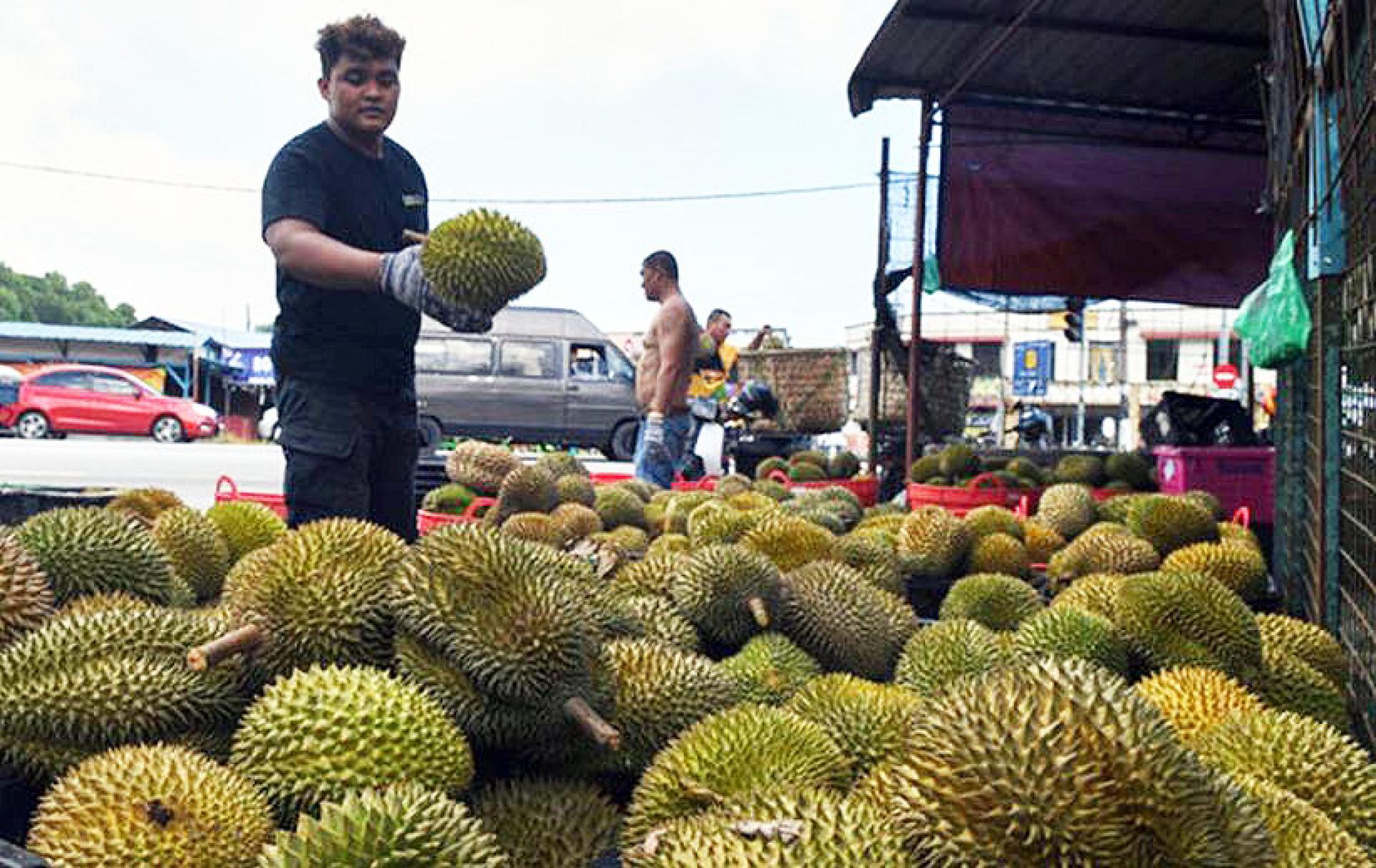
Malaysia’s Minister of Agriculture and Food Security, Datuk Seri Mohamad Sabu, pointed out that Malaysia is negotiating with the Thai government and the General Administration of Customs of China to open up a land route for exporting Malaysian durians to China, in order to reduce logistics costs and expand into the Chinese market.
He said this move is one of the measures the Malaysian government is taking to assist durian growers, especially as several states’ durian seasons are arriving simultaneously, resulting in an oversupply in the market.
“The Thai minister of agriculture has already met with me; we will be discussing how to export to China via land and railways. Currently, we are in close negotiations with Thailand and the General Administration of Customs of China.”
He said this to Bernama today after accompanying Pakatan Harapan’s Million Town state seat candidate, Zhang Chenyi, in canvassing votes from residents at Masai Street.
Mohamad Sabu mentioned that compared to the currently expensive air freight model, land transportation is expected to be a more economical option.
He said this measure will also help open up the market in China’s smaller cities, each with a population of about two million, representing huge market potential.
He said that with the durian season occurring concurrently in Kedah, Penang, Perak, Selangor, Johor, and Pahang, market supply has increased, causing pressure on prices for growers. However, consumers can now enjoy high-quality durians such as Musang King and Black Thorn at lower prices.
When talking about agricultural development in Johor, Mohamad Sabu said that Johor remains one of Malaysia’s main agricultural producing states, being a major producer of pineapples, fruits, and vegetables.
He said the pineapple industry development program promoted by the Ministry of Agriculture has doubled output over the past three years and has attracted more young people to take up pineapple farming for higher incomes.
On food security, he said Malaysia still needs to increase the self-sufficiency rates of major agricultural products such as rice, meat, and feed corn.
He said a recent visit to Iran made him deeply aware of the importance of food security, as Iran is able to meet 85% of its food needs and only needs to import 15%.
“Our domestic rice production is still insufficient, and our meat supply still relies on imports. As for corn for animal feed, we depend almost 100% on imports.”
“We are actively promoting various policies, and we hope that by 2030, at least 30% of our animal feed corn can be produced domestically.”