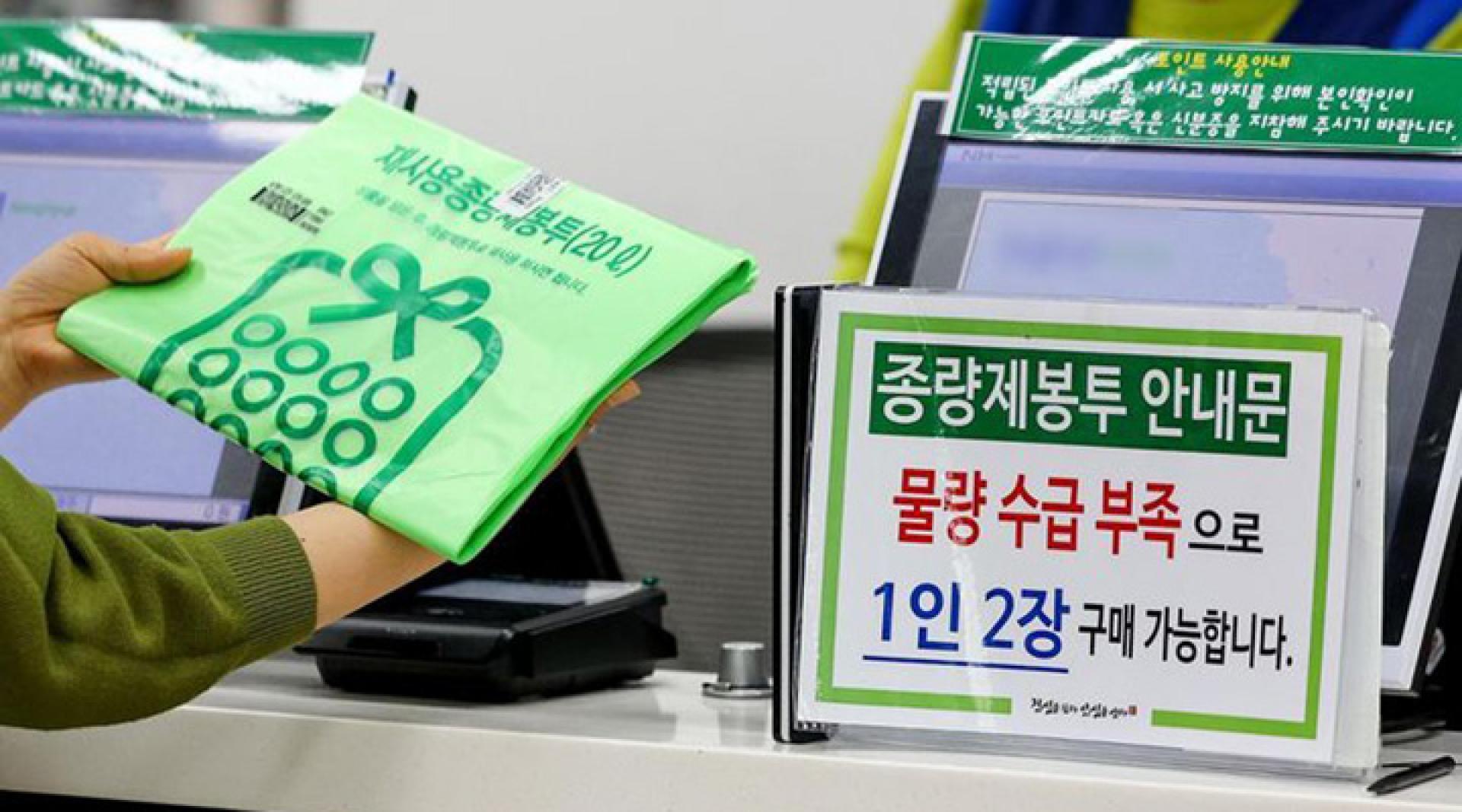
The South Korean government has announced that the average stock of garbage bags can last for more than three months. Additionally, the government has issued 12 nationwide energy-saving initiatives, including shortening shower times.
South Korea has an extremely high dependence on external sources for energy. According to data from the Korea International Trade Association, about 70% of the country’s oil and 20% of its liquefied natural gas comes from the Middle East. Since the United States and Israel launched military strikes against Iran at the end of February, shipping through the Strait of Hormuz has been continuously disrupted, putting South Korea's energy supply under great pressure.
Due to this, concerns over the supply of naphtha, a refined oil product, have intensified in the South Korean market, even leading to a wave of panic buying of garbage bags.
In South Korea, residents must use special garbage bags issued by local governments or purchased at supermarkets and convenience stores to dispose of household waste. According to Nikkei Asia, the Ministry of Environment, Climate and Energy of South Korea issued an emergency statement on Wednesday, urging the public to remain calm, and stating that currently, the stock of garbage bags held by local governments nationwide is enough to last for an average of more than three months.
The Ministry of Environment stated, “Some local governments may impose purchase limits per person on garbage bags, but this is a preventive measure aimed at avoiding panic buying driven by anxiety about the Middle East conflict, and is unrelated to supply stability.”
On the same day, the President’s Chief Secretary for Public Relations stated in an interview that the president had instructed relevant departments to study the use of recycled materials in garbage bag production, and emphasized that “currently, the likelihood of a ‘garbage bag shortage’ is extremely low.”
The South Korean government also issued 12 nationwide energy-saving initiatives, calling on people to shorten shower duration, choose bicycles for short-distance travel, actively cooperate with vehicle restrictions, prioritize public transportation, control indoor temperatures reasonably, and try to charge electric vehicles and electronic devices during daylight hours.
The government announced that starting Wednesday, all public institutions would implement a license plate end-number traffic restriction system for official vehicles. This is the first time in 15 years South Korea has relaunched this measure in the public sector, after it was implemented in 2011 when international oil prices exceeded $100 per barrel.
In addition, the authorities plan to implement staggered commuting hours to reduce traffic pressure, while also requiring energy-intensive enterprises to formulate energy-saving plans. Qualified enterprises will receive priority support in areas such as financing for energy-saving facilities.
Due to this, concerns over the supply of naphtha, a refined oil product, have intensified in the South Korean market, even leading to a wave of panic buying of garbage bags.
In South Korea, residents must use special garbage bags issued by local governments or purchased at supermarkets and convenience stores to dispose of household waste. According to Nikkei Asia, the Ministry of Environment, Climate and Energy of South Korea issued an emergency statement on Wednesday, urging the public to remain calm, and stating that currently, the stock of garbage bags held by local governments nationwide is enough to last for an average of more than three months.
The Ministry of Environment stated, “Some local governments may impose purchase limits per person on garbage bags, but this is a preventive measure aimed at avoiding panic buying driven by anxiety about the Middle East conflict, and is unrelated to supply stability.”
On the same day, the President’s Chief Secretary for Public Relations stated in an interview that the president had instructed relevant departments to study the use of recycled materials in garbage bag production, and emphasized that “currently, the likelihood of a ‘garbage bag shortage’ is extremely low.”
The South Korean government also issued 12 nationwide energy-saving initiatives, calling on people to shorten shower duration, choose bicycles for short-distance travel, actively cooperate with vehicle restrictions, prioritize public transportation, control indoor temperatures reasonably, and try to charge electric vehicles and electronic devices during daylight hours.
The government announced that starting Wednesday, all public institutions would implement a license plate end-number traffic restriction system for official vehicles. This is the first time in 15 years South Korea has relaunched this measure in the public sector, after it was implemented in 2011 when international oil prices exceeded $100 per barrel.
In addition, the authorities plan to implement staggered commuting hours to reduce traffic pressure, while also requiring energy-intensive enterprises to formulate energy-saving plans. Qualified enterprises will receive priority support in areas such as financing for energy-saving facilities.