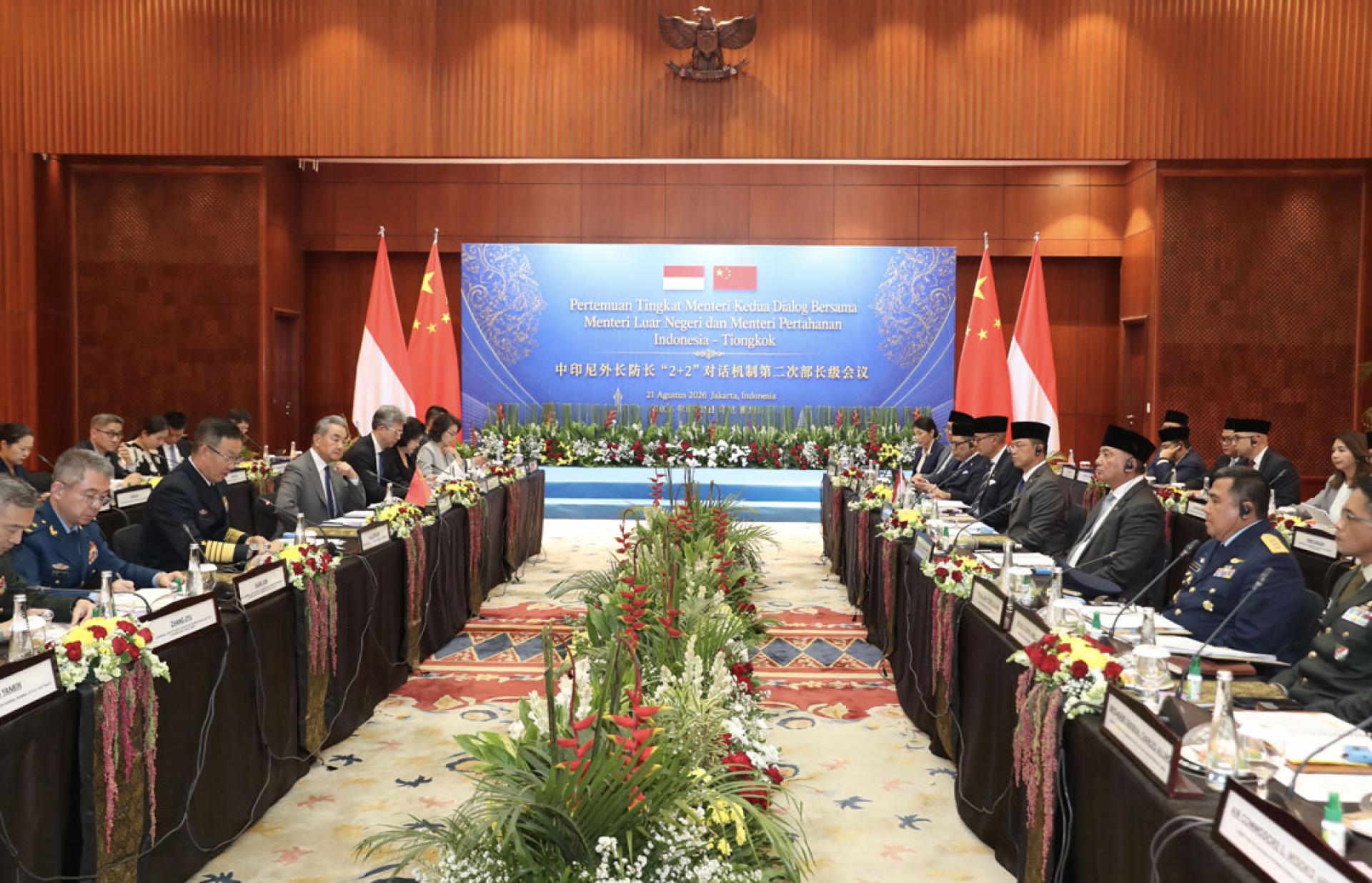
The second ministerial meeting of the China-Indonesia Foreign and Defense Ministers '2+2' Dialogue Mechanism was held on the 21st in Jakarta, Indonesia. Chinese Foreign Minister Wang Yi and Defense Minister Dong Jun attended alongside Indonesian Foreign Minister Retno Marsudi and Defense Minister Prabowo Subianto. The two sides held in-depth strategic communication and reached a series of important consensuses.
Wang Yi stated that the China-Indonesia '2+2' mechanism is the first ministerial-level '2+2' mechanism established by China globally, building a new platform for strategic communication between the two countries. The first meeting strongly promoted political-security and defense cooperation, jointly safeguarding the legitimate interests of both countries. Over the past year, the international situation has undergone major changes, the transformation unseen in a century is accelerating, and international challenges keep emerging. As major developing countries and important members of the Global South, China and Indonesia timely enhance solidarity and cooperation, which means much more than just the bilateral level and will play a demonstrative and leading role in the region and the world. China is willing to work with Indonesia to implement the strategic consensus reached by the two countries' leaders to date, jointly consolidate the foundation of political-security cooperation, and advance the construction of a community with a shared future at a high level, for the greater benefit of the people of both countries, and contribute more to regional and global stability and prosperity.

He said that the world is currently at a crossroads of unity or division, cooperation or confrontation. More than 70 years ago, China and Indonesia worked hand in hand to make a historic contribution to the successful Bandung Conference, promoting Asia-Africa-Latin America solidarity and cooperation. Under the new era's circumstances, China and Indonesia should continue to promote the Five Principles of Peaceful Coexistence and the Bandung Spirit, gather the strength of developing countries, and work together to promote Global South cooperation. China is willing to strengthen strategic coordination with Indonesia in multilateral platforms such as the United Nations, APEC, and BRICS, advocate for a multipolar world featuring equality and order, inclusive and beneficial economic globalization, and promote the construction of a more just and reasonable global governance system.
Dong Jun stated that in recent years, under the strategic guidance of the leaders of both countries, bilateral defense cooperation has been improved in quality and efficiency, providing a model for the new type of defense cooperation between the Global South and developing major countries. At present, the global transformation has entered a new cycle of intensified crisis, and the region faces multiple security challenges. China is willing to work with Indonesia to advance defense and military construction cooperation with a strategic perspective, continuously explore the potential for defense cooperation, create more highlights, build a solid security barrier for their respective developments, play a backbone role in regional stability, and inject more stability, certainty, and constructiveness into a world full of turmoil.
Retno Marsudi pointed out that against the backdrop of the current challenging international situation, holding the second ministerial '2+2' meeting between Indonesia and China bears great significance, fully reflecting the high level of strategic mutual trust and strong willingness to cooperate between the two countries. Indonesia thanks China for its firm support on matters such as safeguarding national sovereignty, reaffirms its commitment to the One China Policy, opposes any external interference, and is willing to expand cooperation with China on counter-terrorism, law enforcement, combating cyber fraud, strengthening intelligence sharing and capacity building, and deepen communication and collaboration within frameworks such as ASEAN-China multilateral cooperation, jointly maintaining regional peace and stability.
Prabowo Subianto also said that since the first ministerial meeting of the dialogue mechanism, cooperation between the two militaries has further consolidated its positive momentum. Indonesia is willing to strengthen strategic communication with China, increase military exchanges, further cooperation in defense, maritime security, cyber security, combating online gambling and telecommunications fraud, as well as transnational crime, resolutely safeguard regional peace and stability, and jointly respond to global challenges. As long as the two countries maintain brotherly friendship, the comprehensive strategic partnership will continue to achieve new development.
The two sides exchanged in-depth views on international and regional security issues of common concern and unanimously agreed to coordinate development and security, and unite to address various external challenges. Both sides will foster a sense of security partnership, mutually support each other's core interests, jointly oppose external interference, keep the future of their countries and nations in their own hands, better safeguard the modernization processes of both countries, and contribute more to world peace and development.
Both sides highly evaluated the role of the '2+2' mechanism, and will continue to rely on this important strategic communication platform to deepen solidarity and cooperation, and promote positive progress in political-security and defense cooperation. Both sides agreed to strengthen law enforcement and security cooperation against transnational crime, fugitive pursuit and asset recovery, and support participation in the international fight against telecom and cyber fraud. The two sides will implement maritime security cooperation documents and ensure the security and smooth operation of key sea lanes.
The two sides will deepen defense cooperation, advance normalization and institutionalized development of pragmatic cooperation such as equipment technology, joint exercises and training, personnel training, maritime security, and continuously improve quality and efficiency. Both sides will jointly advocate for an Asian security model based on sharing security, seeking common ground while reserving differences, and dialogue and consultation, to truly safeguard mainstream cooperation in the region and peace and stability in the South China Sea. Both sides are also willing to carry out more cooperation within the framework of the Four Major Global Initiatives and jointly safeguard the multilateral trading system, strengthen coordination on Middle East issues, and actively promote peace and end conflict.
Both sides agreed to effectively turn consensus into outcomes, set an example of unity and self-improvement for developing countries, and strive to maintain peace and promote development.