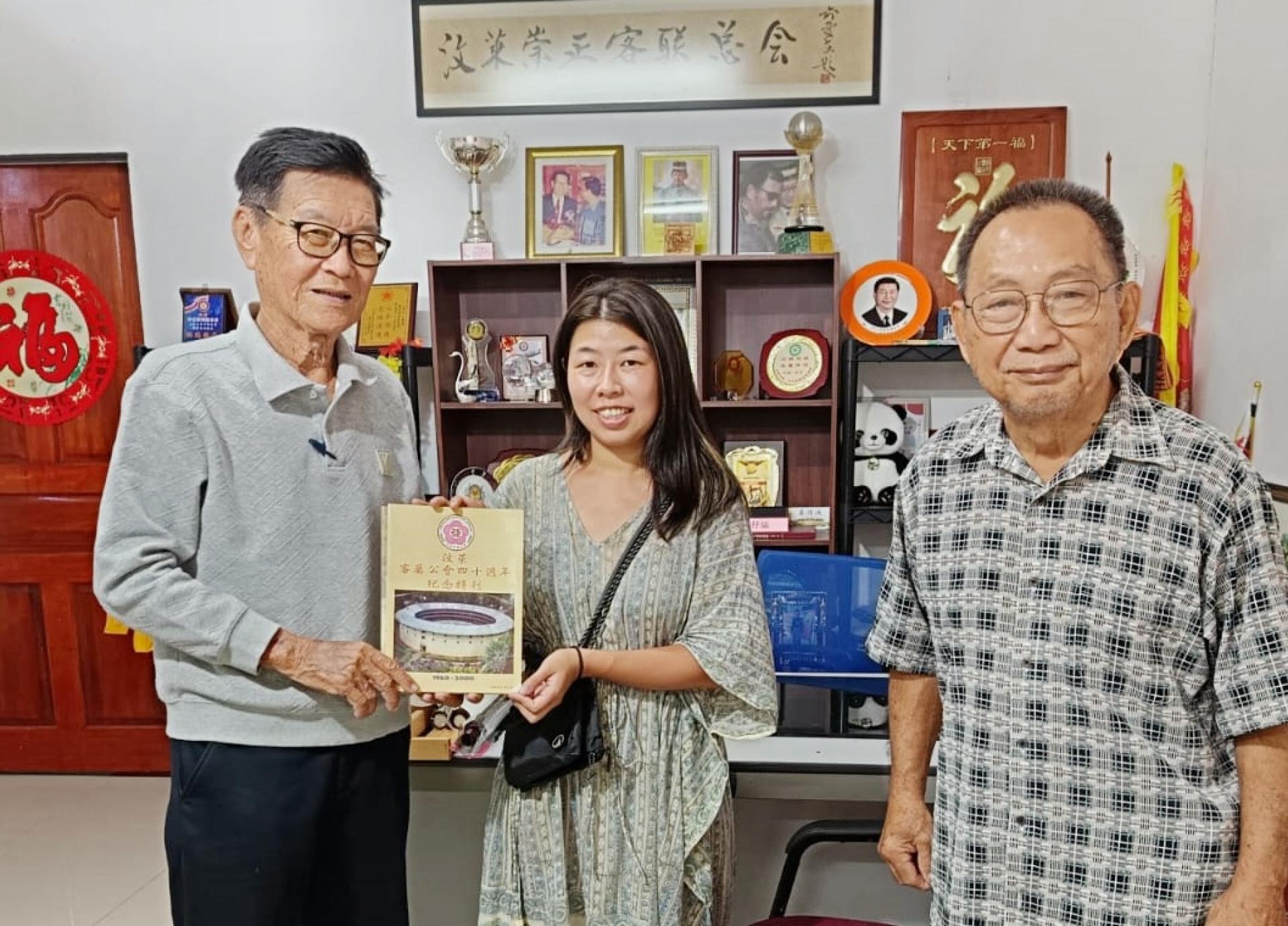
(Bandar Seri Begawan, 9th) Hsieh Kai-Chuan, specialist of the Hakka Foundation under the Taiwan Hakka Affairs Council’s "Hakka Stream Project," recently made a special visit to Brunei, and met with Chua Chai Yun, spiritual leader of Brunei's Hakka community and Founding and Permanent Honorary President of the Brunei Chung Cheng Hakka Association. Both parties engaged in an in-depth exchange on topics such as the history of Hakka ancestors migrating south, the daily life and culture of Hakkas in Brunei, and the inheritance of Hakka culture.
The exchange was held in Chua Chai Yun's office, and the association’s Deputy Welfare Director, Yang Guo Hua, was also present to welcome the visitors. At the meeting, both parties focused on discussing the 19th-century history of Hakka people crossing the seas from Meizhou, Huizhou, and other places in Guangdong to Brunei to seek livelihoods and settle down, and exchanged views on the life habits, food culture, and social development of early Hakkas in Brunei.
Both parties paid special attention to the continuation of Hakka culture among younger generations, and discussed how Hakka language, traditional culture, and the Hakka spirit can continue to be inherited by the third and fourth generations of Hakka descendants.
During the discussion, Chua Chai Yun provided Hsieh Kai-Chuan with precious original materials such as early member registers, event photos, and related historical documents preserved by the Brunei Chung Cheng Association, offering invaluable first-hand resources for Taiwan’s research on Southeast Asian Hakka history and culture.
Hsieh Kai-Chuan expressed gratitude to Chua Chai Yun for his long-term dedication to preserving and promoting Hakka culture, and also thanked the Brunei Chung Cheng Association for its strong support during this field investigation.
Chua Chai Yun in turn thanked the Taiwan Hakka Affairs Council, the Hakka Foundation, and the Taiwan Hakka Culture Association for their long-standing concern for Southeast Asian Hakka communities, and recognized Taiwan’s efforts and contributions in promoting and advocating Hakka culture.
Both sides stated that in the future, they will further strengthen exchanges and cooperation between Taiwanese and Brunei Hakka communities, promote the preservation and inheritance of Hakka history, culture, and language, and work together to contribute to the continuing development of global Hakka culture.
The exchange was held in Chua Chai Yun's office, and the association’s Deputy Welfare Director, Yang Guo Hua, was also present to welcome the visitors. At the meeting, both parties focused on discussing the 19th-century history of Hakka people crossing the seas from Meizhou, Huizhou, and other places in Guangdong to Brunei to seek livelihoods and settle down, and exchanged views on the life habits, food culture, and social development of early Hakkas in Brunei.
Both parties paid special attention to the continuation of Hakka culture among younger generations, and discussed how Hakka language, traditional culture, and the Hakka spirit can continue to be inherited by the third and fourth generations of Hakka descendants.
Hsieh Kai-Chuan expressed gratitude to Chua Chai Yun for his long-term dedication to preserving and promoting Hakka culture, and also thanked the Brunei Chung Cheng Association for its strong support during this field investigation.
Chua Chai Yun in turn thanked the Taiwan Hakka Affairs Council, the Hakka Foundation, and the Taiwan Hakka Culture Association for their long-standing concern for Southeast Asian Hakka communities, and recognized Taiwan’s efforts and contributions in promoting and advocating Hakka culture.
Both sides stated that in the future, they will further strengthen exchanges and cooperation between Taiwanese and Brunei Hakka communities, promote the preservation and inheritance of Hakka history, culture, and language, and work together to contribute to the continuing development of global Hakka culture.