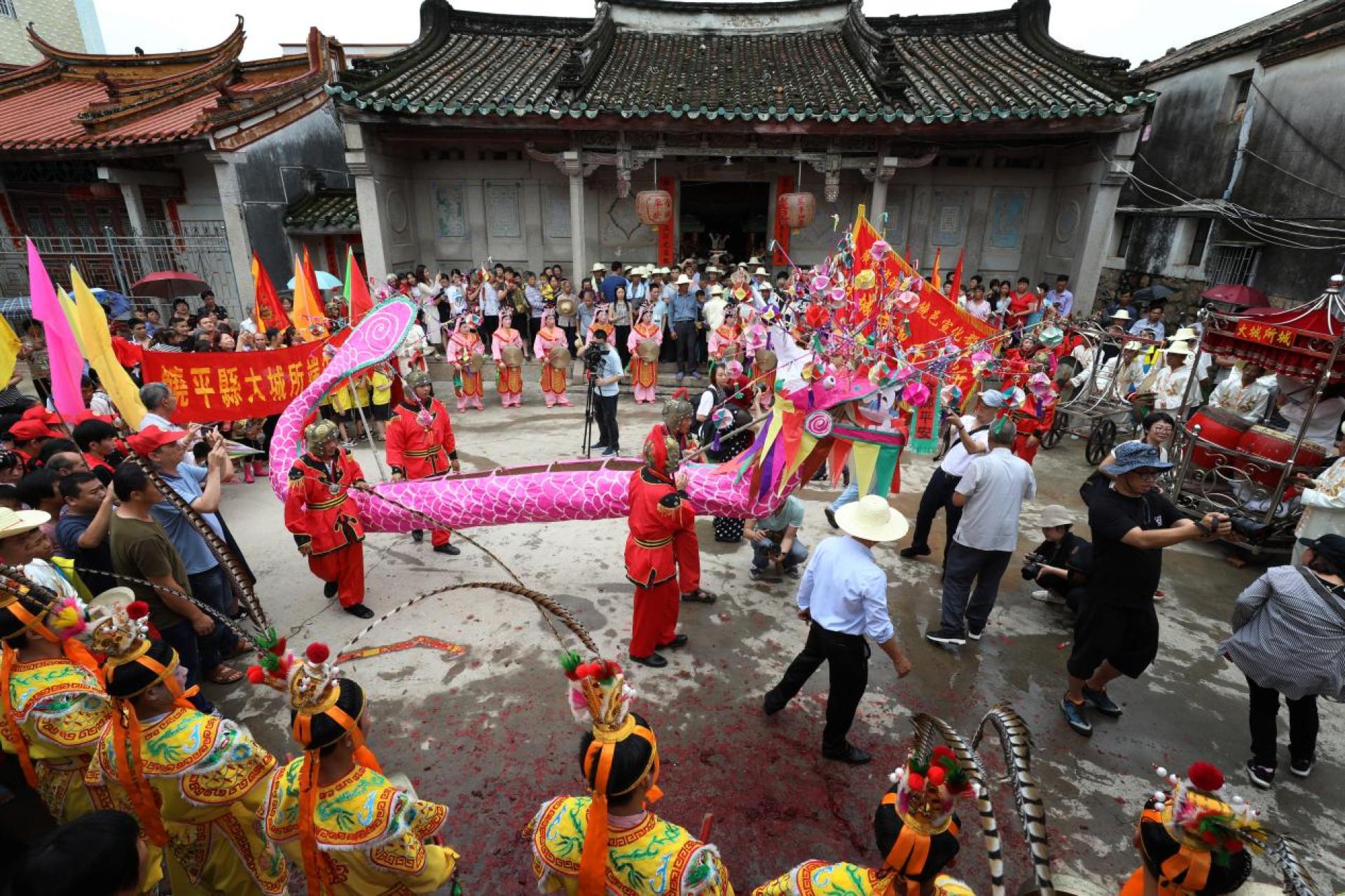
During the Dragon Boat Festival, the waters of Guangdong are filled with the sound of drums. Yet in Dachengsuo, Raoping, Chaozhou, a special dragon boat parade is quietly taking shape in the deep lanes of the ancient streets—the dragon boat does not travel by water, but only on land.
What is a land dragon? Who is it that year after year weaves the dragon’s tendons and bones? And why has a city guarded it for 600 years?
One Dragon, Six Colors, Parading Through Three Streets and Six Alleys
The land dragon has walked the land of Raoping for 600 years. Every year, from the first to the sixth day of the fifth lunar month, the entire town of Suocheng enters into the period of "parading the land dragon."
Chen Huanqun is a native of Suocheng. His main job is as a rural elementary school teacher, and he is also the president of the Traditional Culture Promotion Association of Dachengsuo, Raoping County. For him, parading the land dragon is not just a folk custom, but a living testimony of history.
He weaves through the three streets and six alleys of Dachengsuo, introducing them as if counting treasures: “From the first to the sixth day, there are six land dragons in total—pink, reddish brown, green, purple, red, yellow—each appearing in sequence, carrying with them our beautiful wishes for favorable weather and national peace and prosperity.”
Each land dragon is about 7 meters long, with a bamboo frame for bones and paper for scales, and is covered all over with flower balls crafted from colored paper. During the parade, elders lead the way sprinkling water tinged with red flowers, while people carry the land dragon through the three streets and six alleys of Suocheng. Children aim for the flower balls on the dragon’s body, waiting for a chance to "snatch" them—whoever gets one will have good luck for the entire year.

A Nostalgic Memory Exclusive to Suocheng
Behind the land dragon parade is a story of migration and grounding.
Chen Huanqun’s research reveals that before Dachengsuo was established, the area nearby actually had streams, the biggest being Longxi (Dragon Stream), named for its perennial dragon boat races, and located to the west of today’s Suocheng Town. Later, as the coastline retreated and the river silted up, waterborne dragon boat races became impossible.
The garrison of Dachengsuo was made up of soldiers and families from all over China, many of whom came from Hunan and Hubei provinces. As the Dragon Boat Festival approached, they missed the bustling dragon boat races of their homelands, so they crafted land dragon boats using bamboo strips, bamboo splints, and colored paper, and paraded them through the town. From the Ming and Qing dynasties to the present, the land dragon parade has been infused with Chaozhou craftsmanship, music, embroidery, woodcarving, and many other local cultural elements, becoming a unique folk activity.
The soldiers who left their homes long ago embedded their longing for their native lands into the land dragon. Over the generations, the foreign land became home, and the land dragon became a unique vessel of nostalgia for the people of Suocheng. Every Dragon Boat Festival, with the sound of drums and the march of the land dragon, the streets and alleys fill with people—elderly residents who have lived here for generations, young parents carrying their children to join the festivities, and those returning from faraway places just for this moment.
Six hundred years ago, when the soldiers stationed at Dachengsuo could no longer race on the water, they substituted with the land dragon, shouldering it to travel throughout the three streets and six alleys. Today, this dragon still roams the land, passing through city gates and vibrant daily life, continuing without end.