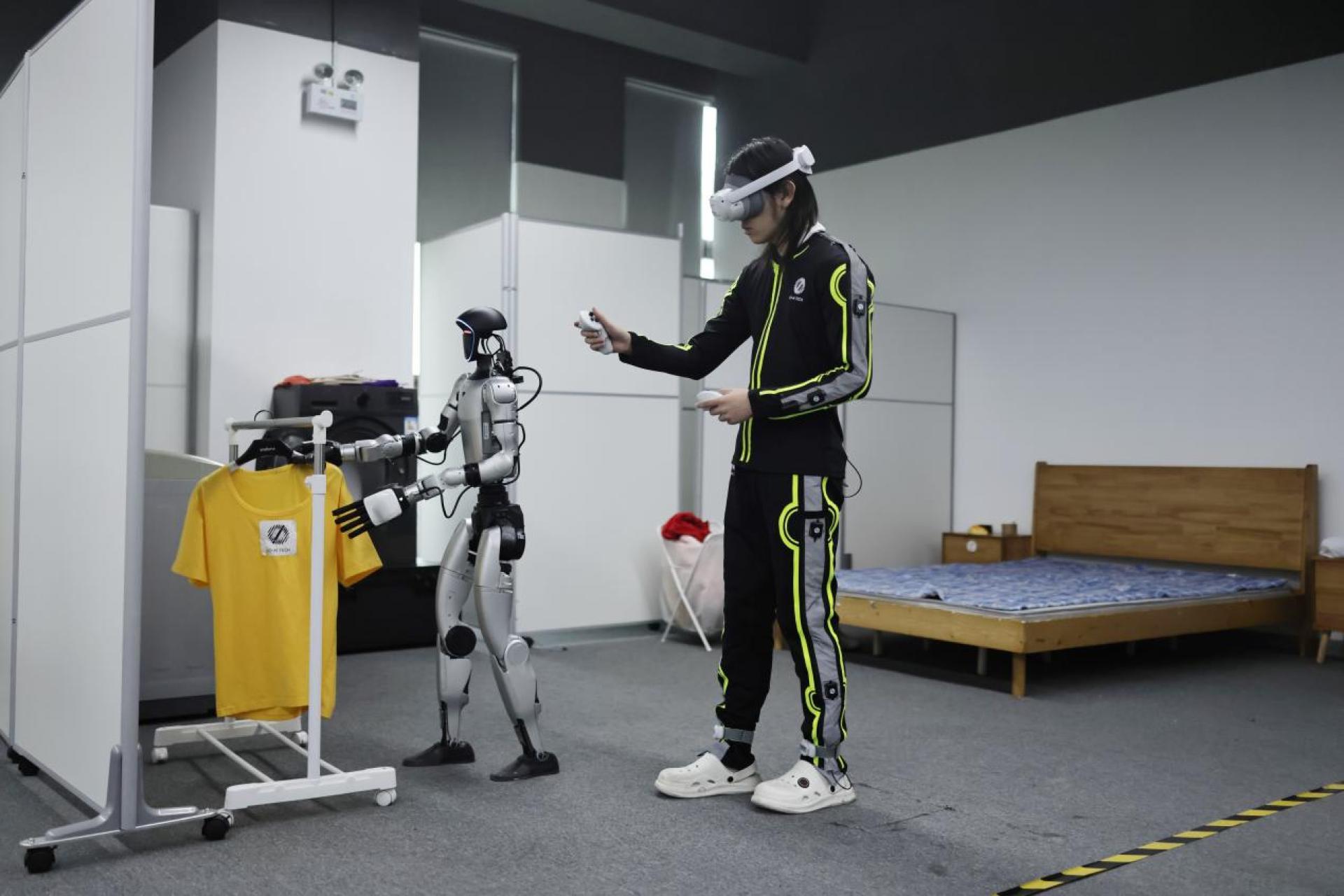
In each separate space, young employees wear motion capture suits, holding controllers in hand, moving slowly but precisely to perform actions like grasping, flipping, and placing. Beside them, the robots imitate synchronously like a mirror.
They are the "robots' first teachers", engaged in a job that sounds somewhat sci-fi: teaching robots to understand the world and learn how to act.
This is an emerging position—data collector. In daily work, they may repeat the same action tens of thousands of times, so that robots can learn to break down and reorganize actions, and eventually internalize them as their own "muscle memory."

A Novel "Parenting" Experience
During data collection, the body needs to maintain an extremely standard posture. The degree of finger bending and the range of wrist rotation must be accurate to the millimeter.
"Yes, it's really tiring," says data collector Xiao Peng. "But when you see it slowly learning, you feel it's worth it."
He has a cat named "Fa Cai" (Fortune), which he brought home at two months old and is now two years old. From teaching the cat to use the litter box, to teaching it to shake hands, high-five, and spin, he enjoys the process of "teaching things to do what they couldn't before." Now, he brings the same patience to the robot.
"Robots learn slowly, but after experiencing tens of thousands of repetitions and seeing it get smarter and able to interact with you—from failing at every action to doing it well—the sense of accomplishment is like watching a child grow up."
Xiao Peng describes his work this way: "Extremely sci-fi." He offers a vivid comparison: "If you liken a robot to ingredients, doing data collection is like being a chef—the quality of the ingredients determines if a good dish can be made. Teaching robots actions is also like raising a kid: from not being able to walk to being able to steadily grasp things, it's a very magical feeling."
"It's like my shadow—whatever I do, it does too. Sometimes I even feel like I'm creating another version of myself," says Xiao Peng.
He uses a younger and more passionate metaphor: "It's like piloting a Jaeger in Pacific Rim."
But this skill of "piloting a Jaeger" is far from as romantic as in the movies. More common scenes are: the robot suddenly loses control, its robotic arm crashes into a desk corner, or the finger gripper gets stuck. At this time, the collector must put down the controller, squat to check and debug, and start over.
Of course, there are discouraging moments. "Just like teaching a kid who just can't learn," Xiao Peng says.

"Infrastructure" Starting from Zero
Ding Zhezhang, co-founder of AIo Smart, did the math: a simple grasping action requires at least ten thousand valid data samples before the robot gains basic generalization ability. To allow a robot to autonomously make decisions in complex scenarios, the data volume must reach the scale of millions or tens of millions.
"Human learning needs data, and model learning even more so," he says. "Embodied intelligence data, unlike text or images, must integrate multiple modalities like vision, movement, joints, and environmental perception. It must be real interaction in the physical world—what things people touch, how the robot responds, how much force, how big the angle deviation—there is no ready-made data. It all needs to be collected bit by bit."
Ding Zhezhang defines 2026 as the "first year of embodied intelligence data." In his view, the industry has completed the proof-of-concept phase from 0 to 1, and next comes the scale-up from 1 to 100.
"Starting this year, data collection factories are being built everywhere. Hardware companies and model companies are all increasing their investment. This is a clear signal: the industry is about to develop rapidly."
For Ding Zhezhang, it is the enthusiasm of young people and the uniqueness of the industry that form the original intent of his entrepreneurship. The core team previously focused on autonomous driving and robot hardware. When they keenly realized that data was the "bottleneck" restricting embodied intelligence development, they pivoted quickly.
Currently, their business focuses on two main types of data: one is called "real machine data," collected with real robots; the other is called "human data," collected from people's movements, vision, and joint information through wearable devices. The former is expensive, the latter is fast—walking on two legs.
Not Limited to AI as a Choice
From large models to embodied intelligence, from autonomous driving to AI for drug discovery, this AI boom has seen founders becoming younger. During college application season, AI has also become a hot major.
The company's average team age is 27. Ding Zhezhang has his own take. As AI specialties become highly sought-after, he advises young people to return to their roots: "First, combine what you are most skilled in and what you are most interested in. Every major is important; under the AI wave, each has its way to connect with AI."
He values interdisciplinary ability: "I think, in the next development stage, people who have domain expertise and know how to use AI tools will be scarce in every field."
He encourages college students not to blindly chase popular majors, but to consider how to use AI tools to empower their original field and create greater value. "If your field has not yet fully used AI tools, it means there's huge space and opportunity."
When asked about future outlooks, Ding Zhezhang says that as a new occupation, data collectors are giving rise to new work forms. "In the future, we will bring collection solutions to any robot, allowing the entire industry to move toward a more universal and open direction."
He paints a sci-fi style future: "Maybe by the 10th or 20th generation of robots, it won't be humans training them, but robots teaching you something."