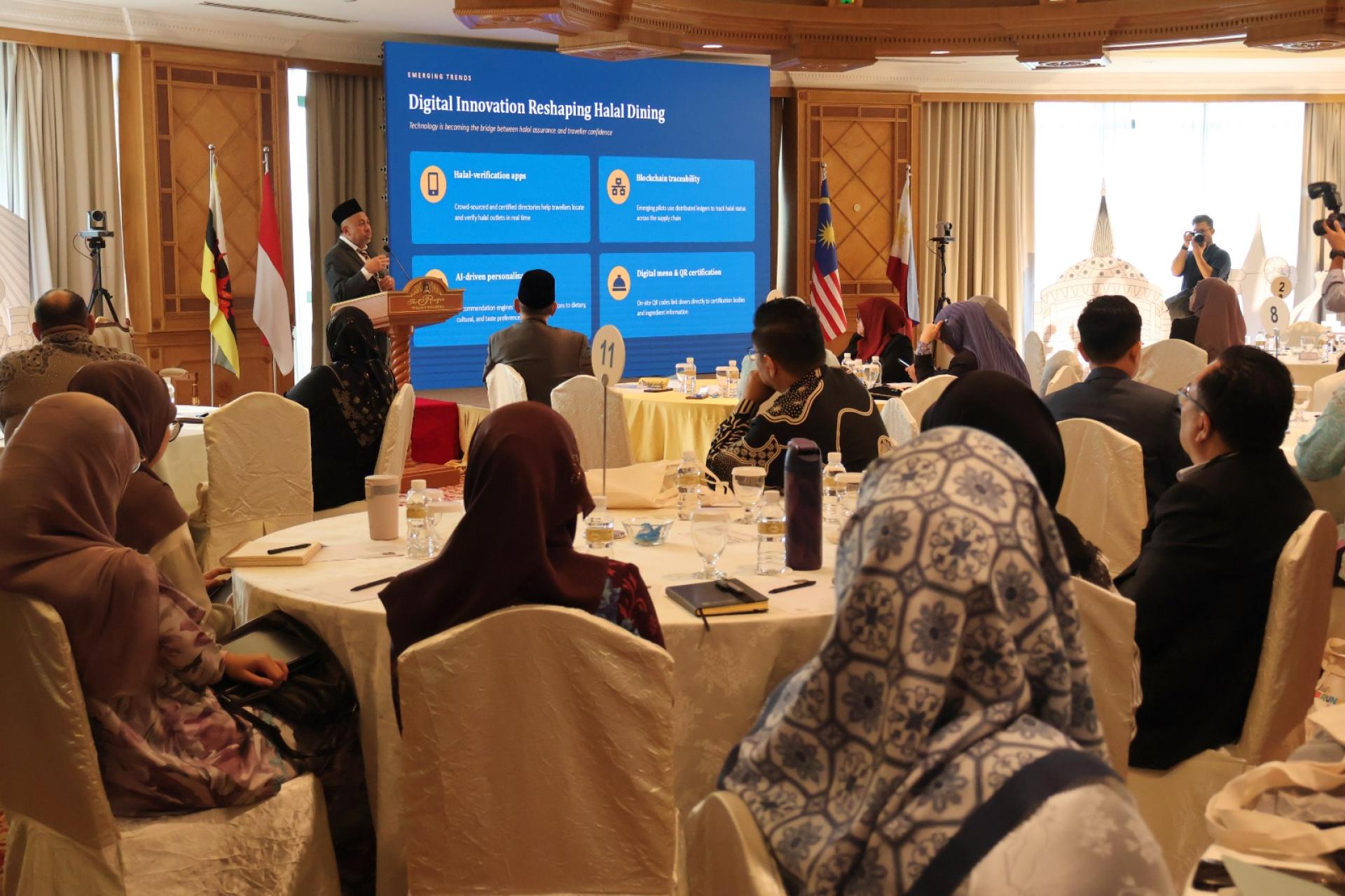
(B.S.B., 8th) The Best Practices Seminar on Halal Food Service and Tourism of the Brunei-Indonesia-Malaysia-Philippines East ASEAN Growth Area (BIMP-EAGA) was held in Brunei on July 1, bringing together government officials, tourism operators, and representatives from BIMP-EAGA member countries to explore trends in halal tourism development, share best practices, and promote regional tourism cooperation.
The seminar was organized by Brunei's Ministry of Economy, Trade and Industry (METI) via the Tourism Development Department, in collaboration with the Sultan Sharif Ali Islamic University (UNISSA) Halal Science and Sustainable Tourism Faculty and the Halal Food Research Centre.
The seminar was held in conjunction with the Brunei MYCE 2026 (Brunei Year of International Conferences and Events 2026), attracting over 60 delegates, including representatives from BIMP-EAGA member countries. It provided a platform for knowledge exchange, experience sharing, and promotion of high-quality regional halal tourism products.
The event aimed to help participants gain deeper insights into the needs and expectations of Muslim tourists for travel destinations, while sharing Brunei's experience and best practices in halal food service and tourism facility management.
The seminar highlighted operational procedures related to halal certification, covering food preparation, food handling, and services for Muslim travelers, while encouraging tourism operators to establish more systematic and standardized halal tourism service models based on their respective regional contexts.
Acting Director of Tourism Development, Salina, stated in her welcome speech that culinary experience is an important element in enhancing the overall tourism experience, and halal food service provides a reliable framework for improving the quality, consistency, and consumer confidence in tourism products.
She pointed out that as the global halal tourism market continues to grow, tourism destinations must meet the ever-evolving market demands through comprehensive halal certification systems, professional talent training, unified standards, and trustworthy operational mechanisms.
She also emphasized that this seminar contributes to strengthening knowledge exchange, promoting regional cooperation, and enhancing the ability of tourism operators to provide high-quality halal tourism services.
Professor Ahmad Puad Mat Som from UNISSA's Faculty of Halal Science and Sustainable Tourism delivered a keynote speech analyzing global halal tourism development trends, including changes in consumer demand, digital innovation, sustainability, and the expanding Muslim travel market.
He stated that tourism operators can further enhance their halal tourism products through innovation and sustainable practices, boosting the competitiveness of tourist destinations.
During the seminar, several panel discussions were held where delegates exchanged views on topics such as halal certification, halal assurance systems, certification procedures, and the practical application of halal standards in tourism operations. Representatives also shared practical experiences and successful cases from different member countries.
The seminar concluded by reaffirming that BIMP-EAGA member countries should continue to strengthen cooperation, jointly promote the development of Muslim-friendly tourism services, and enhance industry capabilities through knowledge-sharing platforms, aiming to build a more resilient, sustainable, and competitive regional tourism industry.
The seminar was held in conjunction with the Brunei MYCE 2026 (Brunei Year of International Conferences and Events 2026), attracting over 60 delegates, including representatives from BIMP-EAGA member countries. It provided a platform for knowledge exchange, experience sharing, and promotion of high-quality regional halal tourism products.
The event aimed to help participants gain deeper insights into the needs and expectations of Muslim tourists for travel destinations, while sharing Brunei's experience and best practices in halal food service and tourism facility management.
The seminar highlighted operational procedures related to halal certification, covering food preparation, food handling, and services for Muslim travelers, while encouraging tourism operators to establish more systematic and standardized halal tourism service models based on their respective regional contexts.
Acting Director of Tourism Development, Salina, stated in her welcome speech that culinary experience is an important element in enhancing the overall tourism experience, and halal food service provides a reliable framework for improving the quality, consistency, and consumer confidence in tourism products.
She pointed out that as the global halal tourism market continues to grow, tourism destinations must meet the ever-evolving market demands through comprehensive halal certification systems, professional talent training, unified standards, and trustworthy operational mechanisms.
She also emphasized that this seminar contributes to strengthening knowledge exchange, promoting regional cooperation, and enhancing the ability of tourism operators to provide high-quality halal tourism services.
Professor Ahmad Puad Mat Som from UNISSA's Faculty of Halal Science and Sustainable Tourism delivered a keynote speech analyzing global halal tourism development trends, including changes in consumer demand, digital innovation, sustainability, and the expanding Muslim travel market.
He stated that tourism operators can further enhance their halal tourism products through innovation and sustainable practices, boosting the competitiveness of tourist destinations.
During the seminar, several panel discussions were held where delegates exchanged views on topics such as halal certification, halal assurance systems, certification procedures, and the practical application of halal standards in tourism operations. Representatives also shared practical experiences and successful cases from different member countries.
The seminar concluded by reaffirming that BIMP-EAGA member countries should continue to strengthen cooperation, jointly promote the development of Muslim-friendly tourism services, and enhance industry capabilities through knowledge-sharing platforms, aiming to build a more resilient, sustainable, and competitive regional tourism industry.