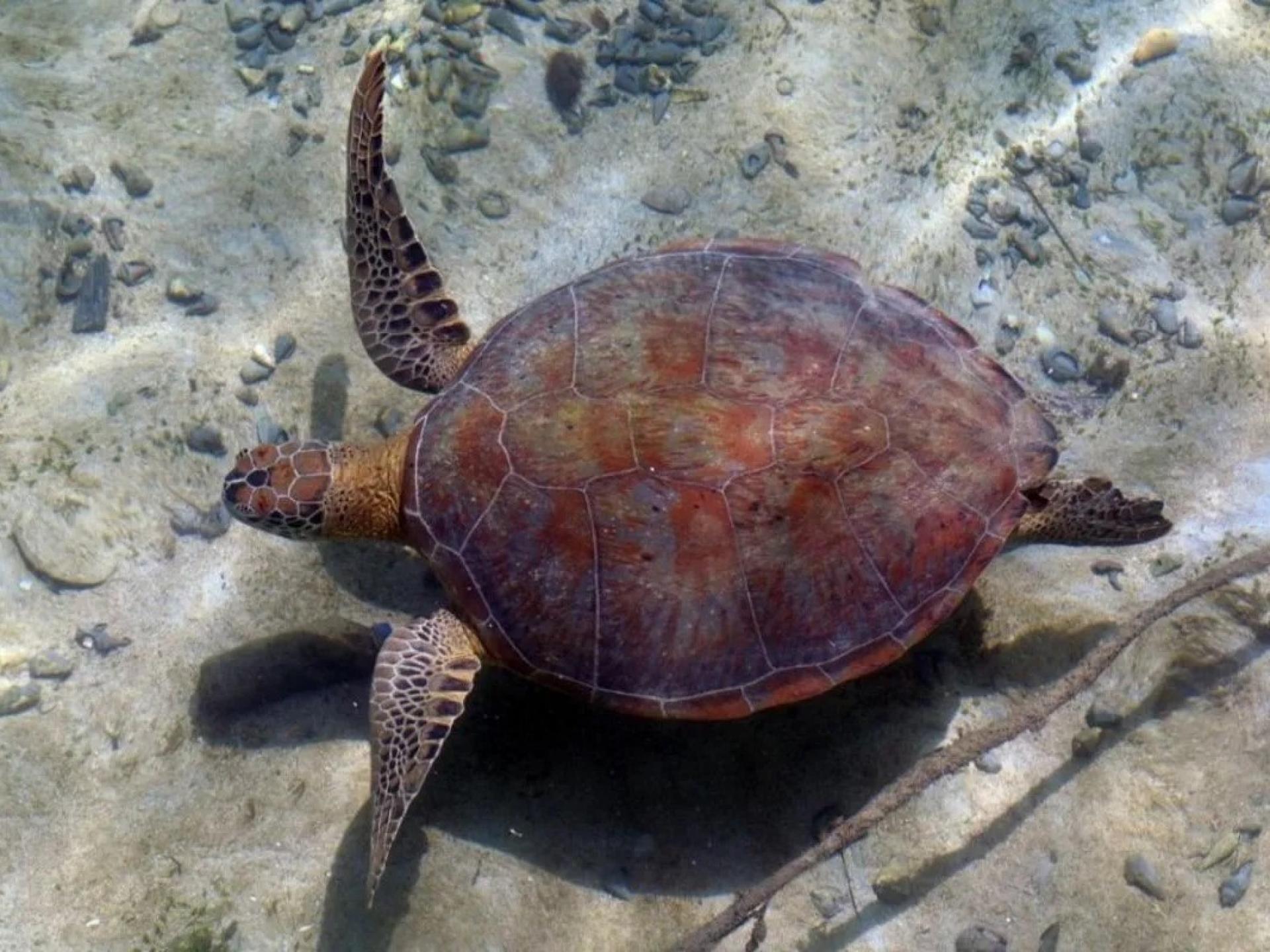
(Samarinda, 21st) The East Kalimantan Maritime and Fisheries Office, in collaboration with government agencies, NGOs, and local residents, is conducting green turtle conservation efforts in the Derawan Islands.
The head of the office, Ilhan Hukmaidi, stated: “Residents must participate in green turtle conservation because community involvement is the key to long-term success.” He emphasized that conservation cannot rely solely on regulations; when communities participate directly and possess capability and responsibility, coastal and marine resources are more likely to be effectively protected.
The Derawan Islands are the largest green turtle nesting habitat in Southeast Asia, holding global conservation strategic significance. To strengthen community involvement, the Nusantara Nature Conservation Foundation, in partnership with the East Kalimantan Maritime and Fisheries Office and the Pontianak Marine Management Authority, is conducting “Somacore” turtle monitoring technology training.
“Somacore” stands for Solutions for Marine and Coastal Resilience in the Coral Triangle Area. The training targets communities in the Derawan Islands and surrounding coastal and island conservation areas, and is scheduled for February 3–7, 2026. It is funded by the German Federal Ministry for the Environment, Nature Conservation, Nuclear Safety, and Consumer Protection (BMUV) through the International Climate Initiative (IKI), and is implemented by a coalition of ten domestic, regional, and international organizations in six Coral Triangle countries.
Surveys show that parts of Derawan’s coastal and island beaches serve as year-round landing and nesting sites for turtles, with activity peaking from June to August. However, coastal human activities often impact the safety of turtle nesting.
Rizya Aldi Wijaya pointed out: “Turtles are very sensitive to human presence; even slight disturbances can prevent nesting. Therefore, local community involvement is essential for protecting nesting beaches.” The training enhances community capacity through citizen science, with about 60 fishermen and coastal residents receiving intensive courses on turtle biology, species identification, lifecycle, conservation threats, nesting beach monitoring, and data management, as well as hands-on practice, including identifying turtle tracks, recording nests, and simulating the use of Android apps for data collection and management.
The Derawan Islands are the largest green turtle nesting habitat in Southeast Asia, holding global conservation strategic significance. To strengthen community involvement, the Nusantara Nature Conservation Foundation, in partnership with the East Kalimantan Maritime and Fisheries Office and the Pontianak Marine Management Authority, is conducting “Somacore” turtle monitoring technology training.
“Somacore” stands for Solutions for Marine and Coastal Resilience in the Coral Triangle Area. The training targets communities in the Derawan Islands and surrounding coastal and island conservation areas, and is scheduled for February 3–7, 2026. It is funded by the German Federal Ministry for the Environment, Nature Conservation, Nuclear Safety, and Consumer Protection (BMUV) through the International Climate Initiative (IKI), and is implemented by a coalition of ten domestic, regional, and international organizations in six Coral Triangle countries.
Surveys show that parts of Derawan’s coastal and island beaches serve as year-round landing and nesting sites for turtles, with activity peaking from June to August. However, coastal human activities often impact the safety of turtle nesting.
Rizya Aldi Wijaya pointed out: “Turtles are very sensitive to human presence; even slight disturbances can prevent nesting. Therefore, local community involvement is essential for protecting nesting beaches.” The training enhances community capacity through citizen science, with about 60 fishermen and coastal residents receiving intensive courses on turtle biology, species identification, lifecycle, conservation threats, nesting beach monitoring, and data management, as well as hands-on practice, including identifying turtle tracks, recording nests, and simulating the use of Android apps for data collection and management.