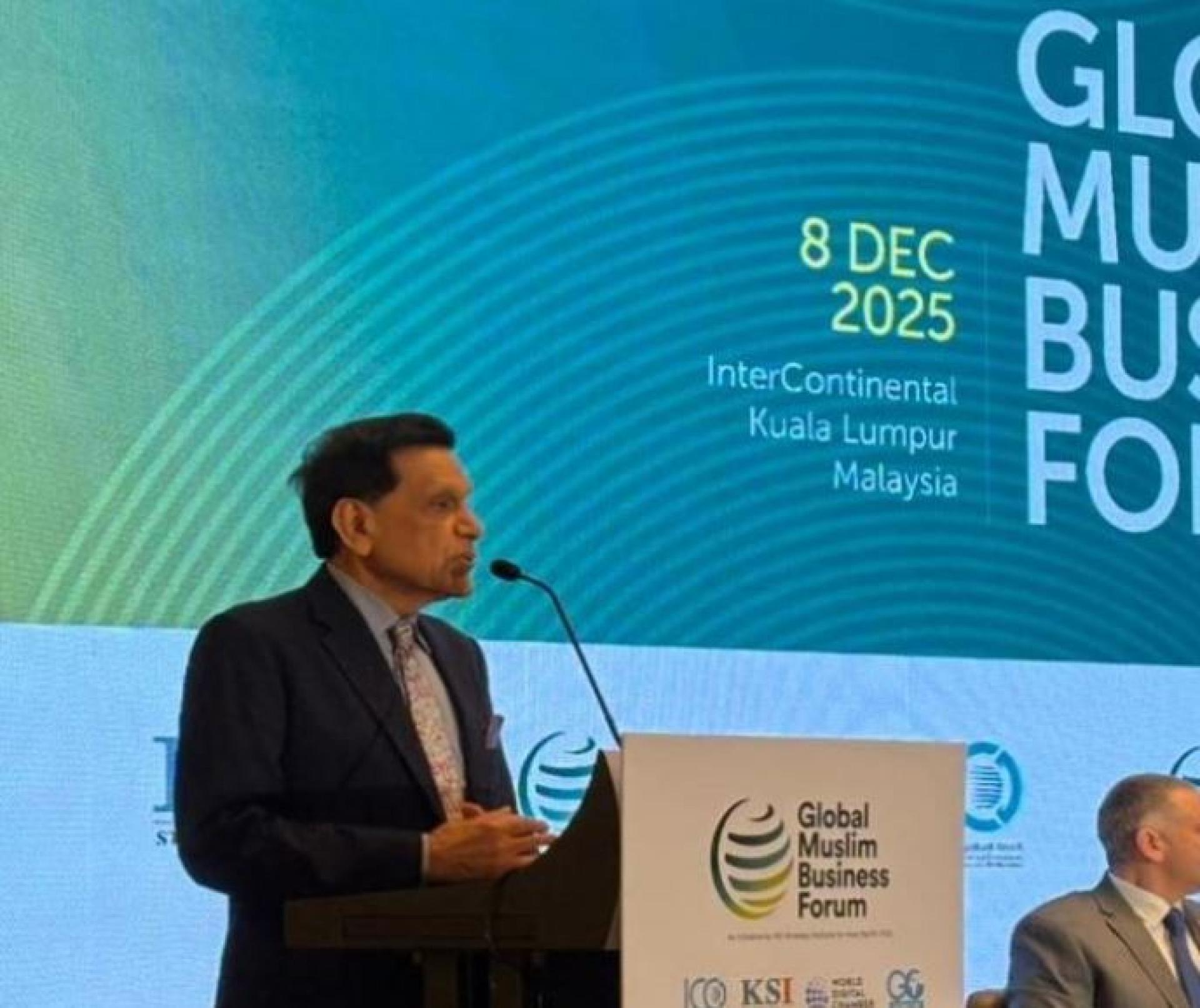
Cooperation among the global Muslim business community is essential to strengthening its collective capacity and positioning it as a real potent economic force, said Global Muslim Business Forum president Datuk Seri Mohamed Iqbal Rawther.
He said the Muslim community is far from being a marginal market player, given its collective strength of nearly two billion people and its rapidly expanding economic footprint across the Muslim world.
"The Muslim community, the Ummah, is not a marginal player, but it is a dominant could be a real potent force. This is why cooperation is no longer optional. It is essential, and we are in that process. We must build deeper economic linkage... (as) the Muslim world moves together, it shapes markets," he said in his opening address at the Global Muslim Business Forum 2025, here today.
The forum was jointly organised by the KSI Strategic Institute, the Islamic Chamber of Commerce and Development (ICCD), and Global One, a United Kingdom-based United Nations-accredited non-governmental organisation. It brings together policymakers, business leaders, scholars, and innovators to think ahead, look forward, and act with purpose for the global Muslim community
Mohamed Iqbal, who is also KSI Strategic Institute for Asia Pacific deputy chairman, said Malaysia has long believed in the value of constructive engagement within the Muslim community. He noted that as a country, Malaysia bridges Southeast Asia, the Gulf, South Asia, and the broader international system.
"Malaysia has consistently championed dialogue, moderation, and economic cooperation, our leadership in Islamic finance, halal standards, trade facilitation, and law leadership reflecting a commitment to building bridges rather than walls.
"As the ASEAN chair in 2025, Malaysia is able, in a unique position, to encourage collaborative approaches between the East and West, and we have seen that in the last month, exemplary and executed by Malaysia, with confidence," he added.
With a global population of 1.9 billion and rising, Muslims represent one of the most important demographic and economic forces worldwide. In 2022, Muslim consumer spending reached US$2.29 trillion, driven by growth in halal food, pharmaceuticals, modest fashion, travel, and media.
"The Muslim community, the Ummah, is not a marginal player, but it is a dominant could be a real potent force. This is why cooperation is no longer optional. It is essential, and we are in that process. We must build deeper economic linkage... (as) the Muslim world moves together, it shapes markets," he said in his opening address at the Global Muslim Business Forum 2025, here today.
The forum was jointly organised by the KSI Strategic Institute, the Islamic Chamber of Commerce and Development (ICCD), and Global One, a United Kingdom-based United Nations-accredited non-governmental organisation. It brings together policymakers, business leaders, scholars, and innovators to think ahead, look forward, and act with purpose for the global Muslim community
Mohamed Iqbal, who is also KSI Strategic Institute for Asia Pacific deputy chairman, said Malaysia has long believed in the value of constructive engagement within the Muslim community. He noted that as a country, Malaysia bridges Southeast Asia, the Gulf, South Asia, and the broader international system.
"Malaysia has consistently championed dialogue, moderation, and economic cooperation, our leadership in Islamic finance, halal standards, trade facilitation, and law leadership reflecting a commitment to building bridges rather than walls.
"As the ASEAN chair in 2025, Malaysia is able, in a unique position, to encourage collaborative approaches between the East and West, and we have seen that in the last month, exemplary and executed by Malaysia, with confidence," he added.
With a global population of 1.9 billion and rising, Muslims represent one of the most important demographic and economic forces worldwide. In 2022, Muslim consumer spending reached US$2.29 trillion, driven by growth in halal food, pharmaceuticals, modest fashion, travel, and media.