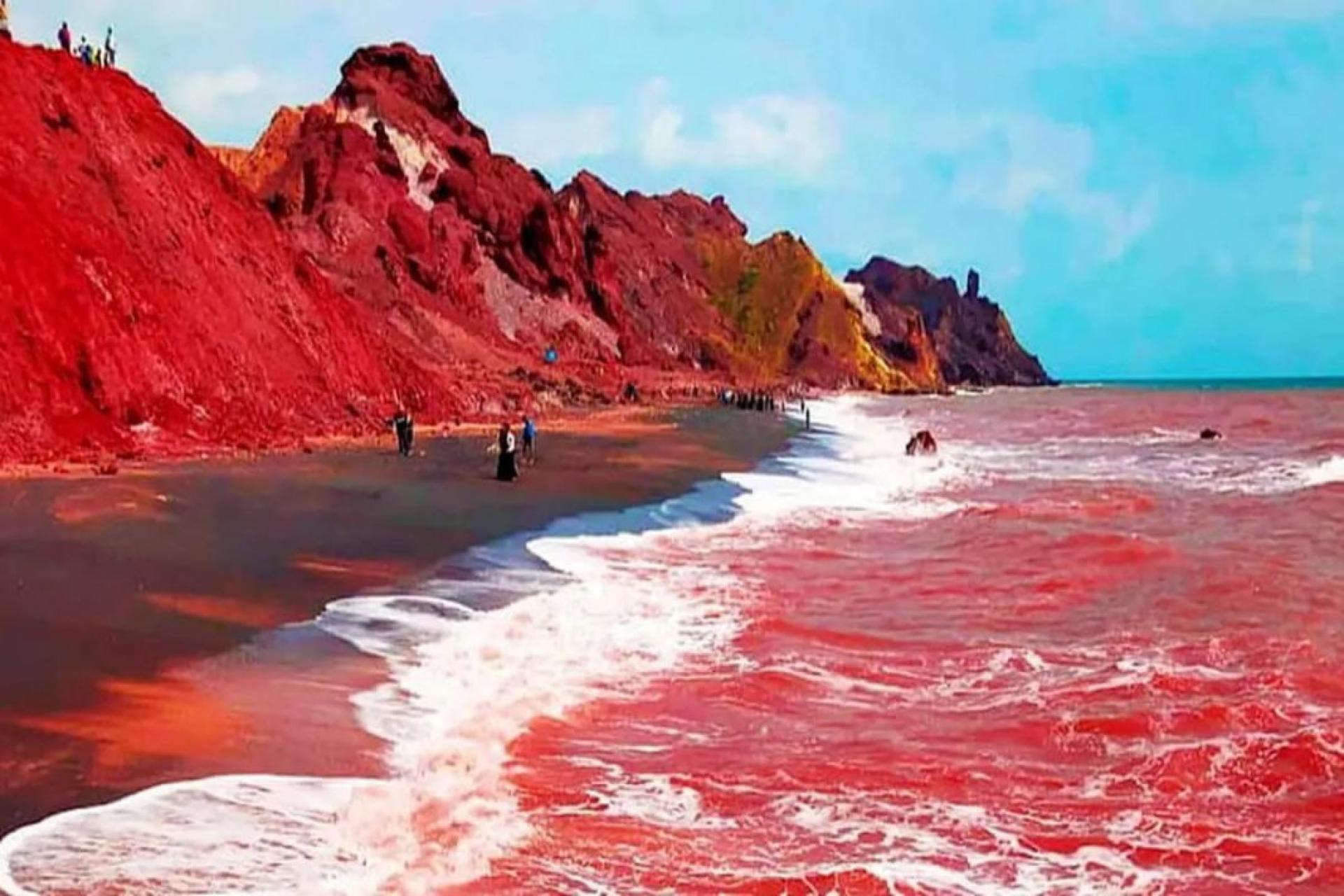
Recently, Iran’s Hormuz Island in the Persian Gulf has once again witnessed the shocking phenomenon of “blood rain.” The bizarre scene is reminiscent of apocalyptic signs described in the Bible, sparking concerns among the public.
However, this is actually a natural phenomenon, related to the island’s iron oxide-rich soil. According to The Sun, Hormuz Island’s soil contains abundant iron oxide, locally known as “Golak,” which turns red when it comes into contact with water.
Recently, a “red rainstorm” swept across Hormuz Island; as river water flowed into the sea, the surrounding ocean appeared to be dyed blood red.
In fact, the island is famous for its red soil, with the color being even more noticeable in areas with severe erosion. Hematite is a common iron oxide mineral, and its red properties are also the reason for Mars’ red landscape. This red color is due to its absorption of short-wavelength green and blue light, and reflection of longer-wavelength red light.
The report points out that after extreme weather, soil mixes with rainwater and seawater, causing the water to change color. Researchers from NASA’s Earth Observatory noted that the island is a salt dome composed of rock salt, gypsum, anhydrite, and other evaporite rocks. Under high pressure, rock salt loses its brittleness and flows slowly like a liquid.
The “blood rain” phenomenon also brings to mind the “Ten Plagues” described in the Bible, one of which includes the Nile turning to blood. However, Hormuz Island is not the only place to experience such occurrences.
In August this year, Israel's Sea of Galilee suddenly turned red, which was regarded as an “ominous sign.” Nevertheless, Israel’s Ministry of Environmental Protection explained that it was due to a massive algae bloom; with prolonged sunlight, pigment accumulation eventually turned the lake water red.